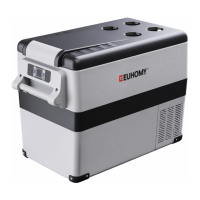
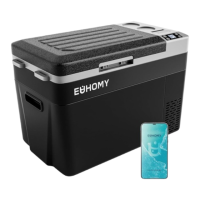
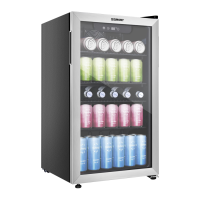
This document is an instruction manual for the Euhomy Car Refrigerator, available in SKU models CF-35, CF-45, and CF-55. It provides comprehensive information on safety precautions, installation, operation, temperature control, maintenance, troubleshooting, specifications, warranty, and app connectivity.
The Euhomy Car Refrigerator is designed to either refrigerate or freeze food, making it suitable for various outdoor uses such as camping and tailgating, as well as for home use. It features a high-efficiency DC inverter compressor and a conversion module, ensuring high reliability and a long lifespan. The appliance utilizes fluoride-free insulation, which contributes to good heat preservation performance and low energy consumption. It is designed to operate on both 12/24 V DC and 110–240 V AC power supplies, offering versatility for use in vehicles or at home. Key features include compressor delay protection, quick cooling capabilities (down to -4 °F based on a 77 °F ambient temperature), an intelligent car battery protection system, and wide-range electronic temperature control. The unit is capable of operating in ambient temperatures between 50°F and 110°F, with humidity up to 90%, and can operate continuously at an angle of up to 30°.
Technical Specifications:
The refrigerator comes in three models: CF-35, CF-45, and CF-55, with varying capacities and weights.
- Capacity: CF-35 (37 qt), CF-45 (48 qt), CF-55 (59 qt).
- Cooling Performance: -20°C to 20°C (-4°F to 68°F).
- Average Power Consumption: 45W for all models.
- DC Fuse: 15A for all models.
- Rated Current for DC: 5.0A (12V) / 2.5A (24V) for all models.
- Net Weight: CF-35 (27.3 lbs), CF-45 (29.3 lbs), CF-55 (32.0 lbs).
- Unit Dimensions (LWH):
- CF-35: 690345382mm (27.1713.615.1in)
- CF-45: 690345462mm (27.1713.618.2in)
- CF-55: 690345524mm (27.1713.620.6in)
- Climatic Category: T/ST/N/SN.
- Protective Classification of Electric Shock Resistance: III.
- Refrigerant: CF-35 (32g), CF-45 (34g), CF-55 (40g).
Usage Features:
The refrigerator's control panel allows for easy operation. It automatically switches on when connected to AC or DC power, displaying the current cabinet temperature, battery monitor setting, and ECO setting, as well as the input voltage.
- Power On/Off: Press the power button.
- Temperature Setting: Use the up or down arrows to adjust the temperature.
- Cooling Modes: Press the settings button to choose between Eco (energy-saving) or Max (fast-cooling) mode. The factory setting is Max.
- Battery Protection: Hold the settings button for three seconds until "H" flashes. Then, press the settings button again to select a battery protection mode: H (High), M (Medium), or L (Low). The factory setting is H. This multilevel battery monitor protects the vehicle battery against excessive discharging.
- Temperature Settings Customization: The cooler allows for advanced temperature settings by turning it off, holding the settings button until "E1" appears, and then cycling through 9 different settings (E1-E9) to adjust parameters like lowest/highest temperature, temperature return, soft-start, Fahrenheit/Celsius display, temperature compensation, and overcooling.
- App Control: For models equipped with app control, users can download the "Car Fridge Freezer" app from the App Store or Google Play, activate Bluetooth, open the app, search for the fridge, and connect by pressing the settings button on the fridge's display panel when "AP" is shown.
- Storage Recommendations: Fresh and frozen foods should not be stored together. When set at 32°F or lower, avoid storing glass bottles or liquids that may freeze and burst. Store fruits and vegetables closer to the top of the compartment, which is slightly warmer. Keeping the compartment as full as possible improves efficiency. Minimize door openings to prevent warm air from entering.
Maintenance Features:
Regular cleaning and maintenance are crucial for optimal performance and longevity.
- Initial Cleaning: Clean the appliance with a soft cloth moistened with lukewarm water before initial use. Ensure no water drips into the seals.
- Regular Cleaning: Clean the fridge periodically and whenever it is dirty.
- Cleaning Agents: DO NOT use solvents, acids, gritty substances, brushes, files, hard objects, or sharp tools to clean the fridge.
- Power Disconnection: Always disconnect the power cable and switch off the fridge before cleaning.
- Stubborn Dirt: For stubborn dirt, use baking soda dissolved in lukewarm water.
- Storage: When storing the fridge for an extended period, leave the lid slightly open to prevent mold and odors.
- Ventilation: Ensure adequate airflow around the compressor and avoid placing the unit near heat sources or in direct sunlight, especially when in a vehicle or trailer, to maintain efficient power consumption and performance.
Safety Precautions:
- Electrical Safety: Ensure the local outlet voltage and circuit frequency match the appliance's rating label. Insert the plug firmly into a properly grounded AC power supply or a 12V DC socket. Do not alter the plug.
- Moisture Protection: Do not immerse the cable, plug, or appliance in water. Keep hands dry when touching the plug or switching on. Do not use on wet surfaces.
- Cable Handling: Do not kink or damage the power cable. Do not move or carry the unit by pulling the cable. Keep the cable away from heated surfaces. Never touch uninsulated cables with bare hands.
- Ventilation: Never obstruct the vents to the compressor.
- Defrosting: Defrost the unit regularly. Do not use hard or sharp tools to remove ice.
- Internal Appliances: Do not use any electrical appliances inside the cooling compartment.
- Children's Safety: The appliance is not intended for use by persons with reduced physical, sensory, or mental capabilities, or lack of experience and knowledge, unless supervised. Children should be supervised to ensure they do not play with the appliance.
- Boat Installation: If connected to an AC power supply on a boat, the system must be protected by a fuse and a ground fault or leakage current protective device. Installation should be carried out by a qualified electrician.
- DC Power Cable: Use only the supplied DC power cable. For extension cables, a 6 mm diameter (AWG11) 4.58 mm2 twin-sheath two-core cable with direct connection to battery terminals and 15A inline fuse protection is recommended. Consult a qualified automotive electrician for DC extension cable use.
- Over-voltage/Reverse Polarity: The fridge is protected against over-voltage and reverse polarity. It will automatically switch off if the power source voltage is insufficient to protect the battery.



 To Next Page
 General