4 5
WARNING
Location Warnings – continued
Rear-facing and Forward-facing Use
• ONLY use this child restraint on vehicle seats with
backs that lock into place.
Premature Infants
Rear-facing Use Only
• DO NOT use this or any child restraint with a
premature infant until after consulting your doctor.
Premature infants may have difficulty breathing when
in a seated or semi-reclined position. Using additional
padding or pillows behind the infant’s head or failing
to properly recline the child restraint could increase
the child’s risk of serious injury or death.
Rear-facing Only Warnings
• When using this restraint rear-facing, DO NOT loosen
the vehicle seat belt to provide more leg room, as this
will prevent the child restraint from protecting the
child.
• DO NOT use the highest set of harness slots rear-
facing. The harness will not properly restrain the child
during a crash.
• Fold-down armrests could pose a hazard to a
rear-facing child in certain types of collisions. Consult
your vehicle owner’s manual before installing any rear-
facing child restraint in front of a fold-down armrest.
• NEVER turn a child restraint forward-facing with a
child who weighs less than 10 kg (22 lbs). Crash forces
may cause serious injury or death.
• DO NOT use the tether strap when the child restraint
is in the rear-facing position.
• The headrest on the vehicle seat that the child faces
when sitting in the rear-facing mode should be placed
in the lowest position. The vehicle seat back that the
child faces must be fully padded and free of any hard
objects.
Forward-facing Only Warnings
• If your child weighs more than 22.6 kg (50 lbs) or their
shoulders are above the highest harness level, you
MUST discontinue using this child restraint as it may
no longer adequately protect your child.
• MUST be at least two years of age.
Important
WARNING
General Warnings
Rear-facing and Forward-facing Use
• Failure to follow installation instructions can result in
the child striking the vehicle’s interior during a sudden
stop or crash. Serious injury or death may result.
These instructions and the instructions in your vehicle
owner’s manual must be followed carefully. If there is a
conflict between the two, the vehicle owner’s manual
regarding child restraint installation must be followed.
• NEVER leave child unattended.
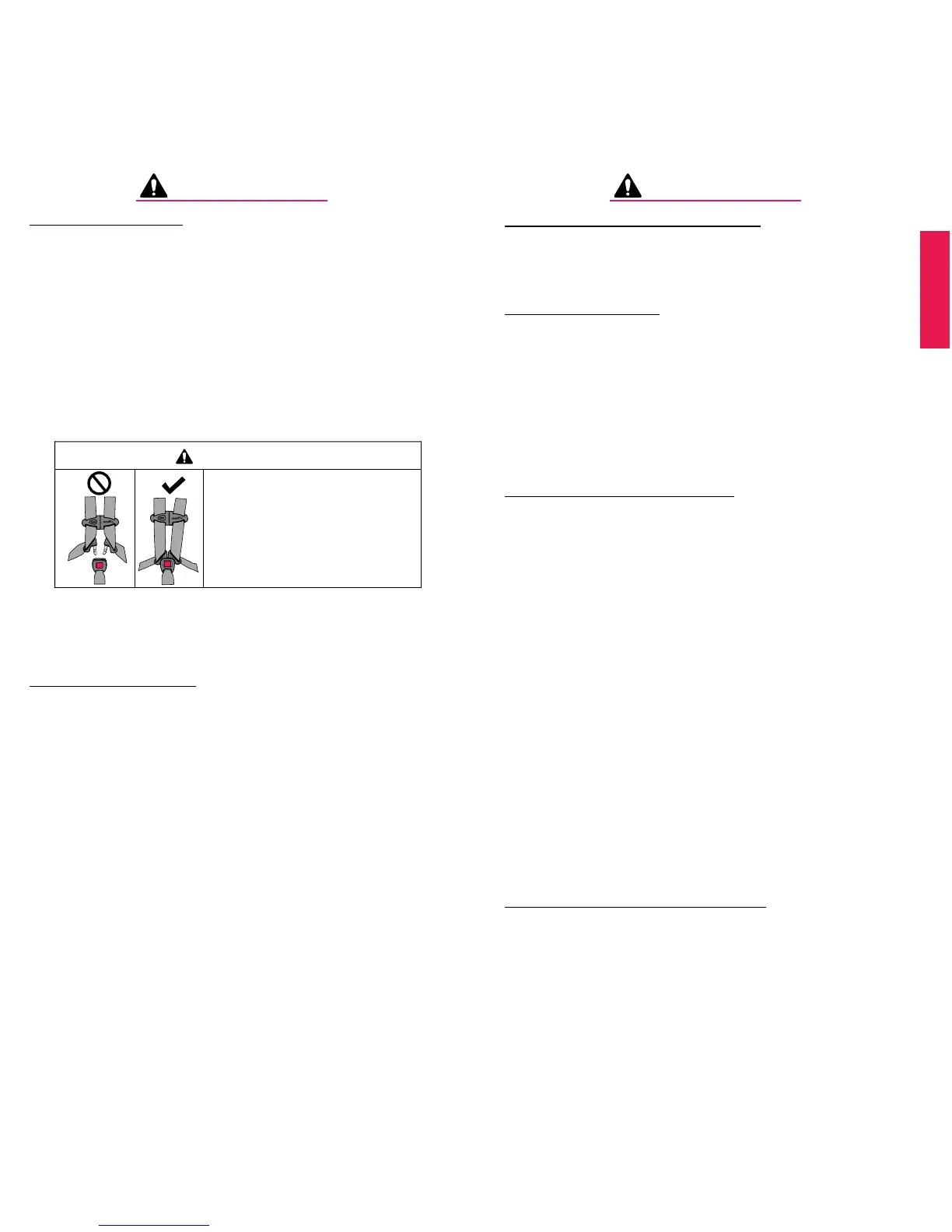
• Children have STRANGLED in loose or partially
buckled harness straps. Fully restrain the child.
• DO NOT use child restraint if it is damaged, broken,
or missing parts.
• DO NOT use this restraint if it has been involved in a
crash. It must be replaced.
Location Warnings
Rear-facing and Forward-facing Use
• ALWAYS read and follow exactly the instructions that
accompany your vehicle and child restraint.
• According to statistics, children are safer when properly
restrained in a rear seating position than in the front
seating position. Generally, the center rear position is
safest and should be used if available.
• Some child restraints do not fit all vehicles or all seating
locations. There are many thousands of combinations
of vehicle makes, models, child restraint configurations,
vehicle seat belt designs, and seat cushion shapes. The
easiest way to determine whether your child restraint
is suitable for a particular seating position is to check
for a tight installation. If the child restraint cannot be
properly installed, DO NOT use the child restraint.
Consult vehicle owner’s manual, try a different seating
location, or call Evenflo for further assistance.
• ONLY use this child restraint on forward-facing
vehicle seats. DO NOT use this restraint with
vehicle seats that face the rear or side.
WARNING
Children have STRANGLED
in loose or partially buckled
harness straps. Fully restrain
the child.






 To Next Page