Need help?
Do you have a question about the evertz 9767VIP8-NGI and is the answer not in the manual?
Do not expose apparatus to rain or moisture to prevent fire or shock.
Avoid exposure to dripping/splashing; keep liquid-filled objects away.
Ensure complete disconnection by unplugging the power supply cord.
The mains plug of the power supply cord must remain readily operable.
Details CE marking compliance with EMC and Low Voltage Directives and conformity to European standards.
States compliance with FCC Part 15 rules for Class A digital devices, including potential interference.
Outlines the initial release version (0.1) and its specific feature set at the time of editing.
Describes the VIP series' suitability for signal monitoring, WUXGA resolution, and VistaLINK enablement.
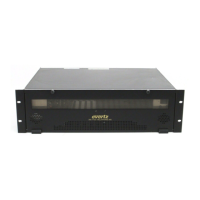
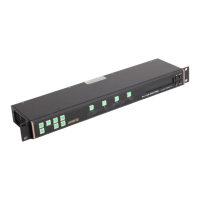
Illustrates the physical arrangement of controls, indicators, and displays on the front panel.
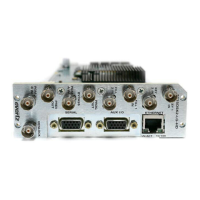
Depicts the various input/output connectors and ports located on the rear panel.
Explains the SCSI connector for 20 GPI inputs and 8 GPI outputs, and their operational principles.
Details parameters for composite analog video and discrete analog audio inputs.
Covers specifications for DVI-I display output, serial video output, and genlock input.
Outlines parameters for serial ports, LTC input, Ethernet, and electrical requirements.
Explains the green LED indicating proper module operation.
Describes the red LED for identifying module faults or errors.
Details the 4-character dot matrix display and its use for information and menu navigation.
Guides on setting IP, subnet, and SNMP TRAP destination addresses via the serial port.
Explains how to navigate and configure settings using the front panel buttons and 4-character display.
Steps for launching VIP Maestro and creating a new VIP system configuration.
Instructions for moving existing VIP system data between computers.
Methods for updating and managing VIP system configurations via the System Manager.
Detailed steps for upgrading the VIP module's firmware using Maestro.
How to access and utilize the Display Manager window and its context menus.
Introduces the main interface elements of the VIP Maestro design screen.
Explains the 'File' menu options: Load, Save, Save As, and Upload.
Details functions within the 'Edit' menu for console, alignment, positioning, and clipboard operations.
Covers navigation, zoom, screen display, and tool window management options.
Explains dynamic sizing, calculator access, importing names, and system reset.
Access to keyboard shortcuts and application information.
Description of the main UI components like title block, menu bar, and icon bar.
Guide on creating and placing video windows and objects using drag-and-drop.
Specifics on adding digital clocks and configuring their appearance and behavior.
Options for adjusting window aspect ratio, clearing canvas, and creating templates.
How to set background, border, size, and name for monitor objects.
Setting size and colors for error, warning, and OK regions of audio level bars.
Adding and configuring fault, tally, or UMD status items within a window.
Configuring fault message alignment, colors, text, and trigger conditions.
Configuring UMD message alignment, colors, size, text, and mode settings.
Configuring tally message alignment, colors, size, text, and active state.
Methods for receiving Virtual GPI data via serial or TCP/IP connections.
Step-by-step guide for setting up VGPI reception over a serial port.
Step-by-step guide for setting up VGPI reception over a TCP/IP connection.
Recommends and outlines the VIP/Maestro method for firmware updates.
Details the FTP protocol steps for upgrading module firmware.
Explains VistaLINK's capabilities for remote monitoring and control using SNMP.
Process for updating VistaLINK client with new VIP software parameters via JAR files.
Describes the configuration options available within the VistaLINK PRO Network Management System.
Lists general keyboard shortcuts applicable across Maestro VIP.
Shortcuts for managing and navigating display system elements.
Shortcuts for loading and managing presets within the catalog.
Keyboard shortcuts for navigating and manipulating objects within the Design Studio.
 General
| Model | 9767VIP8-NGI |
|---|---|
| Manufacturer | Evertz |
| Frame Synchronization | Yes |
| Humidity | 10% to 90% non-condensing |
| Inputs | 8x 3G/HD/SD-SDI |
| Outputs | 8x 3G/HD/SD-SDI |
| Video Standards | 3G-SDI, HD-SDI, SD-SDI |
| Audio Processing | Embedded audio |
| Control Interface | Ethernet |
| Power Supply | Dual redundant power supplies |
| Operating Temperature | 0 to 40°C |
| Storage Temperature | -20 to 70°C |
| Dimensions | 1RU, 19" rack mountable |
| Protocols | SNMP |
| Ports | BNC connectors |


 To Next Page