1 3
EXPERT Manual
The final step in your flight pack installation will be to determine the
amount each control surface will move on your model at full transmit-
ter stick deflection. Please refer to your aircraft’s instruction manual
for suggested travel limits.
It is possible to increase/decrease the amount that your control surface
moves at full stick deflection by mechanical adjustments.
It is imperative that the servo does not attempt to push/pull the con-
trol surface past its mechanical limits. This condition is called “binding.”
When a servo moves a control surface into a “binding” position, the
servo itself then becomes “stalled,” unable to reach its full deflection.
This condition is both harmful to your control linkage and to your
servo. This “stalled” condition will also force the servo to drain power
more quickly from your flight pack battery, thereby reducing your
usable flying time. Fortunately, servo “stalling” is usually easy to
detect by either a “buzzing” or “humming” sound which comes from
the stalled servo.
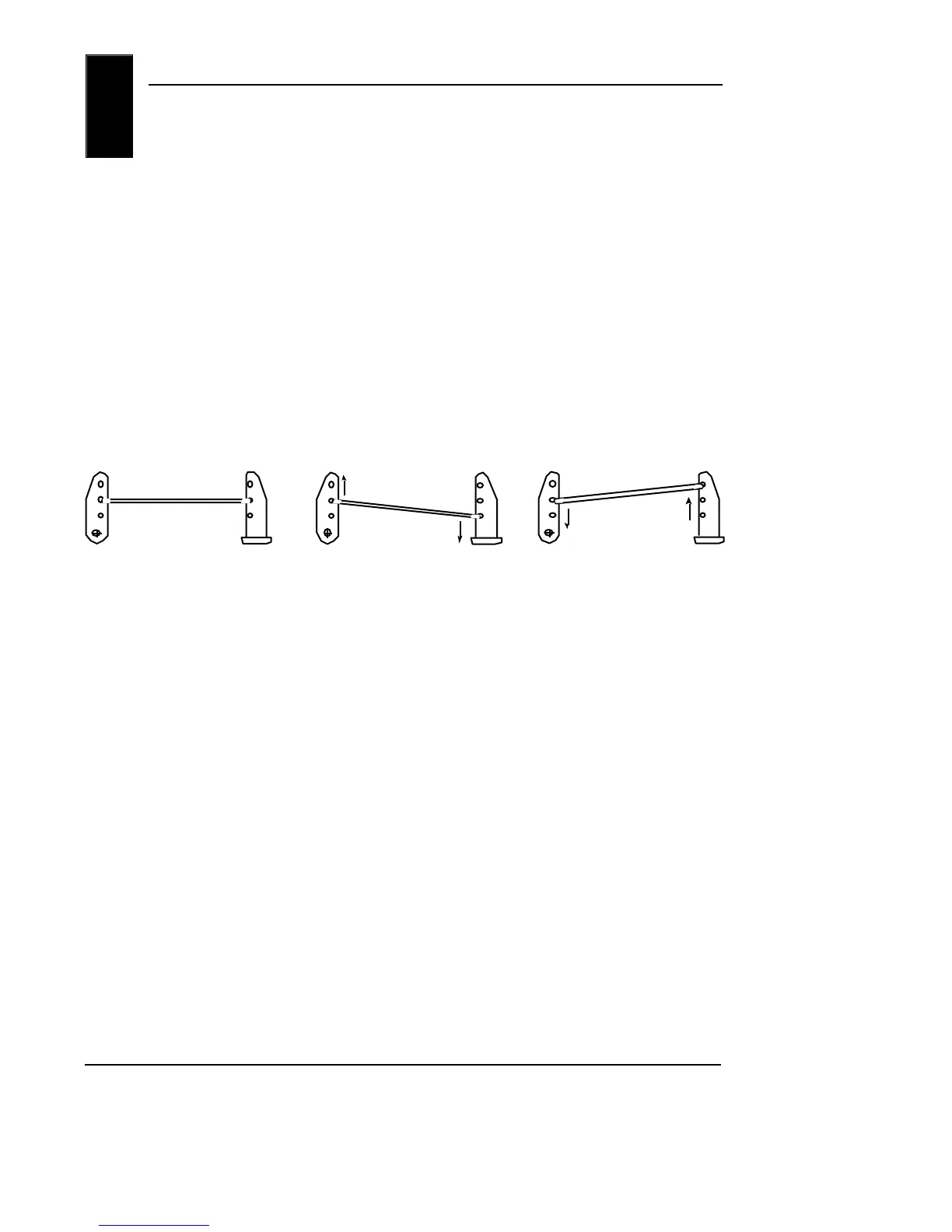
The following diagram is designed to help clarify how to increase or
decrease control surface travel mechanically to eliminate control sur-
face “binding” and servo “stalling”.
To increase control surface travel, select a linkage attachment point fur-
ther outward on the servo arm or further inward on the control horn
closer to the control surface (Figure 2).
To reduce control surface travel, select the linkage attachment point
close to the center of the servo area or further out on the control horn
on the control surface (Figure 3).
Quite simply, by moving the control rod in on the servo arm/wheel,
control surface travel will be reduced, and by moving the control rod
out on the servo arm, the control surface travel will be increased. The
opposite holds true for the control surface arm (horn) as well. You may
also use any combination of these positions to achieve proper control
surface/servo travel.
NOTE:Once the appropriate servo arm/wheel and control rod location
has been established, be certain that you have secured the
servo arm to the servo output shaft using the original servo
horn screw.
Control Rod
Figure 1 Normal (Linear)
Linkage Set Up
Figure 2 Increased Control
Surface Movement
Figure 3 Reduced Control
Surface Movement
Servo Arm
Control Surface Arm
(Horn)
Control Surface Arm
(Horn)
Control Surface Arm
(Horn)
Servo Arm Servo Arm
Control Rod
Control Rod
ADJUSTING CONTROL SURFACE TRAV E L
9.3



 To Next Page