*$62/,1(32:(5('3(56211(/&$55,(56*2/)&$5
Page 1
Owner’s Manual and Service Guide
Read all of manual to become thoroughly familiar with this vehicle. Pay particular attention to all Notes, Cautions and Warnings
Thank you for your purchase. The vehicle is equipped
with a twin cylinder overhead cam 4 cycle engine. Before
driving the vehicle, we ask you to spend some time read-
ing this Owner’s Manual and Service Guide. This guide
contains information that will assist you in maintaining
your highly reliable vehicle. This guide covers the opera-
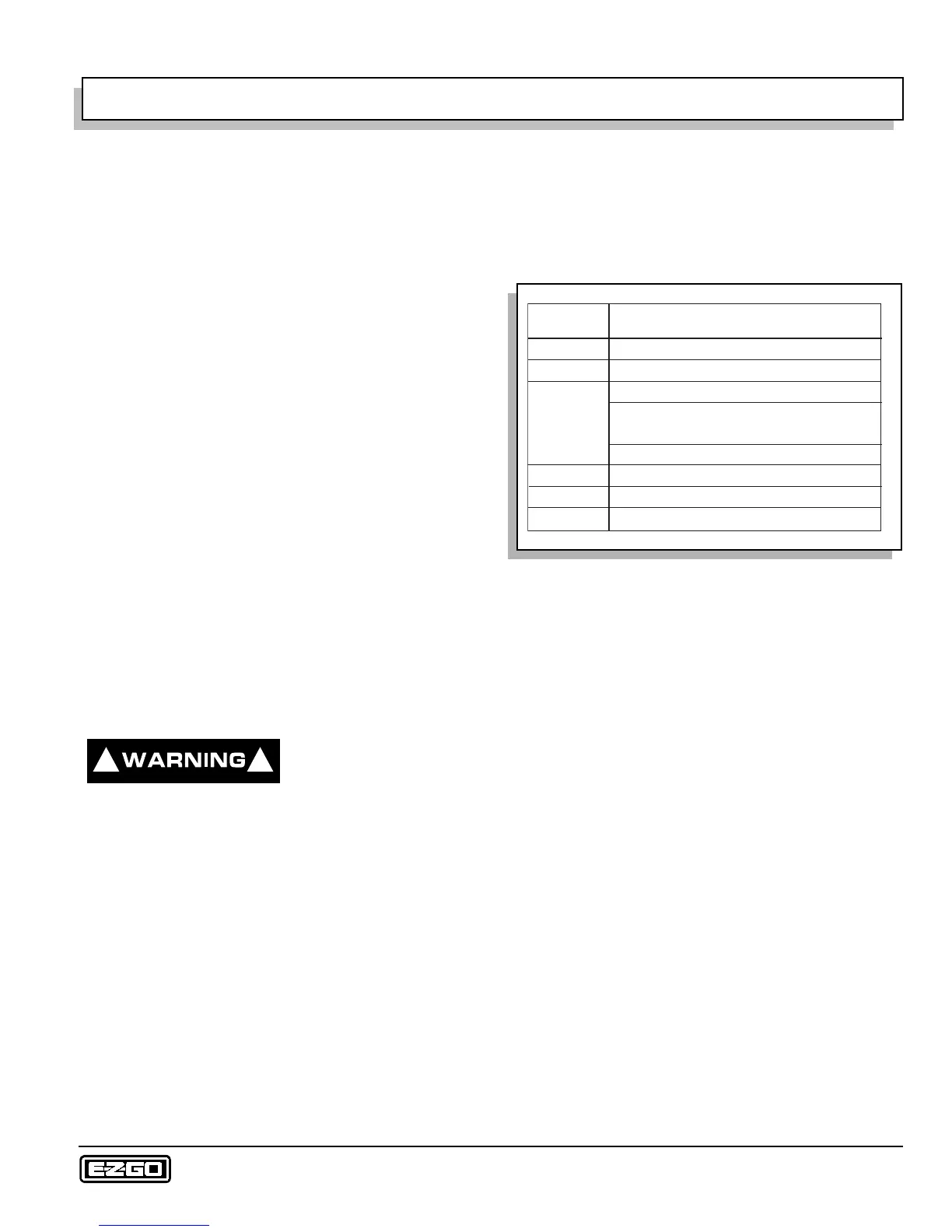
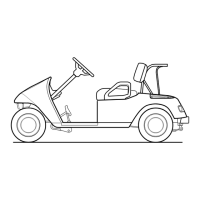
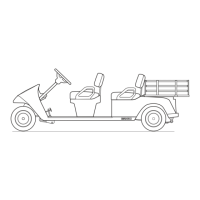
tion of several vehicles, therefore some pictorial views
may not represent your vehicle. Physical differences in
controls will be illustrated. Some illustrations may show
items that are optional for your vehicle.
Most of the service procedures in this guide can be
accomplished by an individual using common automotive
hand tools. Refer to an authorized representative for
information on servicing the vehicle in accordance with
the Periodic Service Schedule.
To facilitate maintenance, a Service Parts Manual and a
Technician’s Repair and Service Manual is available from
a local Distributor, an authorized Branch or the E-Z-GO
Service Parts Department. When ordering parts or
requesting information for your vehicle, provide vehicle
model, serial number and manufacture code.
BEFORE INITIAL USE
Read, understand and follow safety label on the instru-
ment panel. Be sure you understand the vehicle, its
equipment and how to use it safely. Although the vehicles
have been designed to provide safe and reliable opera-
tion, maintaining good performance depends to a large
extent on the operator.
Hydrogen gas is generat-
ed as a natural part of the
lead acid battery charg-
ing process. A 4% concentration of hydrogen gas is
explosive and could cause severe injury or death.
Charging must take place in an area that is adequate-
ly ventilated (minimum of 5 air exchanges per hour).
To reduce the chance of battery explosion that could
result in severe injury or death, never smoke around
or charge batteries in an area that has open flame or
electrical equipment that could cause an electrical
arc.
Hydrogen gas is generated in the charging cycle of bat-
teries and is explosive in concentrations as low as 4%.
Because hydrogen gas is lighter than air, it will collect in
the ceiling of buildings necessitating proper ventilation.
Five air exchanges per hour is considered the minimum
requirement.
Never charge a vehicle in an area that is subject to flame
or spark. Pay particular attention to natural gas or pro-
pane gas water heaters and furnaces.
Before a new vehicle is put into operation, it is recom-
mended that the items shown in the INITIAL SERVICE
CHART be performed (Ref. Fig. 1 on page 1).
Vehicle battery must be fully charged before initial use.
Preparation of Seats for Service
Remove the protective plastic coverings from the seats
before placing the vehicle in service. The only function of
the plastic covering is to protect the seat bottom and
back rest during shipping. If the plastic covering is left on
the seat and becomes torn, dirt may get under the plastic
covering and be ground into the cover material. Water
getting under the plastic covering can become trapped
and eventually will damage the seat assembly.
SERIAL NUMBER PLATE LOCATION
The serial and manufacturing numbers are located on a
plate on the passenger side of the dash panel of the vehi-
cle (Ref. Fig. 2 on page 2).
Design changes take place on an ongoing basis. In order
to obtain correct components for the vehicle, the manu-
facturing date and serial number must be provided when
ordering service parts.
! !
Fig. 1 Initial Service Chart
ITEM SERVICE OPERATION
Battery Charge battery
Seats Remove protective plastic covering
Brakes Check operation and adjust if necessary
Check hydraulic brake fluid level if
equipped
Establish mechanical brake base line
Tires Check pressure (see SPECIFICATIONS)
Fuel Fill tank with correct fuel
Engine Check oil level



 To Next Page