ELECTRICAL INSTALLATION
System Wiring Requirements
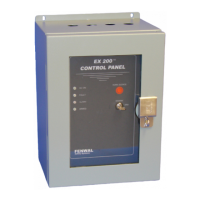
The EX 200™ control panel and all explosion suppression system hardware must be
wired exactly as shown on the system specific drawings supplied as part of the system
order. Notes on the system drawings supersede the instructions in this manual.
Recommended wire size depends on the detectors utilized. Notes on the system
drawings denote the wire size to use for each circuit. Field resistance for wiring of the
EED circuit, terminals 44 & 45, must be less than 20. All wiring must be copper and
must comply with all federal, state, and local codes. Splices in wiring runs must be
avoided when possible. Make component connections with devices that will not loosen
under vibration.
Most detectors and HRD extinguishers are provided with flexible cable assemblies that
terminate in pigtails. Connectors that are used to connect field wiring to pigtails must
provide a positive mechanical and a solid electrical connection and must be removable
for servicing. Wire nuts are recommended.
Electrical components must be installed in a manner that will prevent moisture from
accumulating to avoid shorts circuits to ground. Junction boxes are to be approved for
use as required by the area classification where the system is to be installed.
Weatherproof or explosion proof junction boxes and fittings are recommended to prevent
water infiltration. An illustration of the recommended connection is shown in Figure 6.
All wiring associated with a system’s detection and suppression components must be
shielded and run separate from all other wiring, including wiring of another system. The
shield may be either electrical conduit or the metal shield of shielded cable. The shield
must be grounded. If conduit is used as the wiring shield, it should be marked such that
no other wiring will be run in the same conduit. * Failure to comply with these wiring
requirements may lead to false actuation of the system.
AC Power to the system control panel must be dedicated, with a circuit breaker, such
that power can be removed from the control panel during service without interrupting
other machinery.
All wires should be color-coded or numbered to facilitate service. A copy of the coding
scheme should be readily available to inspection and maintenance personnel. To further
facilitate servicing, all explosive actuator circuit wiring should be connected through
terminal strips in a common junction box.
Conduit must be sealed after inspection and approval of the system by a FENWAL field
engineer. Conduit entry holes are atop the control panel enclosure. Holes that are not
used should be plugged with NEMA rated plugs (supplied with the control panel).
All equipment conveying air or material into, through, or out of the protected process
must be electrically interlocked through trouble contacts in the EX 200™ control panel.
This is to ensure that the process will be shut down when the system is not armed or
when an incipient explosion is detected.
* Follow specific wiring instructions and notes on the system drawings.
Page 20 FSS/MC-519 Rev BC FENWAL
Protection Systems


 To Next Page