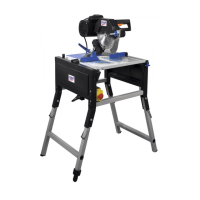
12. Interlocking knob
13. Mitre guide
14. Nut
15. Screw
16. Spindle
2. safety instructions
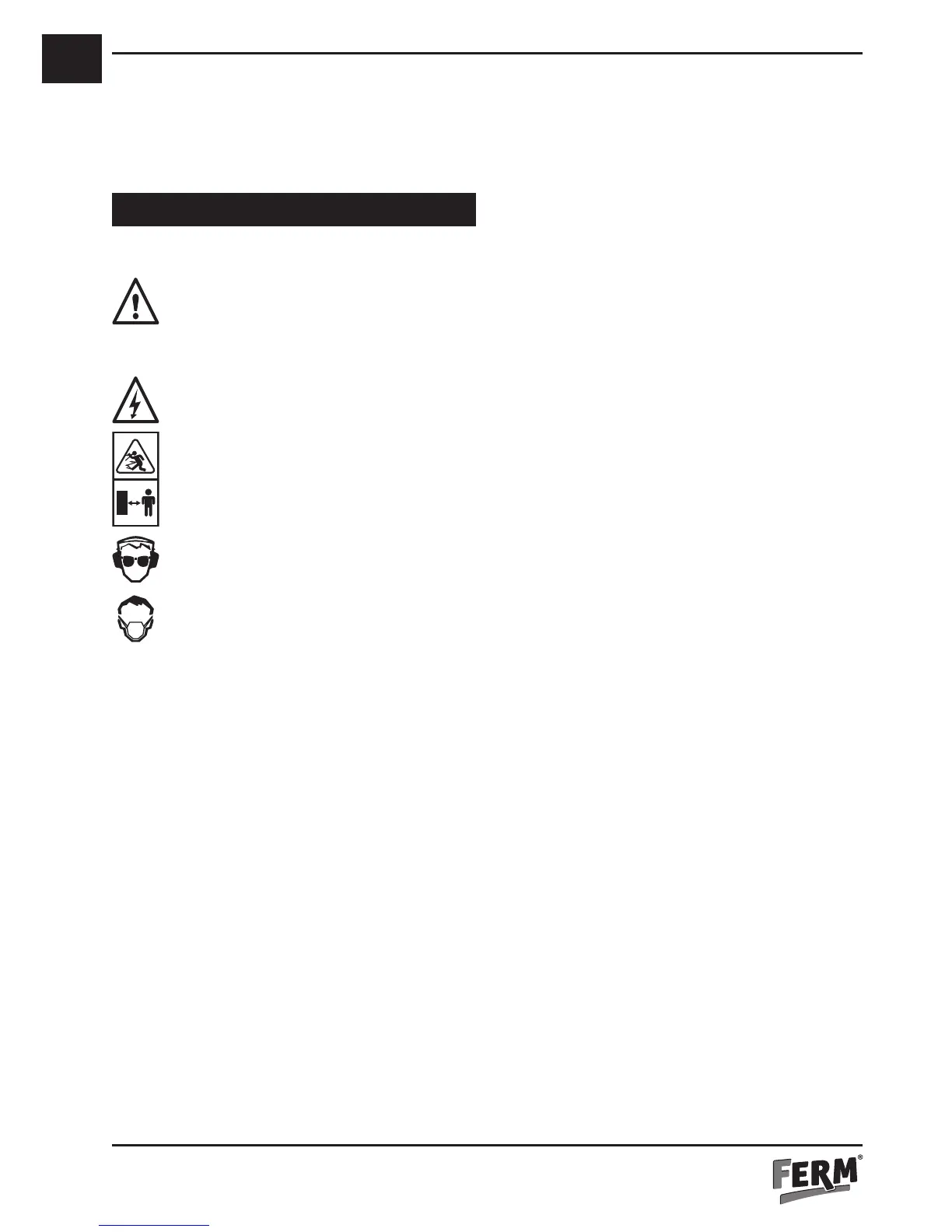
Explanation of symbols
Denotes risk of personal injury, loss of
life or damage to the tool in case of non-
observance of the instructions in this
manual.
Indicates the presence of an electrical
voltage.
Keep bystanders away.
Wear eye and ear protection.
Wear a dust mask protection
Before using the appliance
Make sure that the saw bench is adequately •
and effectively illuminated.
When you use strip lighting you should be •
aware of the so-called stroboscopic effect.
This may cause a rotating saw blade to
appear to be stationary. One solution is to use
two fittings in order to create
phase displacement.•
Check the following points:•
Does the voltage of the motor and any fuse •
employed correspond with the mains voltage?
Appliances with a voltage of 230 V~ may be
connected without problems to a mains
voltage of 220 V~.
Are the feeder cable and plug in good •
condition: sturdy, without loose bits or
damage?
Has the saw blade lost any teeth or is it •
displaying cracks or fractures? If so, replace
the saw blade immediately.
The protective hood may not be set higher •
than required to let the workpiece pass.
The riving knife should be narrower than the •
saw cut and broader than the saw blade.
Do not exercise lateral pressure on the saw •
blade as it may cause it to break.
Check the wood for knots, nails, cracks and •
waste residues.
These irregularities may cause the workpiece •
to kick back dangerously.
Ensure that no objects get into the extraction •
system.
These objects may come into contact with the •
saw blades resulting in potentially hazardous
situations.
Using the appliance
Push the workpiece that you are going to saw •
securely to the table surface.
Hold at the same time the section of the •
workpiece that has been sawed to prevent it
breaking off. The hand t hat secures the
sawed section should remain behind the saw
blade and move away from it. Make sure that
the hand that you use to secure the workpiece
does not cross the hand that you use to
operate the appliance.
Use the push stick supplied with the •
appliance.
Use the push stick to guide smaller •
workpieces past the saw blade.
Do not use long extension cables.•
Allow the appliance to cool off before moving •
it.
Do not remove wood residues in the vicinity of •
the saw by hand.
When wood residues are trapped between •
stationary and moving parts switch the
appliance off and remove the plug from the
electrical socket. Only then remove the
residues.
Select the appropriate saw blade.•
Select the saw blade (with the correct teeth) •
and the correct speed of rotation and slip
appropriate for the material to be sawed and
fit the saw blade carefully. This will not only
increase the lifetime of the saw blade but also
prevent cracks and fissures with their
attendant hazards. Fit only recommended
saw blades that meet European standard
EN847.
Do not saw pegs or sharp-cornered •
workpieces.
This is hazardous. Saw pegs or sharp-•
cornered workpieces with an appliance


 To Next Page
 Loading...