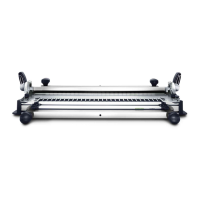
Getting The Most From The Festool VS-600
Jointing System
By: Jerry Work
Few things in woodworking invoke the image of quality more than well cut dovetails
joining the sides of a drawer, box or cabinet. For thousands of years this simple, elegant
joint has been employed by the finest craftsmen for its inherent strength as well as for
its pleasing aesthetics. Watch a person who sees a fine piece of furniture for the first
time. Their hands will invariably rub over the dovetail joints as though to confirm that
this is truly a well crafted piece.
Anatomy of a
Dovetail Joint
There are several different
types of joints that are all
called “Dovetail Joints”. They
get their name from a fan
shaped male piece that looks a
bit like the tail on a dove. That
fan shaped male fits into a
female recess of the same
shape.
Once in place the joint cannot
be pulled apart without
breaking the surrounding
wood.
The strength of the joint does
not rely on glue, nails or
screws. It comes from the
interference fit of the male and
female fan shapes. You simply
cannot pull them apart
without breaking the wood.
A dovetail joint requires at
least one fan shaped male tail
and at least one female fan
shaped recess. It may have
two, three or many more fan
shaped male tails and
corresponding female recesses,
but it must have at least one to
be a joint at all.
3







 To Next Page

