
 Need help?
Do you have a question about the Fine offset WH2810 and is the answer not in the manual?
Lists components of the weather station, including console, transmitter, and adapter.
Instructions for powering and setting up the thermo-hygrometer sensor.
Provides guidelines for mounting the remote sensor on a wall or hanging it.
Instructions for connecting the power adapter and inserting batteries into the display console.
Introduces the mode for configuring various station settings.
How to check and understand barometric pressure readings and history.
Instructions for setting and managing time and temperature alarms.
Process for entering and performing sensor calibration.
Explanation of how to view and clear maximum and minimum recorded values.
Details the station's learning capability and weather forecasting icons.
Steps to resynchronize a lost connection with the outdoor transmitter.
Provides range, accuracy, and resolution for measured parameters.
Lists power requirements for the base station and remote sensors.
Details wireless transmission range, frequency, and update rate.
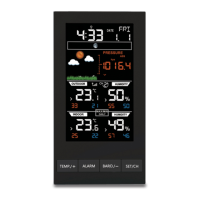
This document describes a color screen multi-channel weather station designed to provide comprehensive environmental data. The device offers a range of features for monitoring temperature, humidity, barometric pressure, and includes advanced forecasting capabilities, as well as moon phase display. It is designed for ease of use with a clear color LCD display and supports multiple remote sensors for broader coverage.
The primary function of this weather station is to measure and display various environmental parameters. It provides wireless outdoor temperature and humidity readings, as well as indoor temperature and humidity. The station supports up to three outdoor sensors, allowing users to monitor conditions in different locations simultaneously. It records minimum and maximum temperature and humidity values, providing a historical overview of environmental changes.
Barometric pressure is a key feature, displayed in inHg, mmHg, or hPa, and is used for its weather forecasting function. The device offers a 12 or 24-hour time display, a perpetual calendar, and a time alarm with a snooze function. Additionally, it displays moon phases, adding an astronomical element to its utility. The console features an LED backlight for visibility in various lighting conditions and can be either wall-hung or free-standing. An included outdoor sensor (transmitter) ensures synchronized instant reception of data.
The weather forecast is based on changes in atmospheric pressure, providing predictions for the next 12 hours. Six color forecast icons visually represent different weather conditions, from sunny to snowy. The device "learns" over time, with barometric calibration occurring over approximately 30 days to ensure accurate personal forecasts for the user's specific location. Pressure tendency arrows indicate whether pressure is rising, unchanged, or falling, correlating with improving, stable, or worsening weather. Similarly, temperature and humidity trend arrows update every 30 minutes, reflecting changes over the past three hours.
Getting started with the weather station involves a specific power-up sequence: remote transmitter(s) first, followed by the display console, to ensure proper synchronization. The console acts as the receiver, collecting data from the thermo-hygrometer(s) (remote transmitters). A power adapter is included for the console, while the remote sensors operate on batteries.
Setting up the thermo-hygrometer sensors requires careful attention to battery polarity and channel selection. Each sensor can be assigned a unique channel number (1, 2, or 3) to prevent interference when multiple sensors are in use. The temperature unit (°F or °C) can also be selected on the sensor itself. For optimal performance, it's recommended to place transmitters about 2 to 3 meters away from the display console.
The display console setup involves plugging in the power adapter, which activates the LCD display and sets the backlight to a high level. The backlight brightness can be adjusted using the LIGHT/SNOOZE key. Backup AAA batteries are also installed in the console to maintain functionality during power outages, though the backlight will only remain on for 5 seconds when operating on battery power alone.
The console's operation is managed through four keys: TEMP./+, ALARM, BARO./-, and SET/CH. These keys facilitate navigation through various program modes: Set Mode, Alarm Mode, Calibration Mode, and Min/Max Mode. Any program mode can be exited by pressing the SNOOZE/LIGHT key or by waiting for a 30-second timeout.
In Set Mode, users can configure various settings such as beep on/off, automatic MAX/MIN record reset, time zone, 12/24 hour format, hour and minute of day, date format (D-M/M-D), year, month, day, temperature units (°C/°F), barometric pressure units (hPa, mmHg, inHg), and hemisphere selection (Northern/Southern). The TEMP./+ and BARO./- keys are used to adjust values, while the SET/CH key confirms and moves to the next parameter. Holding these keys allows for rapid increase/decrease of values.
The device also features a Radio Controlled Clock (RCC) function. After the remote sensor powers up, it attempts to receive the RCC signal for up to 5 minutes. A successful reception is indicated by an RCC icon on both the outdoor sensor LCD and the display console. If the signal is not received, it will automatically resume searching every six hours.
For checking barometric pressure, the BARO./- button allows users to view past 12hr/24hr/48hr/72hr average pressures. The device displays both absolute (measured) and relative (corrected to sea-level) pressures. Users can calibrate the relative pressure to match official reporting stations for their location. The Dew Point of the current outdoor channel can also be viewed by pressing the TEMP/+ key.
The ALARM Mode allows users to set a time alarm with a snooze function. Additionally, a low temperature alarm is triggered if the outdoor temperature falls within the -3°C to 2°C range, indicated by a flashing "LOA" icon and an audible alarm if the beep function is enabled.
The manual provides guidance on battery usage for the remote sensors, recommending fresh alkaline batteries for typical outdoor temperatures and fresh lithium batteries for colder climates. It explicitly advises against using rechargeable batteries and warns about the importance of correct battery polarity to prevent permanent damage.
For remote sensor installation, it is recommended to mount sensors on a north-facing wall in a shaded area to avoid inaccurate temperature readings from direct sunlight or radiant heat sources. Although the sensors are water-resistant, mounting them in a well-protected area, such as under an eave, is advised. The manual suggests using a screw or nail for wall affixing or hanging the sensor on a string.
Calibration Mode allows users to adjust offset values for temperature, humidity, and absolute pressure for each channel (CH1, CH2, CH3, and indoor). This feature enables users to fine-tune readings to match a known source, such as a calibrated thermometer or pressure sensor. The offset values can be adjusted using the + and - buttons, confirmed with SET/CH, and canceled with the ALARM button. The absolute pressure offset will also affect the relative pressure, with specific instructions provided for adjusting the relative pressure independently.
In cases of lost signal between the remote sensor and the display console, the device offers a resynchronization method: pressing and holding SET/CH and TEMP buttons for 5 seconds in normal mode. If synchronization still fails, resetting the console by temporarily removing and reinserting a battery is suggested.
The device also features an automatic daily reset of MAX/MIN records at 0:00, which is enabled by default but can be switched off in the setting mode. This ensures that daily records are refreshed, providing up-to-date maximum and minimum values.
 General
| Model | WH2810 |
|---|---|
| Category | Weather Station |
| Temperature Accuracy | ±1°C |
| Humidity Range | 1% to 99% |
| Humidity Accuracy | ±5% |
| Rainfall Measurement | 0 to 9999 mm |
| Rainfall Accuracy | ±10% |
| Barometric Pressure | 300 to 1100 hPa |
| Transmission Frequency | 433 MHz |
| Power Supply (Outdoor Sensor) | 2 x AA batteries |
| Wind Speed Range | 0 to 50 m/s |
| Wireless Transmission Range | 100 meters (open area) |
| Power Supply (Base Station) | 3 x AA batteries |
| Wind Speed Accuracy | ±1 m/s or 10% (whichever is greater) |
| Wind Direction | 0° to 360° |
| Update Rate | Every 48 seconds |

 To Next Page
