34
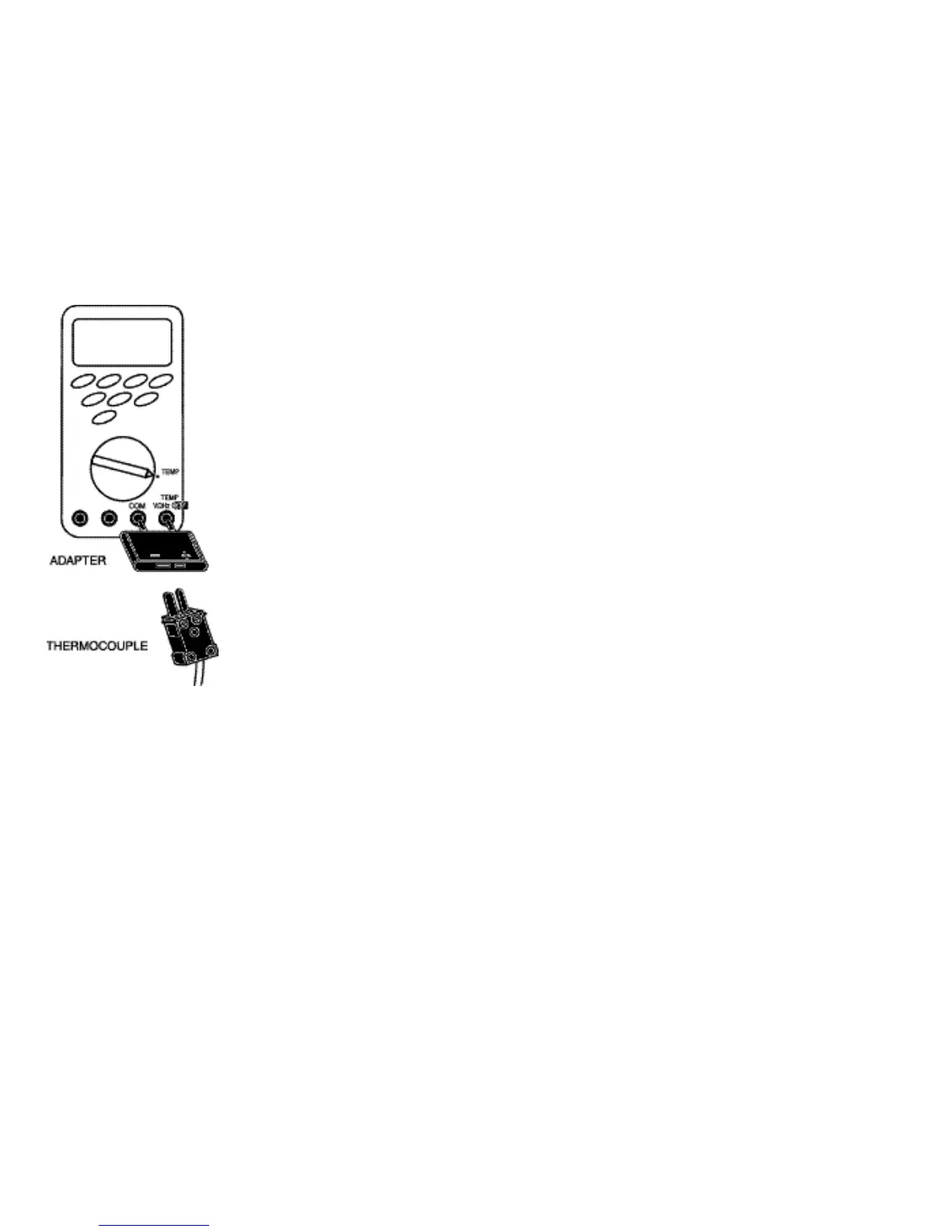
• This Meter directly measures
temperature using a K-type
thermocoup
l
e which optionally
supplied with this Meter.
• This Meter displays temperature
measured in degrees either
Celsius or Fahrenheit.
N O T E : This Meter auto-
matically defaults to the
Centigrade scale. To
measure in Fahrenheit,
toggle the DC/AC button
when the rotary switch
is set to TEMP position.
35
• Repeated sharp flexing can break the thermocouple lead.
To prolong
l
ead life, avo
i
d sharp bends in the lead, especially
near the connector.
• The temperature mea
s
urement range of the K-type
thermocouple supplied with this Meter is -40°C to + 1,370°C (-
40°F to + 2,498°F).
MEASUREMENT TECHNIQUES FOR THE BEST ACCURACY
• Choosing a Proper Thermocouple Probe
The thermocouple optionally supplied with this Meter is a bead
type thermocouple, which is designed for general-purpose use.
For optimum accuracy, use the style of probe that is appropriate
for each type of application. For example, use an air probe for air
measurements, a surface probe for surface measurements, and
an immersion probe for liquid or gel measurements.
• Thermocouple Adapter
The thermocouple adapter supplied with this Meter is made from
the same materials as thermocouple wires. To avoid error, it is
very important to use a thermocouple adapter whose materials
match the thermocouple you are using.
• To Reduce Errors
Ensure that there is a good connection between the
thermocouple and the surface you are measuring. For this
purpose, a thermal conducting compound (such as silicone
grease) can be used between the thermocouple and the surface
you are measuring.
When measuring above-ambient temperatures, adjust the
connection between the thermocouple and the surface until you
get the highest temperature reading.
When measuring below-ambient temperatures, ad
j
ust the
connection between the thermocouple and the surface until you
get the lowest temperature reading.
When measuring near-ambient temperatures, take the reading when
the display is most stable.



 To Next Page