2
PRINCIPLES OF OPERATION
The 55UV5 scanner employs a detector which is a sealed, gas filled, ultraviolet-transmitting special
glass envelope containing two electrodes connected to an AC voltage source. The detector responds
only to a portion of the ultraviolet spectrum from common flames.
When ultraviolet radiation of sufficient energy (at wavelengths shorter than those in sunlight at the
earth’s surface) falls upon the electrodes, electrons are released and the inter-electrode gas becomes
conductive. This results in an electric current flow from one electrode to the other.
The current flow in the detector starts and ends abruptly and is known as an “avalanche.” A very
intense source of UV radiation will produce several thousand avalanches or pulses per second. Less
radiation will produce fewer pulses per second. Upon total loss of flame, the detector output ceases
except for very infrequent single pulses caused by cosmic rays. The circuitry does not respond to
these infrequent pulses. Thus, the presence or absence of pulses is an indication of the presence or
absence of flame; the frequency of the pulses is a measure of flame intensity. Pulses generated by the
scanner are transmitted to a compatible Fireye control via scanner wiring.
FEATURES
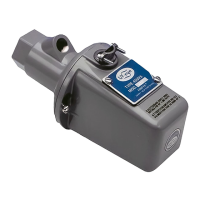
The UV tube, quartz lens, power transformer and related electronic components are contained in an
aluminum enclosure which is sealed with an oil-resistant gasket. The quartz lens is a planoconvex
design, resulting in increased sensitivity. The scanner has a 1" fitting for mounting to a threaded sight
pipe and a 3/4" threaded connection for purge air.
Also included in the Type 55UV5 scanner is an electromagnetic shutter that permits a self-checking
circuit within an associated Fireye control to verify that the scanner and signal circuits are producing
valid flame presence or absence information. During the shutter closed period the detector’s optical
path is blocked from flame radiation. While the shutter is open, flame presence or absence is
detected. The resultant scanner output, while flame is detected, is a continuous, periodically inter-
rupted pulsed flame signal. This is a prerequisite for energizing the associated Fireye control’s flame
relay.
The 55UV5 scanner is equipped with a fitting to accept ½" liquid-tight flexible conduit, and 20 feet
(6 meters) of captive cable to connect to its associated 25SU3 or 25SU5 control.
NOTE: The installation of liquid-tight flexible conduit is mandatory in all installations, and is
furnished by the installer.



 To Next Page