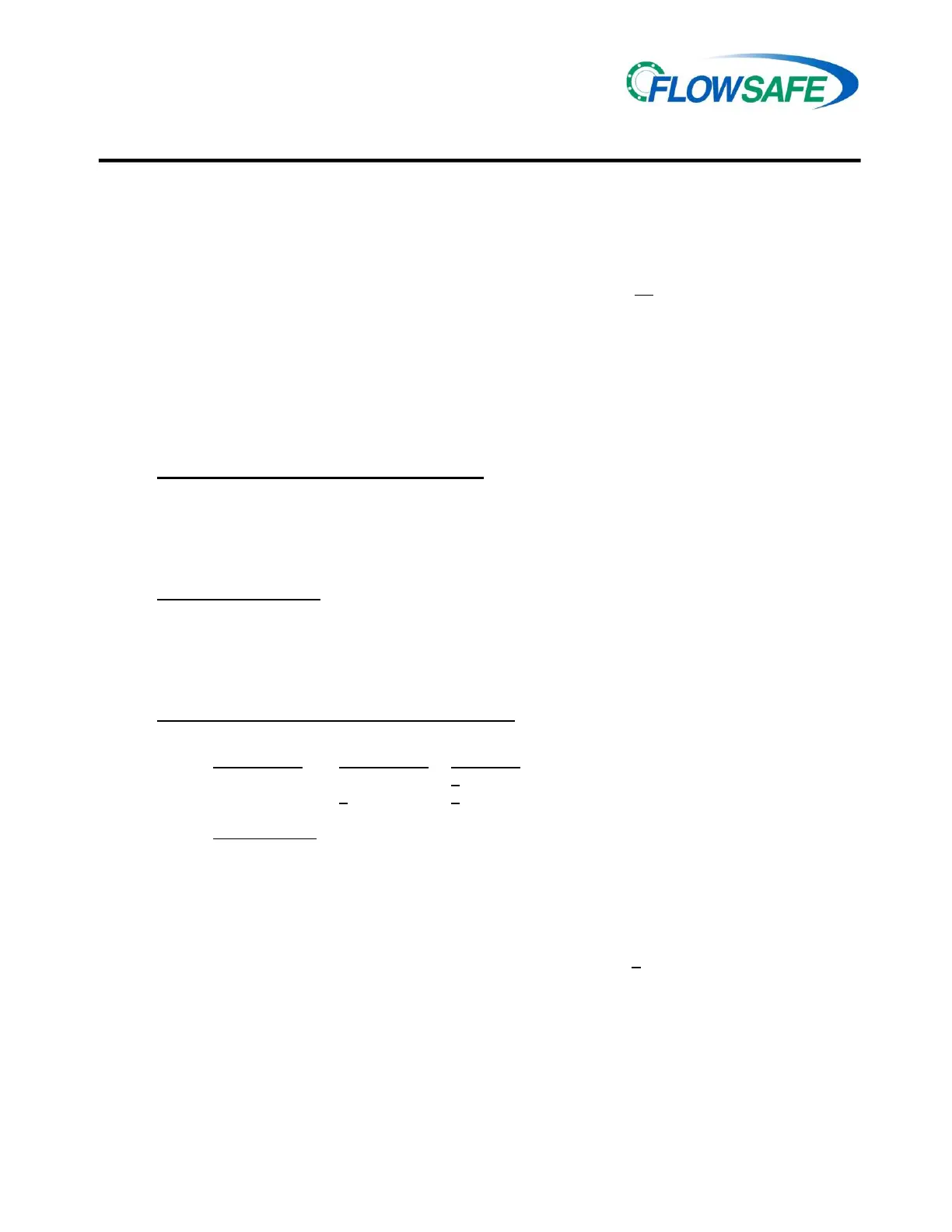
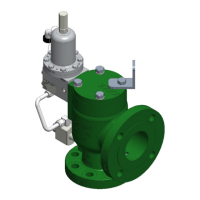
9) Assemble the spring washer(s), spring, and lifting rod subassembly (if applicable) into the bonnet.
10) Assemble the bonnet, adapter plate (for XXL “C” bonnet), bolts, nuts, and lockwashers to the
body. Torque main bonnet bolts to following value:
12-15 ft-lbs -- 3/8-in bolts marked “B8” on ‘C’ body
25-30 ft-lbs -- 1/2-in bolts marked “B8” on ‘D’ or ‘E’ body
65-70 ft-lbs -- 1/2-in bolts marked “B8” on ‘D’ or ‘E’ body
11) Screw the PA screw, lock nut, and seal into the top of the body, with top of screw at previously
recorded value.
12) For lift levers, assemble PA screw, and lock nut around lifting rod. Then reassemble the lift nut
and jam nut to previously recorded position. Assemble the lift lever housing and then the
bushing, seals, shaft, lift lever, and lock nut.
13) Ensure that the rear bolt and seal are secured in the back of the body.
14) The valve is now completely assembled and ready to be tested. See Section 4.0.
4.0 VALVE TESTING AND ADJUSTMENT
The following tests and adjustments are necessary for F88 safety relief valves: set pressure and seat
tightness. Blowdown is not adjustable, and is fixed at approximately 10%-30% of set pressure,
depending on valve size, service media and set pressure.
4.1 TEST EQUIPMENT
F88’s for gas service should be set using air. Where practical, F88’s for liquid service should be set using
water or other suitable liquid. To obtain full-flow conditions and observe blowdown, a sufficiently large
pressure vessel will be needed.
4.2 SETTING / ADJUSTMENT TOLERANCES
Set Pressure: Set Pressure Tolerance
> 70 psig + 3% of specified set pressure
< 70 psig + 2 psi
Seat Tightness: There should be ZERO leakage with inlet pressure at or below:
For gas service:
• 0.90 x set pressure
For liquid service:
• 0.90 x set pressure, if set pressure > 100 psig
• 0.80 x set pressure, if set pressure < 100 psig


 To Next Page