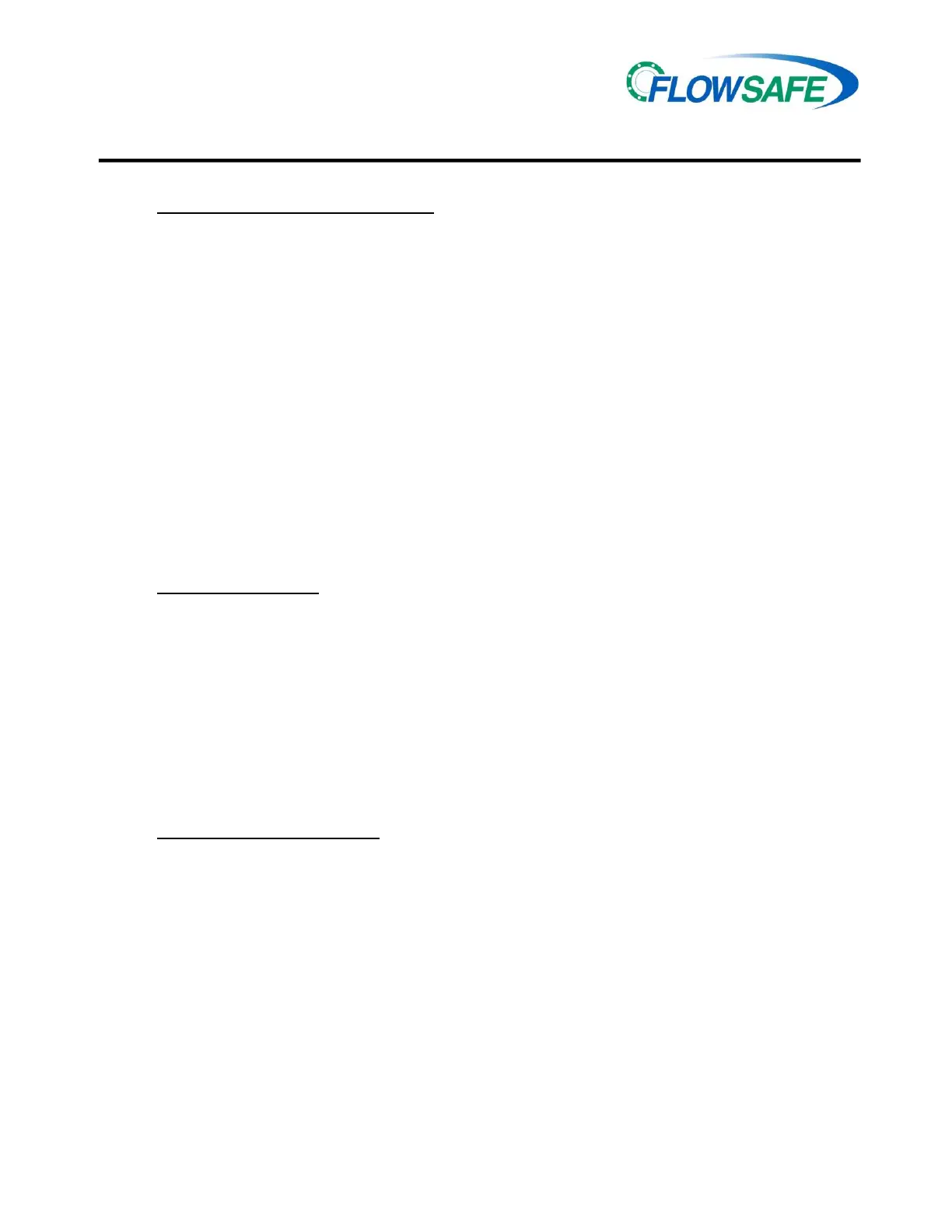
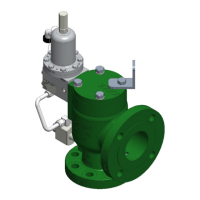
4.3 SET PRESSURE ADJUSTMENT
NOTES: 1. If the set pressure is being changed, then the spring, spring washer, PA screw, and
bonnet may need to be changed. Consult the factory or an authorized FLOW
SAFE assembler for the correct parts.
2. Set pressure for F88’s on liquid service is defined as 93% of the “gush” (pop)
pressure. This corresponds to the first steady stream if valve is being set on a low-
capacity test system. For gas or vapor service, set pressure is “pop”.
1) Remove the PA screw cap (if installed), loosen the PA screw lock nut, and screw the PA screw in
(clockwise) most of the way.
2) FOR GAS SERVICE VALVES: Increase the inlet pressure to the desired level, and then unscrew
(counterclockwise) the PA screw until the valve pops.
FOR LIQUID SERVICE VALVES: Increase the inlet pressure to 1.075 (1 0.93) of the nameplate
set pressure, and then unscrew (counterclockwise) the PA screw until the valve “gushes” liquid.
Full rated flow for the valve will occur within 110% of set pressure (approx. 102% of “gush”
pressure).
3) Tighten down the lock nut and retest. Readjust as required.
4) Install and tighten down the PA screw cap or lift lever housing. Test valve one more time.
4.4 SEAT TIGHTNESS
1) After any repairs and set pressure adjustments, seat tightness should meet the criteria stated in
Section 4.2.
2) If the valve leaks after repair, refer to the troubleshooting guide on Pages 11 & 12. Check for:
• Even seating between the spindle and bushing. With the F88’s, you should be able to
see a full circular line contact on the bushing surface. Make sure that the seat is installed
all the way in the spindle and that the retainer is tight.
• Foreign particles trapped between the seat and bushing. If found, they may have
damaged the seat, requiring that it be replaced.
• Scratches in the beveled seating area of the nozzle (bushing).
4.5 LIFT LEVER OPERATION
CAUTION: Do not operate a lift lever unless valve inlet pressure is at least 75% of nameplate set
pressure. Prepare the system as necessary to handle a discharge from the valve.
NOTE: The lift lever enables verification that the valve spindle and seat can open freely, but does
not allow set pressure to be verified.
1) With inlet pressure as stated in the above CAUTION, rotate the lift lever handle clockwise or
counterclockwise until it meets resistance.
2) Continue rotating the handle slowly until there is indication of flow through the valve. NOTE that,
if inlet pressure is greater than reseat pressure (approx. 80% of set pressure), the valve may
develop full flow (gush) and will stay open long enough to blow down to that pressure.
3) Return the lift lever handle to the down position. If flow through valve could not be achieved, or if
the valve does not close, have the valve disassembled and serviced by a qualified organization.


 To Next Page