EasyManua.ls Logo

Fluke 825A - Page 26

Fluke 825A
50 pages
Print Icon
To Next Page IconTo Next Page
To Previous Page IconTo Previous Page
Loading...
825А
(3)
The
ЕМЕ
of
the
standard
cell
will
change
if
the
cell
has
been
inverted,
or
if
the
cell
has
been
inadver-
tently
short-circuited.
If
the
EMF
has
changed,
the
825A
will
naturally
be
out
of
calibration
on
all
ranges.
In
either
case,
the
cell
will
return
to
its
original
EMF.
If
the
cell
were
inverted
or
shorted
for
only
a
few
seconds,
the
825A
should
be
able
to
measure
voltages
within
speci-
fications
after
several
hours
recovery
time.
e.
DECIMAL
LAMP
REPLACEMENT.
The
decimal
lamps
are
normal
6.
3
volt
pilot
bulbs.
To
prolong
their
life
these
bulbs
are
operated
from
a
5
volt
transformer
winding.
However,
these bulbs
do
occasionally
fail.
To
replace,
proceed
as
follows:
(1)
On
cabinet
models,
remove
screws
at
back
of
cabinet
and
slide
instrument
out
of
case.
(2)
Remove
four
screws
that
hold
tront
panel
assembly
to
chassis.
(3)
Being
careful
to
avoid
wiring
damage,
gently
lift
front
panel
assembly
from
instrument
and
set
face
down
in
front
of
instrument.
(4)
Remove
screws
holding
range
resistor
printed
circuit
board
and
Kelvin-Varley
printed
circuit
board
to
front
panel
assembly.
(5)
Push
these
printed
circuit
boards
aside
enough
to
allow
access
to
pilot
light
holders.
(6)
Remove
pilot
light
holder
from
bracket
by
applying
pressure
to
each
side
of
holder.
(7)
Remove
cardboard
light
shield
and
replace
pilot
light.
(8)
On
rack
models,
remove
screws
holding
cover
to
instrument
and
set
cover
aside.
(9)
Remove
pilot
light
holder
from
bracket
by
applying
pressure
to
each
side
of
holder.
(10)
Remove
cardboard
light
shield
and
replace
pilot
light.
4-4.
CALIBRATION
a.
GENERAL,
Тһе
825A
сап
be
calibrated
as
often
as
deemed
necessary.
However,
it
is
recommended
that
the
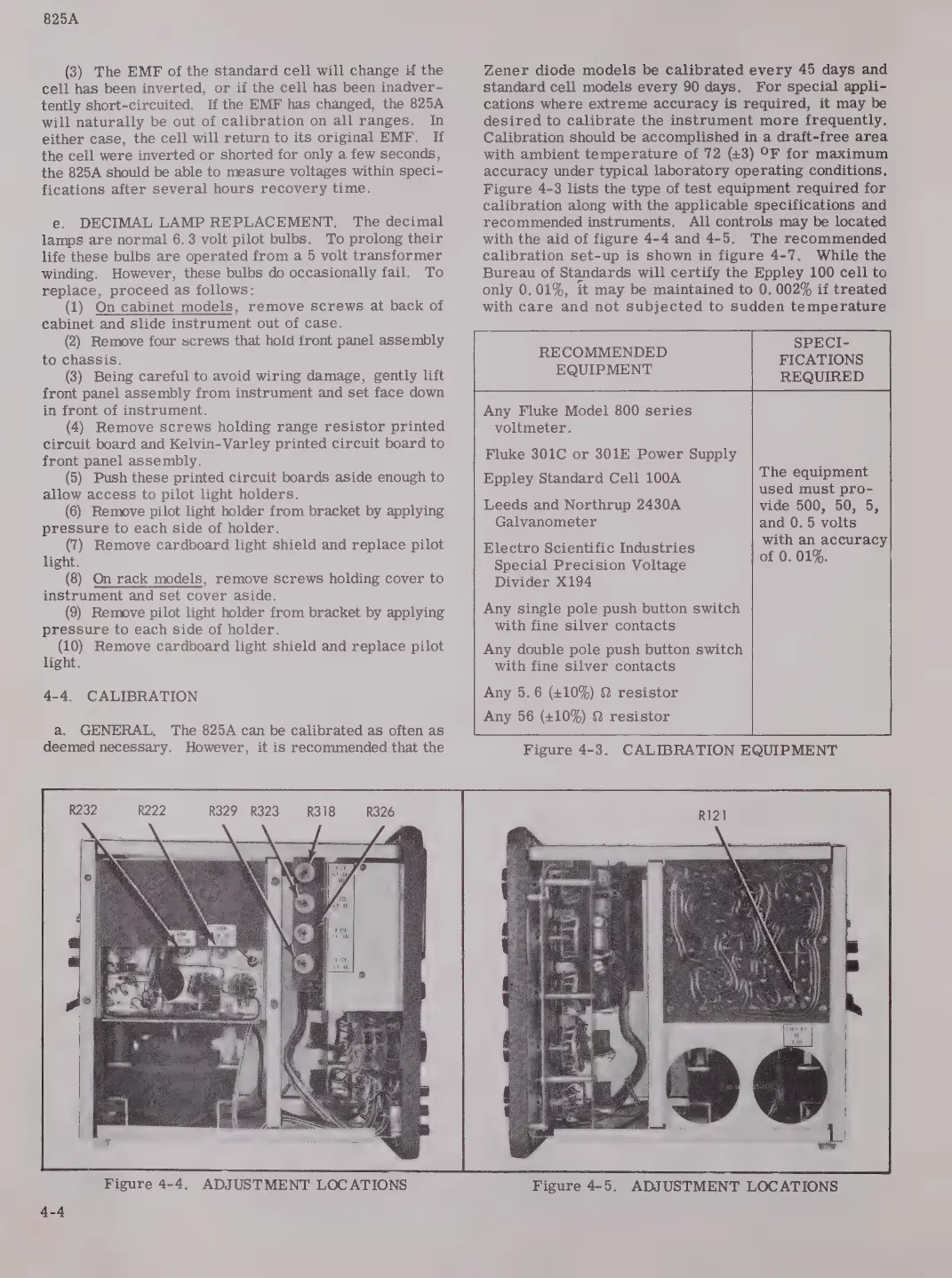
R329
R323 R318
R326
Figure
4-4,
ADJUSTMENT
LOC
ATIONS
Zener
diode
models
be
calibrated
every
45
days
and
standard
cell
models
every
90
days.
For
special
appli-
cations
where
extreme
accuracy
is
required,
it
may
be
desired
to
calibrate
the
instrument
more
frequently.
Calibration
should
be
accomplished
in
a
draft-free
area
with
ambient
temperature
of
72
(+3)
ОЕ
for
maximum
accuracy
under
typical
laboratory
operating
conditions.
Figure
4-3
lists
the
type
of
test
equipment
required
for
calibration
along
with
the
applicable
specifications
and
recommended
instruments.
All
controls
may
be
located
with
the
aid
of
figure
4-4
and
4-5.
The
recommended
calibration
set-up
is
shown
in
figure
4-7.
While
the
Bureau
of
Standards
will
certify
the
Eppley
100
cell
to
only
0.01%,
it
may
be
maintained
to
0.
002%
if
treated
with
care
and
not
subjected
to
sudden
temperature
SPECI-
FICATIONS
REQUIRED
RECOMMENDED
EQUIPMENT
Any
Fluke
Model
800
series
voltmeter.
Fluke
301C
or
301E
Power
Supply
Eppley
Standard
Cell
100A
Leeds
and
Northrup
2430A
Galvanometer
The
equipment
used
must
pro-
vide
500,
50,
5,
and
0.
5
volts
with
an
accuracy
Electro
Scientific
Industries
of
0.
01%.
Special
Precision
Voltage
Divider
Х194
Any
single
pole
push
button
switch
with
fine
silver
contacts
Any
double
pole
push
button
switch
with
fine
silver
contacts
Апу
5.6
(410%)
О
resistor
Any
56
(410%)
Q
resistor
Figure
4-3.
CALIBRATION
EQUIPMENT
Figure
4-5.
ADJUSTMENT
LOCATIONS

Related product manuals