EasyManua.ls Logo

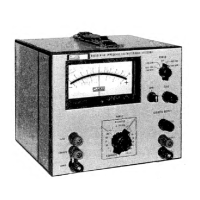
Fluke 825A - Input Attenuator; Operation; Recorder Output

Fluke 825A
50 pages
Print Icon
To Next Page IconTo Next Page
To Previous Page IconTo Previous Page
Loading...
825А
3-2.
INPUT
ATTENUATOR
a.
Inthe
VTVM
mode,
the
resistance
of
the
input
attenuator
and
thus
the
input
resistance
of
the
voltmeter
is
50
megohms
(R301
through
R310).
For
full
scale
deflection,
1
mv
must
be
applied
to
the
null
detector.
The
necessary
reduction
is
provided
by
four
positions
on
the
input
attenuator
that
are
selected
by
range
switch
section
S2C.
~
.
In
the
differential
e
the
resistance
of
the
TM
tems
is
10
megohms
(R305
through
R310)
for
the
10,
1,
0.1,
and
0.
01
null
ranges
and
1
megohm
(R306
through
R310)
for
the
0.
001
volt
null
range.
However,
this
is
not
the
input
resistance
of
the
voltmeter.
The
input
resistance
is
determined
by
dividing
the
terminal
voltage
of
the
unknown
by
the
amount
of
current
drawn
from
the
unknown.
The
current
drawn
from
the
unknown
is
equal
to
the
difference
between
the
unknown
terminal
voltage
and
the
internally
known
voltage
divided
by
the
resistance
of
the
input
attenuator.
Тһе
equation
for
input
resistance
can
be
hence
written
as:
E
Ey
В
Ес
(Ra
+
В,
Rin
=
=
та
5
Seu
в)
-Rg
where:
Rin
=
ие
resistance
of
voltmeter
Ey
=
Eg
-
lu
Rg
=
terminal
voltage
of
unknown
I,
=
current
drawn
from
unknown
Eg
=
source
voltage
of
unknown
Rs
=
source
resistance
of
unknown
В.
=
resistance
of
input
attenuator
E
=
voltage
indicated
by
voltage
readout
dials
|
|
„г
absolute
value
(magnitude
only)
Thus,
the
input
resistance
is
infinite
at
null
when
E
is
equal
to
E,
and
Ес.
c.
For
full
scale
deflection
of
10,
1,
0.1,
and
0.01
volts,
the
voltage
difference
(unknown
voltage
minus
re-
ference
voltage)
must
be
reduced
by
an
attenuator.
This
reduction
is
provided
by
four
positions
on
the
input
at-
tenuator
that
are
selected
by
null
switch
section
S3D.
On
the
0.
001
volt null
range,
the
voltage
across
the
input
attenuator
is
fed
directly
to
the
null
detector.
3-3.
NULL
DETECTOR
a.
GENERAL,
The
null
detector
is
a
fixed
gain
device
containing
four
resistance-capacitance
coupled
voltage
amplifier
stages
with
a
high
amount
of
negative
current
feedback.
With
high
negative
current
feedback,
the
out-
put
current
is
approximately
equal
to
the
signal
voltage
divided
by
the
impedance
of
the
feedback
network
regard-
less
of
the
amplifier
characteristics
or
even
the
load
impedance.
Тһе
high
negative
feedback
also
makes
the
amplifier
relatively
insensitive
to
the
gain
changes
in
individual
tubes
due
to
aging
and
replacement.
Тһе
out-
put
current
from
the
null
detector
is
indicated
on
a
meter
that
has
taut-band
suspension.
This
suspension
does
away
with
all
friction
associated
with
meter
pivot
sticki-
ness.
Thus,
any
tendency
for
the
meter
pointer
to
stick
at
one
point
of
the
scale
and
then
jump
to
another
point
is
completely
eliminated.
3-2
b.
OPERATION.
At
the
input
to
the
null
detector,
R201,
C201,
R202,
and
C202
form
a
double
section
low
pass
filter
that
reduces
any
AC
component
present
on
the
DC
voltage
being
measured.
Тһе
difference
between
the
voltage
appearing
at
the
output
of
the
filter
and
the
voltage
developed
across
the
feedback
network
is
converted
to
an
alternating
voltage
by
G1,
a
94
cycle
chopper
This
chopped
voltage
is
amplified
by
V202A,
V202B,
ала
V203A
before
passing
through
cathode
follower
V203B.
During
half
the
chopper
cycle
the
output
of
the
amplifier
is
clamped
to
approximate
null
detector
common
poten-
tial
by
G1
while
during
the
other
half
the
output
is
filter-
ed
by
C212
to
provide
a
DC
current
for
the
meter.
When
the
chopper
provides
connection
between
contacts
1
and
9,
a
voltage
is
developed
across
feedback
network
R220,
R221,
and
R222
that
is
proportional
to
the
meter
(output)
current.
This
feedback
voltage
reduces
the
filter
output
voltage
with
respect
to
the
four
stage
amplifier.
The
impedance
of
the
feedback
network
(R220,
R221,
and
R222)
is
adjustable
between
8.
82
and
9.
83
ohms.
Since
the
output
current
is
approximately
equal
to
the
signal
voltage
divided
by
the
impedance
of
the
feedback
network,
a
1
mv
signal
voltage
indicates
an
output
current
of
101.
7
to
113.
4
ua.
However,
there
is
a
loss
due
to
finite
amplifier
gain
and
filtering
that
leaves
the
output
current
around
100
ua
which
can
be
set
accurately
by
means
of
the
feedback
network.
Thus,
current
feedback
makes
the
output
current
essentially
proportional
to
the
signal
voltage.
For
full
scale
deflection,
a
1
mv
signal
voltage
will
cause
100
ua
to
flow
through
the
meter.
c.
EFFECT
OF AC
COMPONENTS,
The
only
AC
vol-
tage
component
that
will
reduce
the
accuracy
of
the
825A
is
one
that
either
saturates
the
chopper-amplifier
or
one
that
beats
with
the
chopper
frequency.
Since
the
voltage
required
for
saturation
is
greater
than
that
required
for
beating,
the
null
detector
is
most
sensitive
to
an
AC
component
with
a
frequency
that
is
a
submultiple
or
a
low
multiple
of
the
chopper
frequency.
However,
this
is
easy
to
detect
because
the
meter
will
beat
at
the
differ-
ence
frequency
The
low
pass
filter
at
the
input
of
the
chopper-amplifier
will
attenuate
any
AC
component.
The
magnitude
of
the
AC
voltage
appearing
at
the
output
of
the
filter
depends
on
both
its
amplitude
and
frequency
before
filtering.
For
all
practical
purposes,
one
should
never
encounter
any
trouble
above
a
few
hundred
cycles.
Below
this,
the
filter
may
not
attenuate
the
AC
component
enough.
However,
this
is
not
as
bad
as
it
appears.
A
60
cycle
AC
voltage
that
is
10%
of
the
input
voltage
will
cause
an
error
of
approximately
0.
01%
which
is
well
within
specifications.
If
AC
components
that
affect
accuracy
are
ever
encountered,
additional
filtering
as
set
forth
in
paragraph
2-9
will
eliminate
the
problem.
4.
ADJUSTMENTS.
Variable
resistor
R232
in
the
null
detector
power
supply
provides.a
means
of
adjusting
the
output
current
of
the
amplifier
to
zero
when
there
is
no
input
signal.
The
gain
of
the
amplifier
is
adjusted
by
means
of
R222
in
the
feedback
circuit.
e.
RECORDER
OUTPUT.
The
recorder
output
is
picked
off
divider
string
R225,
R1,
and
R226.
Output
level
control
R1
provides
a
means
of
adjusting
the
out-
put
voltage
up
to
a
maximum
of
approximately
20
milli-
volts
at
full
scale
deflection.
The
voltage
at
the
output
terminals
is
proportional
to
the
meter
reading.

Related product manuals