EasyManua.ls Logo

Fluke 825A - Page 19

Fluke 825A
50 pages
Print Icon
To Next Page IconTo Next Page
To Previous Page IconTo Previous Page
Loading...
SECTION
ІП
THEORY
OF
OPERATION
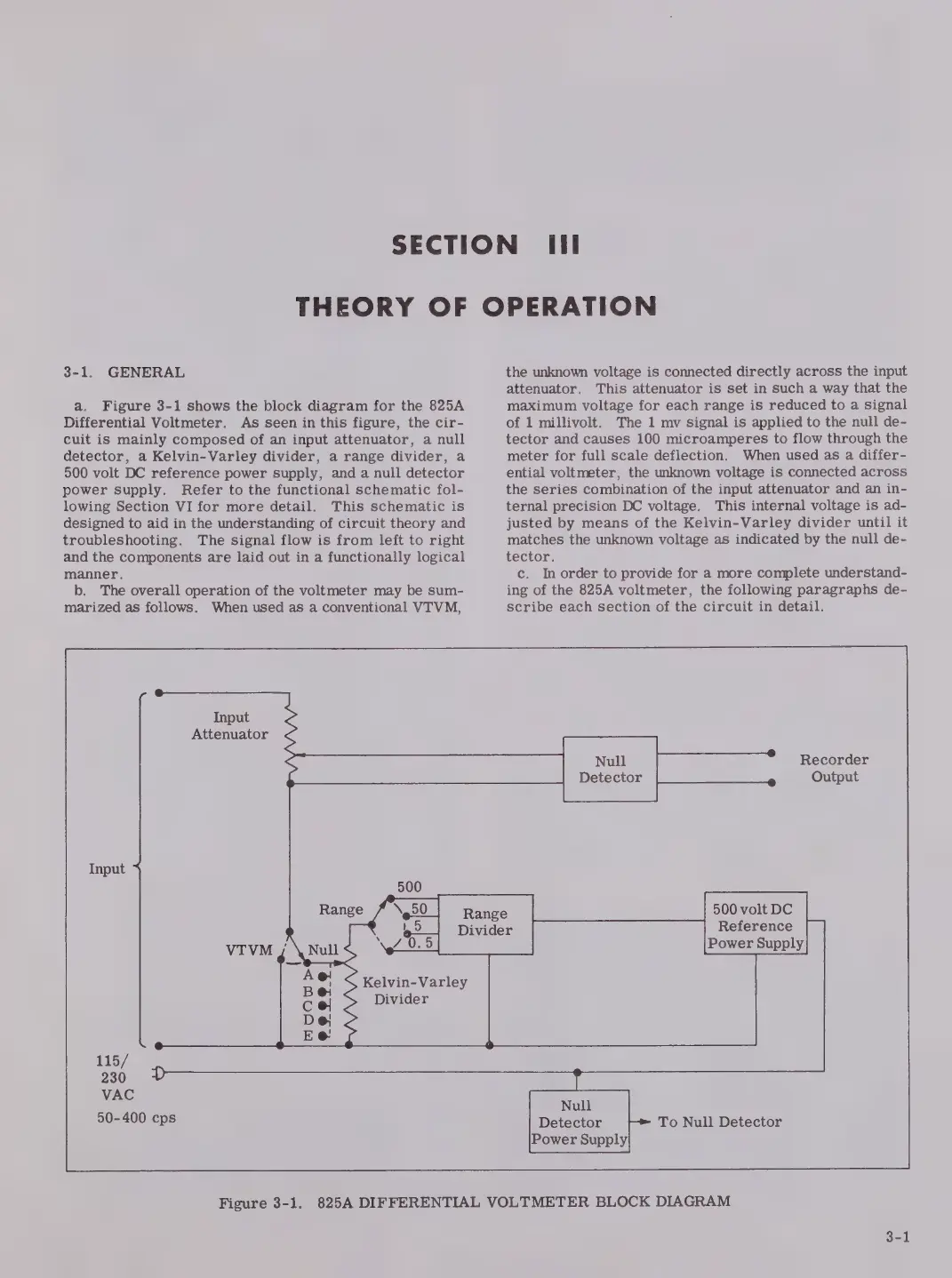
3-1.
GENERAL
a.
Figure
3-1
shows
the
block
diagram
for
the
825A
Differential
Voltmeter.
As
seen
in
this
figure,
the
cir-
cuit
is
mainly
composed
of
an
input
attenuator,
a
null
detector,
a
Kelvin-Varley
divider,
a
range
divider,
a
500
volt
DC
reference
power
supply,
and
a
null
detector
power
supply.
Refer
to
the
functional
schematic
fol-
lowing
Section
VI
for
more
detail.
This
schematic
is
designed
to
aid
in
the
understanding
of
circuit
theory
and
troubleshooting.
The
signal
flow
is
from
left
to
right
and
the
components
are
laid
out
in
a
functionally
logical
manner.
b.
The
overall
operation
of
the
voltmeter
may
be
sum-
marized
as
follows.
When
used
as
a
conventional
УТУМ,
Input
Attenuator
Divider
Kelvin-Varley
Divider
115/
230
VAC
50-400
cps
the
unknown
voltage
is
connected
directly
across
the
input
attenuator.
This
attenuator
is
set
in
such
a
way
that
the
maximum
voltage
for
each
range
is
reduced
to
a
signal
of
1
millivolt.
Тһе
1
mv
signal
is
applied
to
the
null
de-
tector
and
causes
100
microamperes
to
flow
through
the
meter
for
full
scale
deflection.
When
used
as
a
differ-
ential
voltmeter,
the
unknown
voltage
is
connected
across
the
series
combination
of
the
input
attenuator
and
an
in-
ternal
precision
DC
voltage.
This
internal
voltage
is
ad-
justed
by
means
of
the
Kelvin-Varley
divider
until
it
matches
the
unknown
voltage
as
indicated
by
the
null
de-
tector.
c.
In
order
to
provide
for
a
more
complete
understand-
ing
of
the
825A
voltmeter,
the
following
paragraphs
de-
Scribe
each
section
of
the
circuit
in
detail.
Null
Recorder
CULO
АЛ
Еее
Output
500
volt
DC
Reference
Power
Supply
Null
Detector
Power
Supply
To
Null
Detector
Figure
3-1.
825A
DIFFERENTIAL
VOLTMETER
BLOCK
DIAGRAM
3-1

Related product manuals