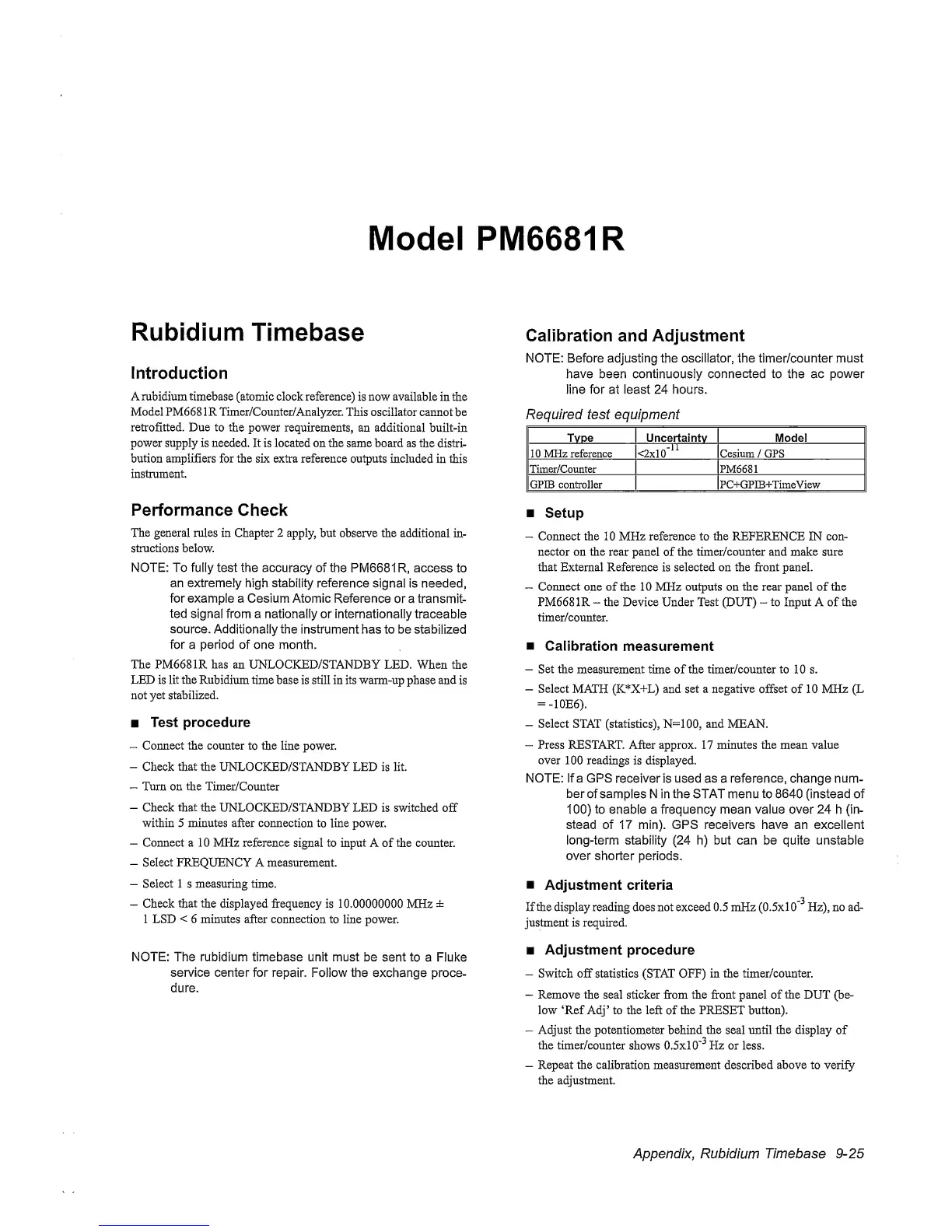
Model PM6681R
Rubidium
Timebase
Introduction
Arubidium
timebase
(atomic clock reference)
is now
available
in the
Model PM6681R Timer/Counter/Analyzer.
This
oscillator
cannot
be
retrofitted. Due
to the
power
requirements,
an additional
built-in
power
supply
is needed. It is located on the same board
as the distri-
bution
amplifiers for the six extra reference outputs
included
in this
instrument.
Performance Check
The
general rules
in
Chapter
2 apply,
but
observe the additional
in-
structions
below.
NOTE: To fully test the
accuracy
of
the
PM6681
R,
access to
an extremely high stability
reference
signal is needed,
for example a Cesium Atomic
Reference
or a transmit-
ted
signal from a nationally or internationally
traceable
source.
Additionally the instrument has to be stabilized
for a period of one month.
The PM6681R has an UNLOCKED/STANDBY
LED.
When the
LED is
lit
the
Rubidium time
base is
still
in its warm-up phase and
is
not
yet stabilized.
Test procedure
-
Connect the counter
to
the
line
power.
-
Check
that
the
UNLOCKED/STANDBY LED
is
lit.
-
Turn on
the
Timer/Counter
-
Check
that the
UNLOCKED/STANDBY
LED is
switched
off
within 5 minutes after connection
to line
power.
-
Connect a 10 MHz
reference signal to input
A of the counter.
-
Select
FREQUENCY A measurement.
-
Select
1
s
measuring time.
-
Check
that the
displayed frequency
is 10.00000000
MHz
±
1 LSD
<
6 minutes after
connection to
line power.
NOTE: The rubidium timebase unit must
be sent to
a Fiuke
service center for
repair. Follow
the exchange proce-
dure.
Calibration
and
Adjustment
NOTE: Before adjusting the oscillator, the timer/counter must
have
been continuously
connected
to the ac
power
line for at least 24 hours.
Required test equipment
Type Uncertainty Model
10 MHz
reference
<2xl0'“
Cesium
/ GPS
Tiiner/Counter
PM6681
GPIB
controller
PC+GPIB+TimeView
m
Setup
—
Connect the
10
MHz
reference to
the
REFERENCE
IN
con-
nector on the rear
panel
of
the timer/counter and make sure
that External Reference
is
selected on the firont panel.
—
Connect
one of the 1 0 MHz outputs on the rear panel of the
PM6681R
-
the
Device Under
Test
(DUT)
-
to
Input A of
the
timer/counter.
Calibration
measurement
-Set the
measurement time
of
the timer/counter to
10 s.
—
Select
MATH
(K*X+L)
and
set a negative
offset
of 10
MHz
(L
=
-10E6).
—
Select STAT (statistics),
N=100,
and MEAN.
—
Press RESTART. After approx.
17
minutes the mean value
over
100
readings
is displayed.
NOTE: If a GPS
receiver
is used as a
reference,
change num-
ber
of samples N in the STAT menu
to
8640
(instead of
100)
to
enable a frequency mean value
over
24 h (in-
stead
of 17 min). GPS receivers have an excellent
long-term stability
(24
h) but can be quite unstable
over shorter
periods.
Adjustment criteria
_3
If
the
display reading does not exceed 0.5 mHz (0.5x1 0 Hz), no ad-
justment is required.
Adjustment
procedure
—
Switch off statistics
(STAT
OFF) in the timer/counter.
—
Remove
the
seal sticker fi:om the front panel of
the
DUT (be-
low ‘Ref Adj’ to the left
of
the
PRESET
button).
—
Adjust the potentiometer
behind
the
seal
until the display
of
the timer/counter
shows 0.5x10"^
Hz
or less.
—
Repeat the
calibration
measurement
described
above
to
verify
the adjustment.
Appendix, Rubidium Timebase
9-25


 To Next Page
 Loading...