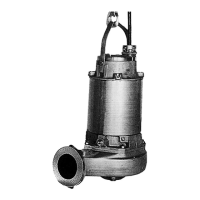
5. To reassemble, clean and inspect all parts. Replace any that show evidence or wear. Starting with the volute
with bearing, insert the two lip seals in the housing. With the volute bearing not turned up, install the thrust
shoe retainer, three thrust shoe segments, a carbon disc and retainer washer. Carefully insert rotor and shaft to
prevent carbon disc damage, splined end down, through the thrust bearing group and the lip seals. On the top
of the rotor shaft, replace the up-thrust washer(s) with the same thickness. Place O-rings in their proper
grooves and lubricate to prevent cutting. Lower the stator over what is now the thrust bearing assembly (make
sure that the cord receptacle is up). The stator must engage the bossed ring at one of the volute fastening
through holes. Note this bossed ring will only engage one of two recesses in the stator bottom end ring.
WARNING: Failure to engage one of the two recesses, at fastening insert, 4 inserts total, will prevent proper
assembly and cause bearing and cutter damage. Fasten from the bottom with four socket head capscrews and
washers. Install O-ring in upper groove of stator. Install O-ring in groove bearing housing. Fill the motor with
Hydromatic Liquidator Fill. (Water can be used if not allowed to freeze during storage or transportation.)
Rotate shaft during fill process to eliminate trapped air.
Insert bearing housing into stator and over shaft using care with placement of O-rings. Some fluid will be displaced
by the bearing housing assuring complete filling.
NOTE: Do not allow fill fluid to remain in cable plug receptacle. This receptacle must remain completely
dry at all times.
Install breather with filter over bearing housing. Place upper cap in line with receptacle opening and secure with
four cap screws and washers. Install snap ring on shaft above spline and replace shims. Place impeller on shaft and
push roll pin into opening of impeller. Place axial cutter on shaft and index to the roll pin. Add the radial cutter
and secure with washer and screw. Place cutter ring into base and secure with three screws. Attach base with four
cap screws, lock washers and nuts.
6. Plug pump into power and operate for two seconds maximum to be sure parts are not rubbing.
Trouble Check List
Below is a list of troubles and their probable causes.
Little or No Liquid Delivered
1. Pump air bound
2. Discharge head too high
3. Pump or piping plugged
4. Wrong rotation
5. Speed too low
6. Pump parts worn
7. Incorrect impeller diameter
Insufficient Discharge Pressure
1. Wrong rotation
2. Air or gases in liquid
3. Impeller damaged
4. incorrect impeller diameter
5. Speed too slow
Pump Overloads Motor
1. Wrong rotation
2. Specific gravity or viscosity of liquid too high
3. Head lower than rating; pumping too much liquid
4. Pump clogged
5. Defective bearings
6. Defective impeller



 To Next Page