9
❏
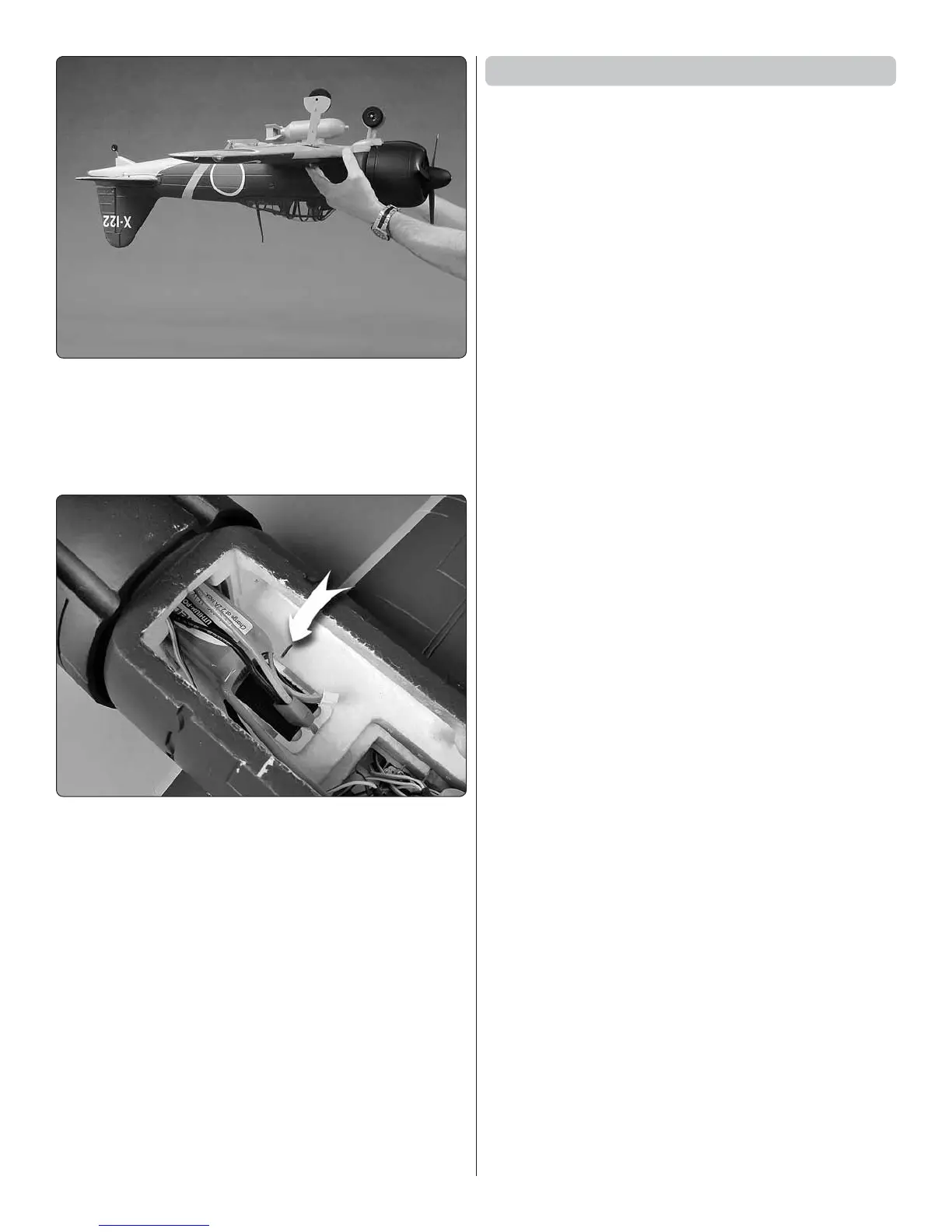
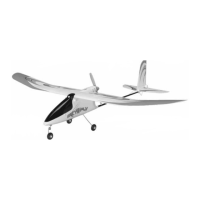
1. Install the battery and canopy. Balance the model upside-
down and support the wing on both sides of the fuselage at the
starting, recommended C.G. location which is 2-3/4" [70mm]
back from the leading edge of the wing – conveniently, this
location is also at the forward panel line which you can feel
with your fi ngertips when supporting the model.
❏
2. If necessary, reposition the battery to get the model
to balance. Once the correct battery location has been
determined you could mark the location on the inside of the
fuselage so you will know where to install it every time.
The full C.G. range is 2-1/4 in [57 mm] – 3-1/4 in [83 mm] back
from the leading edge of the wing at the fuselage. You may
shift the C.G. within the specifi ed range to change the fl ying
characteristics to suit your taste – balanced farther back the
Zero will become more maneuverable and less stable, but also
fl oat longer on landing. Balanced nearer the front of the C.G.
range the Zero will be more stable (less aerobatic), but also
better suited to fl ying at higher speeds or windier conditions.
Balancing the model outside the range could make the Zero
diffi cult to fl y, possibly causing a crash. So always fl y your
Zero within the specifi ed range.
Set a Flight Timer
It’s better to limit your fl ying time with a timer set to a pre-
calculated time instead of waiting for the LVC (low voltage
cutoff) in your ESC to kick in or until you notice a decrease in
fl ight performance. By then, it may be too late to make more
than one landing attempt.
Typical, average battery consumption with the Flyzone Zero
is approximately 220 mAh/minute on 3S and approximately
320 mAh/minute on 4S. But your fl ying style, battery condition
and weather conditions may cause these fi gures to vary, so until
you know for sure, start by setting your timer conservatively
to 6 or 4 minutes respectively. If your transmitter has a timer
built in, link the timer to your throttle stick so only motor run
time is counted. Fly until the timer sounds and land. Note
the time on your transmitter and charge the battery. If your
charger has a digital readout (indicating how much capacity
it took to recharge which indicates how much capacity was
used during the fl ight), divide the capacity that went back
into your battery by the fl ight time to calculate your average
battery consumption for that fl ight. Divide 80% of your
battery capacity by that consumption rate to determine your
new, target fl ight time.
Example:
Suppose you are using a 2200 mAh battery and after you
landed, the motor run time on the timer was four minutes,
fi fteen seconds (that’s 4.25 minutes in tenths). And say it
took 1290 mAh to recharge your battery.
Divide 1290 mAh by 4.25 minutes to calculate an average
battery consumption rate of about 300 mAh per minute.
Your limit capacity to use from a 2200 mAh battery is 1760 mAh
(2200 mAh x 0.8), so 1760 mAh divided by 300 mAh/minute =
5.8 minutes (approximately 5 minutes, 45 seconds).
Maybe on your second fl ight set your timer to 5 minutes and
repeat the procedure to continue to log data for calculating
average target fl ight times.
The more data you log and the more calculations you do,
the more accurate your calculated fl ight times will be – so
you never have an unplanned dead-stick landing or over
discharge your batteries.




 To Next Page