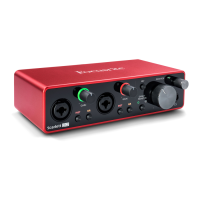
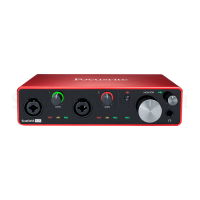
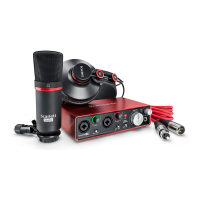
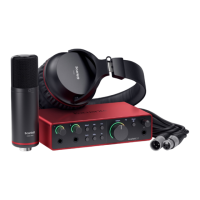
The Scarlett Solo Studio is a third-generation professional audio interface designed for recording with a microphone or directly from instruments, providing high-quality audio routing to and from a computer. This studio package includes the Scarlett Solo audio interface, a Scarlett CM25 MkIII studio-quality condenser microphone, a pair of Scarlett HP60 MkIII reference-quality headphones, and necessary software.
Function Description:
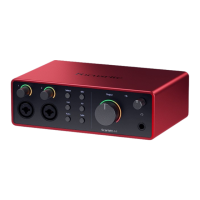
The Scarlett Solo hardware interface serves as the central component, connecting the CM25 MkIII microphone (or other microphones), musical instruments, or line-level audio signals to a computer running macOS or Windows. It allows recording at up to 24-bit, 192 kHz resolution via a USB connection, with recorded or monitor output appearing at the Solo's physical outputs. The device is class-compliant on macOS, offering plug-and-play functionality without the need for a driver. For Windows users, a driver is required, which is installed via the Quick Start tool.
Key enhancements in the third-generation Scarlett interfaces include improved audio specifications, offering greater dynamic range and lower noise and distortion. The mic preamp now accepts higher input levels. A notable feature is Focusrite's AIR function, individually selectable on each channel, which subtly modifies the preamp's frequency response to emulate the sonic characteristics of classic transformer-based ISA microphone preamps. This provides enhanced clarity and definition in the mid-to-high frequency range, particularly beneficial for vocals and acoustic instruments.
The dedicated instrument input offers high headroom, allowing direct connection of guitars or basses without distortion or clipping. Both inputs feature Gain Halo meters for easy input level setting. The Solo also provides balanced outputs, protecting audio from hum or interference when connected to monitors or amplifiers with balanced inputs.
The Direct Monitoring feature allows users to hear what they are playing in "real-time" with zero latency, mixed with computer playback. When Direct Monitoring is ON, input signals are summed to mono and appear in the center of the stereo image. It's crucial to ensure recording software isn't routing its input to its output simultaneously to avoid echoes. Monitoring with Direct Monitoring OFF is useful for incorporating FX plug-ins from the DAW, though this may introduce latency depending on the DAW's buffer size and processing power.
Important Technical Specifications:
- Supported Sample Rates: 44.1 kHz, 48 kHz, 88.2 kHz, 96 kHz, 176.4 kHz, 192 kHz
- Microphone Input:
- Dynamic Range: 111 dB (A-weighted)
- Frequency Response: 20 Hz to 20 kHz ±0.1 dB
- THD+N: <0.0012% (minimum gain, -1 dBFS input with 22 Hz/22 kHz bandpass filter)
- Noise EIN: -128 dB (A-weighted)
- Maximum Input Level: +9 dBu at minimum gain
- Gain Range: 56 dB
- Input Impedance: 3 kΩ
- Line Input:
- Dynamic Range: 110.5 dB (A-weighted)
- Frequency Response: 20 Hz to 20 kHz ±0.1 dB
- THD+N: <0.002% (minimum gain, -1 dBFS input with 22 Hz/22 kHz bandpass filter)
- Maximum Input Level: +22 dBu at minimum gain
- Gain Range: 56 dB
- Input Impedance: 60 kΩ
- Instrument Input:
- Dynamic Range: 110 dB (A-weighted)
- Frequency Response: 20 Hz to 20 kHz ±0.1 dB
- THD+N: <0.003% (minimum gain, -1 dBFS input with 22 Hz/22 kHz bandpass filter)
- Maximum Input Level: +12.5 dBu at minimum gain
- Gain Range: 56 dB
- Input Impedance: 1.5 MΩ
- Line Outputs:
- Dynamic Range: 108.5 dB (A-weighted)
- Maximum Output Level (0 dBFS): +15.5 dBu; balanced outputs
- THD+N: <0.002% (maximum level, -1 dBFS input with 22 Hz/22 kHz bandpass filter)
- Output Impedance: 430 Ω
- Headphone Output:
- Dynamic Range: 104 dB (A-weighted)
- Maximum Output Level: 7 dBu
- THD+N: <0.002% (maximum level, -1 dBFS input with 22 Hz/22 kHz bandpass filter)
- Output Impedance: <1 Ω
Physical and Electrical Characteristics (Scarlett Solo):
- Analogue Input 1 (Microphone): Balanced, female 3-pin XLR; 48V phantom power switch; AIR function (front panel switch or via Focusrite Control).
- Analogue Input 2 (Instrument/Line): ¼" (6.35 mm) jack socket; INST mode (unbalanced, 2-pole TS), LINE mode (balanced TRS); Line/Instrument switching (front panel switch or via Focusrite Control).
- Analogue Outputs (Main): Balanced, 2 x ¼" TRS jacks on rear panel.
- Stereo Headphone Output: ¼" TRS jack on front panel.
- Output Level Control: On front panel (main and headphone).
- Direct Monitoring: Front panel switch; allows zero-latency monitoring of inputs.
- USB: 1 x USB 2.0 Type C connector.
- Front Panel Indicators: USB power (Green LED), Gain Halos (Tri-colour LED rings with GAIN controls), Phantom power (Red LED), Instrument mode (Red LED), AIR mode (Amber LED), Direct Monitor mode (Green LED).
- Dimensions (W x H x D): 143.5 mm x 43.5 mm x 95.8 mm (5.65 in x 1.71 in x 3.77 in).
- Weight: 320 g (0.71 lb).
Scarlett CM25 MkIII Microphone Specifications:
- Capsule: Electret Condenser, 20 mm diameter.
- Polar Pattern: Unidirectional (cardioid).
- Sensitivity: -36 dB ±2 dB (0 dB = 1 V/Pa at 1 kHz).
- Frequency Response: 20 Hz to 20 kHz.
- Impedance: 200 Ω ±30% (at 1 kHz).
- Recommended Load Impedance: >10 kΩ.
- Equivalent Noise Level: 16 dBA (A-weighted IEC651).
- S/N Ratio: 74 dB.
- Power Requirement: 48 V phantom supply, 3 mA.
- Mounting: Standard 5/8" female; 3/8" adaptor supplied.
- Net Weight: 496 g, including DCZ-16 mic clip.
- Body Dimensions: 49.5 mm (dia.) x 158 mm (length) (1.95 in (dia.) x 6.22 in (length)).
Scarlett HP60 MkIII Headphones Specifications:
- Type: Closed-back.
- Drive Diameter: 50 mm.
- Impedance: 32 Ω.
- Sensitivity: 98 dB ±3 dB.
- Frequency Response: 20 Hz to 20 kHz.
- Max. Power Rating: 1.2 W.
- Cable Length: 3 m (approx.).
- Connectors: 3.5 mm stereo jack, 6.35 mm screw-on adaptor.
- Weight: 288 g (inc. cable).
Usage Features:
- Quick Start Tool: Simplifies registration and setup for both Mac and Windows users. Upon initial connection, the Scarlett appears as a Mass Storage Device, guiding users to the Focusrite website for registration and software downloads.
- DAW Compatibility: Compatible with any Windows-based DAW supporting ASIO or WDM, and any Mac-based DAW using Core Audio. Pro Tools | First and Ableton Live Lite are included upon registration.
- Input Configuration: Input 1 is a 3-pin XLR for microphones, requiring 48V phantom power for condenser mics like the CM25 MkIII. Input 2 is a ¼" (6.35 mm) jack for instruments (unbalanced TS) or line-level sources (balanced TRS).
- Gain Control: Tri-color LED 'rings' around the gain knobs indicate signal level: green for signal present (-24 dBFS), amber for close to clipping (-6 dBFS), and red for digital clipping (0 dBFS).
- Microphone Technique Guidelines: The manual provides "Dos and Don'ts" for using the CM25 MkIII, including using a mic stand, observing cardioid orientation (logo indicates front), being aware of room acoustics, experimenting with placement, and enabling a High Pass Filter (HPF) in the DAW to remove low-frequency rumble.
- Headphone Monitoring: The HP60 MkIII headphones connect to the front panel ¼" TRS jack. The MONITOR control adjusts headphone volume. Users are warned about high sound pressure levels and potential hearing impairment from prolonged exposure.
- Loudspeaker Connection: Rear panel ¼" jack outputs connect to monitor speakers. Active monitors can be connected directly, while passive loudspeakers require a separate amplifier. Balanced TRS cables are recommended for professional power amplifiers.
- Kensington Security Lock: A 'K' slot on the rear panel allows securing the device.
Maintenance Features:
- Software Updates: Focusrite Control software is used to set up and configure the interface. The device switches out of "Easy Start mode" once Focusrite Control is installed.
- Troubleshooting: For all troubleshooting queries, users are directed to the Focusrite Help Centre at support.focusrite.com.
- Warranty: Full Terms and Conditions of the Warranty are available at focusrite.com/warranty.

 Need help?
 General




 To Next Page