EasyManua.ls Logo

Fostex 450 - Mixdown Process

Fostex 450
18 pages
Print Icon
To Next Page IconTo Next Page
To Previous Page IconTo Previous Page
Loading...
The
AUX
2
Buss
is
a
natural
monitor
mix
buss
for
overdubs.
You
have
separate
control
over
pan
and
gain
for
eah
channel;
that
is,
these
controls
have
no
effect
on
the
signal(s)
being
sent
to
the
recorder
(see
Block
Diagram,
Pg.
13
).
The
450
is
particularly
well-designed
for
punch-ins.
Unlike
most
other
mixing
consoles,
the
450
has
"in-line
monitoring."
This
enables
you
to
use
only
one
input
channel
to
do
punch-ins/outs.
Most
other
8x4x2
boards
require
you
to
use
one
channel
for
monitoring
the
old
track
and
another
channel
for
monitoring
the
punch-in.
To
use
the
450
for
punching-in,
first
set
the
input,
select
switch
to
"input."
Second,
set
the
channel
assign
selector
to
any
desired
position
(except
off).
Third,
select
the
same
4
channel
buss
on
the
monitor
section.
This
will
enable
you
to
monitor
your
new
track.
To
simultaneously
monitor
the
old
track,
switch
Aux
2
to
"tape,”
and
(if
you
want
to
monitor
in
stereo)
set
the
pan
control
to
the
center.
Then
punch
up
both
L
and
R
of
AUX
2
on
the
monitor
switch
panel.
Press
"play"
on
the
recorder
and
then
adjust
the
Aux
2
gain
and
monitor
level
to
hear
the
original
track.
Then
adjust
the
channel
“trim”
&
“fader"
controls
to
get
the
proper
balance
between
the
old
and
new
tracks
through
the
monitor
mix.
Make
sure
the
gain
and
input
fader
controls
are
also
adjusted
to
give
you
the
correct
level
on
the
recorder.
Once
the
reference
levels
have
been
set,
you’ll
be
able
to
punch-in
and
out
(monitoring
must
be
for
AUX
2
only),
fixing
small
mistakes,
faster
and
more
easily
than
you
ever
have.
M1XDOWN
When
all
the
required
tracks
have
been
recorded,
they
must
be
finally
mixed
together,
adding
effects,
to
a
mono
or
stereo
master
tape.
The
Model
450
offers
facilities
to
do
this
with
no
need
to
repatch
the
system.
For
mixdown,
switch
the
appropriate
“input
selectors"
(2)
tothe
"tape”
position.
Mixdown
the
four
channel
buss
out
to
STEREO
MASTER
by
using
PAN
pot
(15).
Tape
out
signals
are
then
selected
and
grouped
as
desired
by
the
four
channel
buss
out
selector
(7).
In
this
format,
the
four
channel
buss
master
fader
(22)
wil
be
the
GROUP
MASTER
FADER.
Monitoring
of
STEREO
MASTER
is
achieved
by
routing
the
2
channel
master
recorder
tape
out
to
AUX
2
BUSS
IN
and
depressing
the
AUX
2
L
and
R
buttons
of
the
Monitor
Select
switch.
Apply
equalization
if
required
and,
if
you
want
to
use
an
echo
or
other
effects
system,
refer
to
section
4
of
this
manual.
For
information
on
where
to
find
out
more
about
the
art
of
multitrack
recording,
look
to
the
list
at
the
back
of
this
manual.
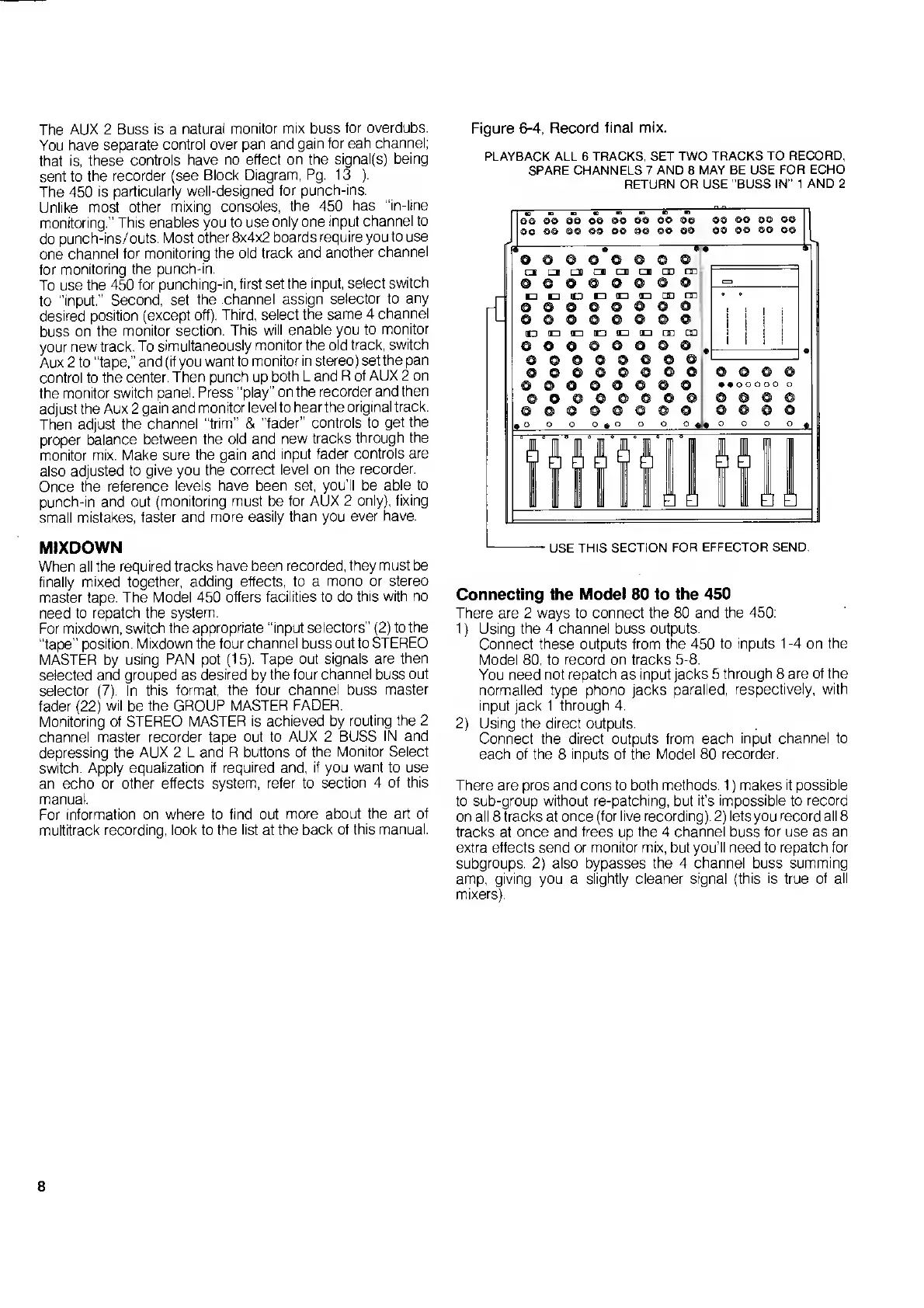
Figure
6-4,
Record
final
mix.
PLAYBACK
ALL
6
TRACKS,
SET
TWO
TRACKS
TO
RECORD,
SPARE
CHANNELS
7
AND
8
MAY
BE
USE
FOR
ECHO
RETURN
OR
USE
“BUSS
IN”
1
AND
2
USE
THIS
SECTION
FOR
EFFECTOR
SEND.
Connecting
the
Model
80
to
the
450
There
are
2
ways
to
connect
the
80
and
the
450:
1)
Using
the
4
channel
buss
outputs.
Connect
these
outputs
from
the
450
to
inputs
1
-4
on
the
Model
80,
to
record
on
tracks
5-8.
You
need
not
repatch
as
input
jacks
5
through
8
are
of
the
normalled
type
phono
jacks
paralled,
respectively,
with
input
jack
1
through
4.
2)
Using
the
direct
outputs.
Connect
the
direct
outputs
from
each
input
channel
to
each
of
the
8
inputs
of
the
Model
80
recorder.
There
are
pros
and
cons
to
both
methods.
1)
makes
it
possible
to
sub-group
without
re-patching,
but
it's
impossible
to
record
on
all
8
tracks
at
once
(for
live
recording).
2)
lets
you
record
all
8
tracks
at
once
and
frees
up
the
4
channel
buss
for
use
as
an
extra
effects
send
or
monitor
mix,
but
you’ll
need
to
repatch
for
subgroups.
2)
also
bypasses
the
4
channel
buss
summing
amp,
giving
you
a
slightly
cleaner
signal
(this
is
true
of
all
mixers).
8

Related product manuals