EasyManua.ls Logo

Fostex 450 - Section 6 Multitrack Applications; Recording Basic Tracks; Overdubbing and Monitoring

Fostex 450
18 pages
Print Icon
To Next Page IconTo Next Page
To Previous Page IconTo Previous Page
Loading...
section
6
MULTITRACK
APPLICATIONS
Multitrack
recording
is
generally
considered
to
be
the
process
of
recording
a
performance
in
sequence,
building
tracks
one
or
more
at
a
time,
then
reviewing,
changing,
and
adding
new
ideas,
until
each
part
is
idealized.
A
single
performer
can
thus
create
an
entity
not
possible
in
real
time,
or
individuals
in
a
group
may
perform
as
many
(or
few)
“takes”
as
necessary
without
imposing
on
the
others.
When
all
tracks
have
been
satisfactorily
recorded,
one
can
take
whatever
time
is
required
to
combine
them
into
an
artistic
composite
in
the
"mixdown”
process.
Even
at
this
point,
flexibilities
are
available
to
change
the
sound
or
character
of
the
separate
tracks
by
means
of
electronic
effects.
Further,
a
performer
not
available
at
the
initial
recording
date
may
be
included
hours,
days
or
weeks
later.
It
is
this
process
that
the
commercial
recording
companies
have
come
to
rely
on,
both
in
terms
of
economics
as
well
as
artistic
flexibility.
The
“personal
multitrack”
concept
of
Fostex
has
made
this
process
available
to
the
independent
musician.
Typically,
the
procedure
begins
with
a
basic
rythm
track
which
provides
the
“reference”
for
the
sections
to
come.
Unlike
ordinary
real-time
recording
in
mono
or
stereo,
relative
balance
of
the
instruments
or
ensemble
is
of
no
concern
during
the
recording
phase
(unless
they
are
combined
on
a
given
track).
Rather,
an
emphasis
is
made
in
getting
the
maximum
undistorted
level
on
each
track
in
the
interest
of
maximizing
signal-to-noise
ratios.
Final
balance
is
achieved
during
mix-
down
or
re-recording,
and
the
end
product
is
a
conventional
mono
or
stereo
tape.
While
specifically
designed
to
work
with
the
Fostex
Model
80
and
Model
20
recorders,
the
mixer
will
interface
satisfactorily
with
most
makes
of
recorders,
provided
that
levels
are
matched
correctly.
RECORDING
BASIC
TRACKS
The
recording
of
signal
onto
separate
tracks
is
reasonably
straight-forward.
Once
levels
have
been
set,
route
the
inputs
by
way
of
the
channel
buss
(7)
and
pan
pot
(8)
to
whichever
tracks
are
selected.
For
four
channel
recording,
output
busses
correspond
to
tracks
1,
2,
3
and
4,
for
the
eight
track
patch
shown
below,
they
are
also
applied
to
tracks
5,
6,
7
and
8
respectively.
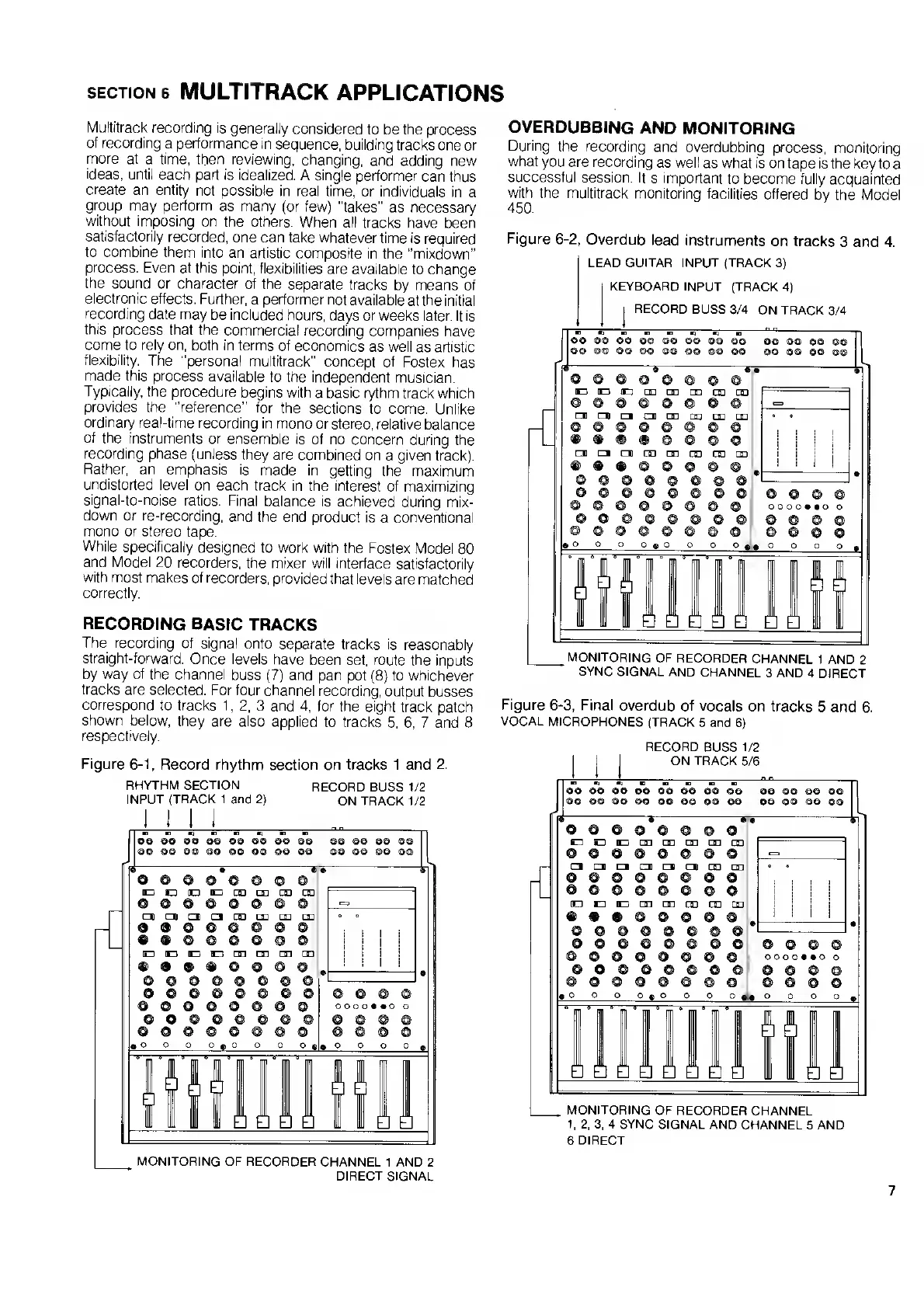
Figure
6-1,
Record
rhythm
section
on
tracks
1
and
2.
RHYTHM
SECTION
RECORD
BUSS
1/2
INPUT
(TRACK
1
and
2}
ON
TRACK
1/2
OVERDUBBING
AND
MONITORING
During
the
recording
and
overdubbing
process,
monitoring
what
you
are
recording
as
well
as
what
is
on
tape
is
the
key
to
a
successful
session.
It
s
important
to
become
fully
acquainted
with
the
multitrack
monitoring
facilities
offered
by
the
Model
450.
Figure
6-2,
Overdub
lead
instruments
on
tracks
3
and
4.
LEAD
GUITAR
INPUT
(TRACK
3)
KEYBOARD
INPUT
(TRACK
4)
|
RECORD
BUSS
3/4
ON
TRACK
3/4
SYNC
SIGNAL
AND
CHANNEL
3
AND
4
DIRECT
Figure
6-3,
Final
overdub
of
vocals
on
tracks
5
and
6.
VOCAL
MICROPHONES
(TRACK
5
and
6)
RECORD
BUSS
1/2
1,
2,
3,
4
SYNC
SIGNAL
AND
CHANNEL
5
AND
6
DIRECT
7

Related product manuals