EasyManua.ls Logo

Fostex G16S - Page 33

Fostex G16S
107 pages
Print Icon
To Next Page IconTo Next Page
To Previous Page IconTo Previous Page
Loading...
1)
Input
a
lOKHz
signal
through
a
tone-burst
generator
(100
msec
ON,
500
msec
~
1
sec
OFF)
and
adjust
the
level
of
tone-burst
signal
for-50dBV
at
G24S/G16S
output
jack.
2)
Route
the
signal
at
TP3
of
R/P
AMP
PCB
Assy
through
a
band
pass
filter
(BPF)
with
the
comer
frequencies
at
20Hz
and
200Hz
and
at
least
a
12dB/octave
roll-off
characteristics.
Then,
route
the
output
signal
from
BPF
to
an
oscilloscope.
3)
Put
G24S/G16S
in
the
REC
mode.
4)
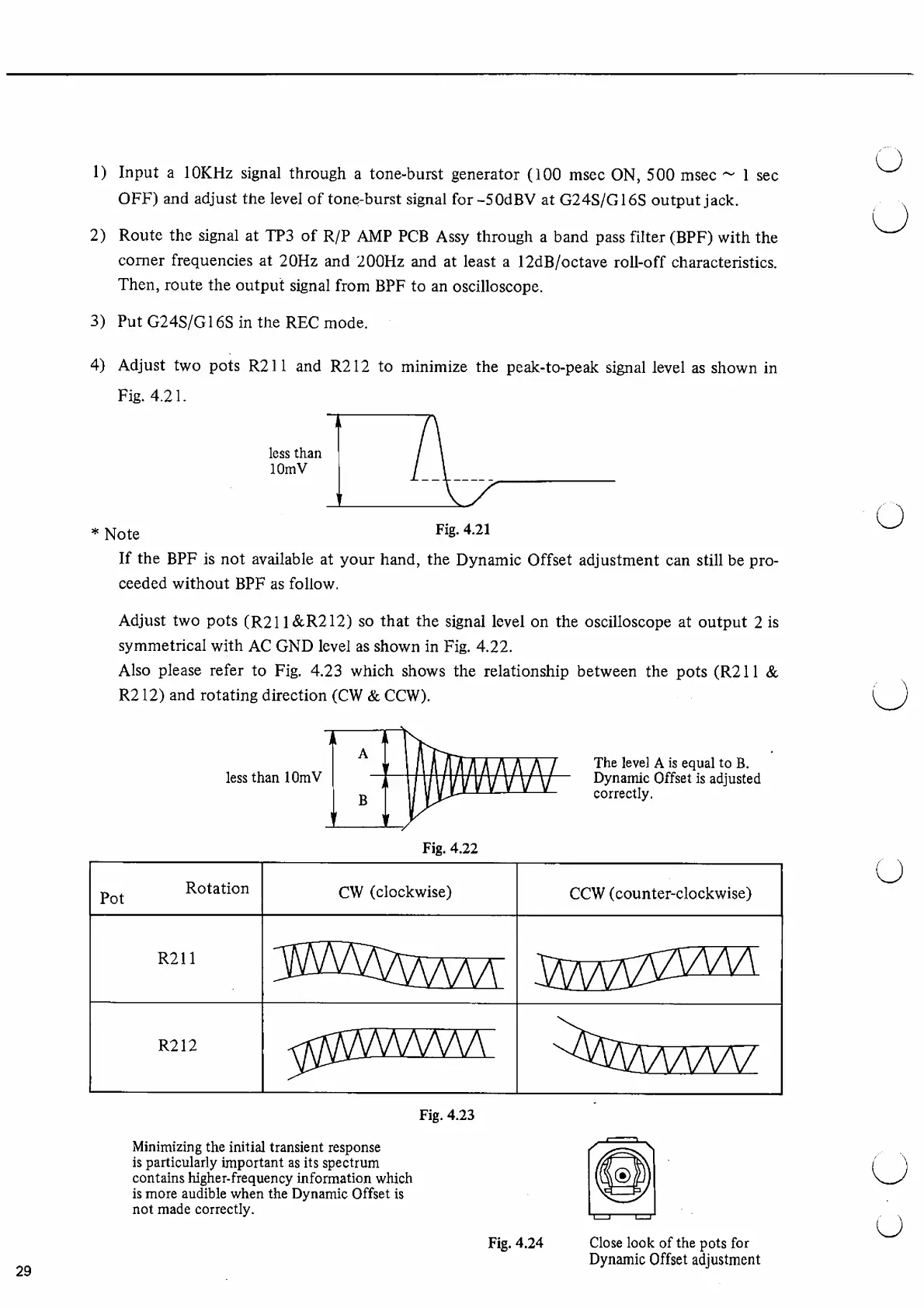
Adjust
two
pots
R211
and
R212
to
minimize
the
peak-to-peak
signal
level
as
shown
in
Fig.
4.21.
*
Note
Fi
S-
421
If
the
BPF
is
not
available
at
your
hand,
the
Dynamic
Offset
adjustment
can
still
be
pro
ceeded
without
BPF
as
follow.
Adjust
two
pots
(R211&R212)
so
that
the
signal
level
on
the
oscilloscope
at
output
2
is
symmetrical
with
AC
GND
level
as
shown
in
Fig.
4.22.
Also
please
refer
to
Fig.
4.23
which
shows
the
relationship
between
the
pots
(R211
&
R2
12)
and
rotating
direction
(CW
&
CCW).
The
level
A
is
equal
to
B.
Dynamic
Offset
is
adjusted
correctly.
Minimizing
the
initial
transient
response
is
particularly
important
as
its
spectrum
contains
higher-frequency
information
which
is
more
audible
when
the
Dynamic
Offset
is
not
made
correctly.
Fig.
4.24
Close
look
of
the
pots
for
Dynamic
Offset
adjustment
29

Other manuals for Fostex G16S

Related product manuals