It is of utmost importance that you have a clear understanding of the type
of wheel securing method employed on your bicycle. It is essential to know
how to securely fasten the wheels and apply the appropriate clamping
force to ensure their safety. It is highly recommended to consult your
dealer for proper guidance on the correct procedure for wheel removal
and installation, as well as to obtain any relevant manufacturer's
instructions that may be available.
Riding with an improperly secured wheel can lead to wobbling or
the wheel falling off the bicycle, resulting in serious injury or death.
Therefore, it is crucial to:
1. Seek assistance from your dealer to ensure you know how to
safely install and remove your wheels.
2. Understand and correctly follow the proper technique for
securing your wheel in place.
3. Before each ride, check that the wheel is securely clamped in
the dropouts.
4. Ensure that the clamping action properly engages the surfaces
of the dropouts.
WARNING
o not remove or disable the secondary retention device. As the
name implies, it serves as a backup in case the wheel is not
secured correctly. Removing or disabling the secondary retention
device may also void the warranty. However, secondary retention
devices should not substitute for correctly securing your wheel.
Failure to properly secure the wheel can result in loss of control
and serious injury or death.
WARNING
1. FRONT WHEEL SECONDARY RETENTION DEVICES:
Most bicycles utilize a secondary wheel retention device on the front fork
to reduce the risk of the wheel disengaging if it is incorrectly secured.
These devices can be categorized as:
a. Clip-on type: This is a part that the manufacturer attaches to the front
wheel hub or front fork.
b. The integral type of front fork dropouts are formed by molding, casting,
or machining them into the outer face.
23 24
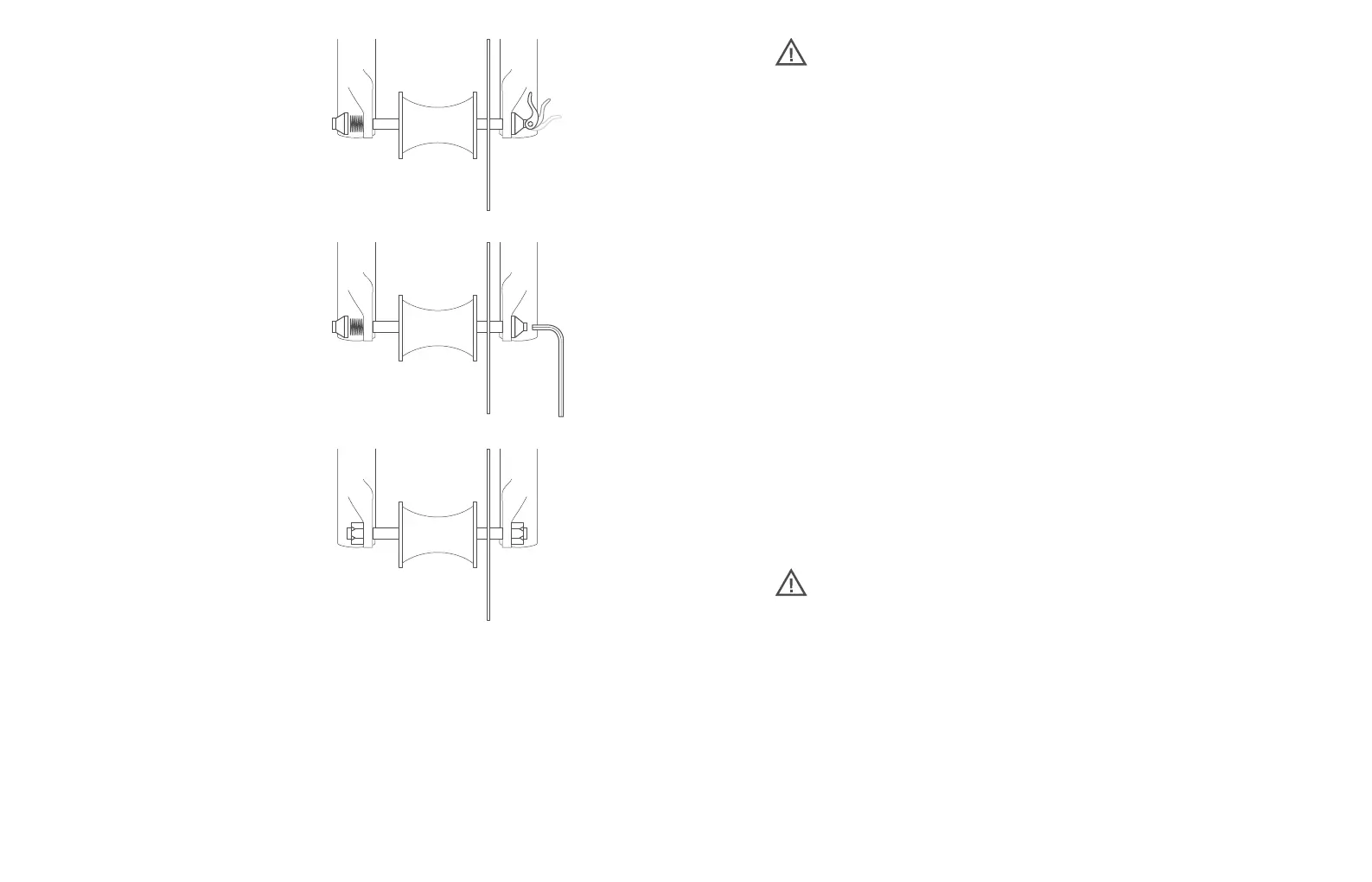
A hollow axle with a shaft,
known as a "skewer," running
through it. This skewer has an
adjustable tension nut on
one end and an over-center
cam on the other.
A hollow axle with a shaft
skewer running through it. This
skewer has a nut on one end
and a fitting for a hex key or a
lock lever on the other.
Hex nuts or hex key bolts
that are threaded onto or
into the hub axle.
3.
2.
1.



 To Next Page