
 Need help?
Do you have a question about the Freewing F 18E and is the answer not in the manual?
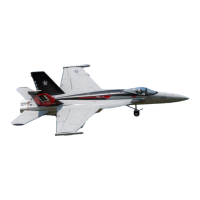
Overview of the Freewing F/A-18 Super Hornet EDF jet and its features.
Important safety warnings and guidelines for operating the model aircraft.
Steps and procedures for assembling the model aircraft.
Instructions for setting up the control surfaces and radio system.
Guidance on determining and setting the correct center of gravity.
Essential safety guidelines to follow before each flight.
Detailed instructions for safe charging, handling, and use of Li-Poly batteries.
Broad safety statements regarding model aircraft operation and user responsibility.
Applying epoxy and attaching the main wing panels to the fuselage.
Securing the wing into its designated position on the fuselage.
Verifying the alignment of the wing with the fuselage and cleaning excess epoxy.
Plugging in the servo connector and wing tip light, ensuring correct polarity.
Carefully routing connected wires and plugs into the fuselage slots.
Securing the elevators to the fuselage using supplied wood screws.
Attaching the nose cone using appropriate adhesive.
Using epoxy to attach vertical fins, ensuring light wires are properly routed.
Pushing drop tanks into the tabs on the wing for attachment.
Connecting the 7-channel receiver to the servo wires at the cockpit opening.
Installing flight batteries and connecting them using Deans connectors.
Configuring the Spektrum DX-7 transmitter, inhibiting AUX2 and FLAP.
Setting wing type selections to OFF on the transmitter.
Setting control surfaces to individual D/R switches.
Configuring servo reversing for specific channels on the transmitter.
Setting dual rates and exponential values for ailerons.
Setting dual rates and exponential values for elevators.
Setting dual rates and exponential values for the rudder.
Programming mix 1 for ELEV to FLAP.
Programming mix 2 for ELEV to AUX2.
Programming mix 3 for AILE to FLAP.
Programming mix 4 for AILE to AUX2.
Setting low and high rates for aileron movement and thrust vector.
Setting low and high rates for elevator movement and thrust vector.
Determining the correct center of gravity range for optimal flight.
Ensuring aircraft assembly, control throws, and operation are correct.
Checking transmitter charge, aircraft balance, and battery security.
Performing a radio range check and selecting appropriate weather for first flights.
Recommendations for takeoffs, landings, and flight maneuvers with the F/A-18E.
Adherence to the official safety code for model aircraft operations.
General provisions of the AMA safety code for model aircraft.
Specific rules and guidelines for radio-controlled aircraft operations.
Regulations concerning night flying, visual contact, and aircraft equipment.
Information on the manufacturer's warranty for material and workmanship defects.



 To Next Page
 General