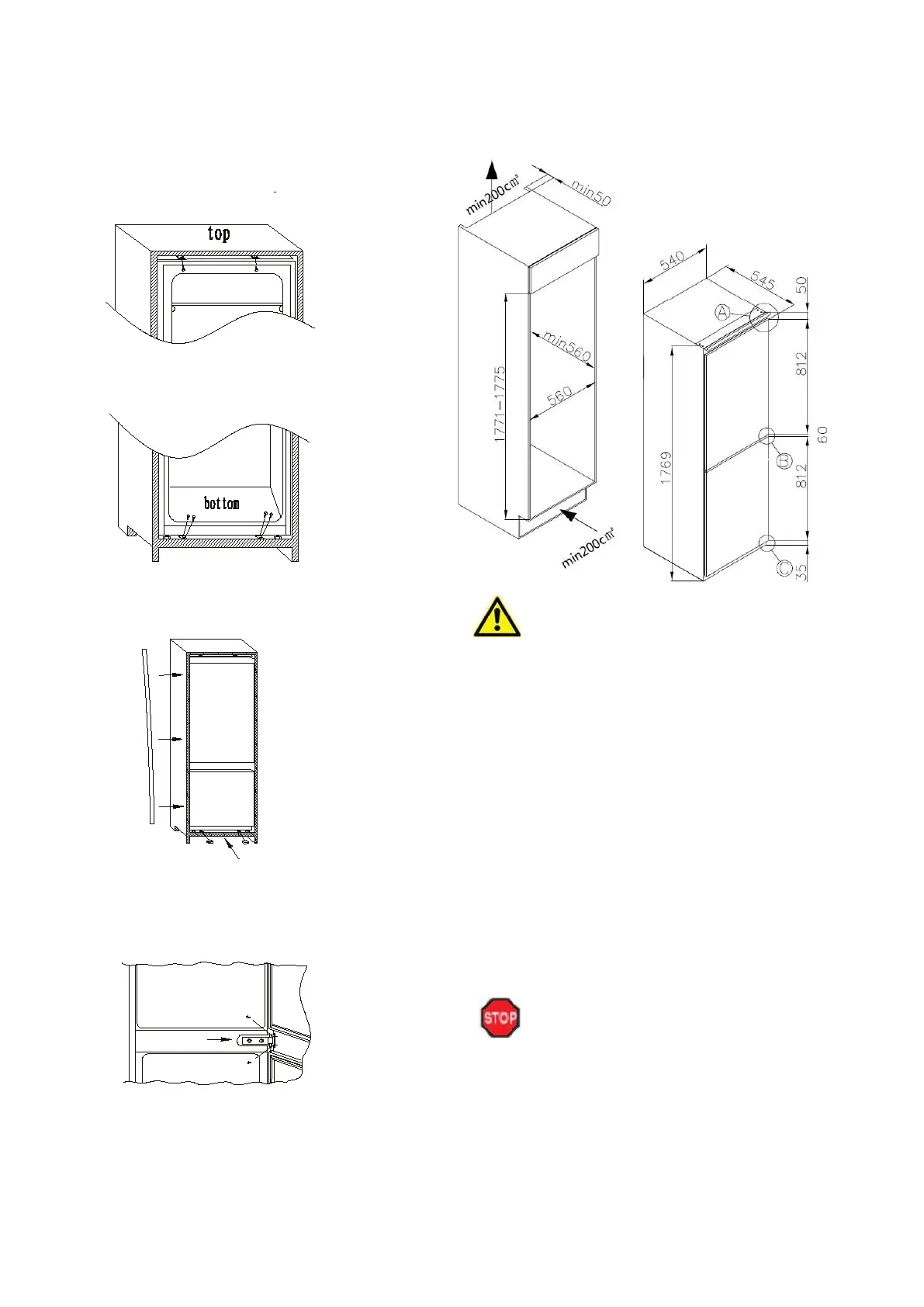
Installation drawing
Do not use washing liquids, sharp or abrasive household
products or any other cleaning agents containing soda.
• Make sure that the pipes for the circulation of the
refrigerant are not damaged in any way during installation
of the appliance.
• The appliance must only be used for the purpose for which
it is intended.
• The appliance must be placed on a firm, level surface.
This is the only way to ensure that the refrigerant can
circulate freely and thus ensure that your appliance will
work efficiently.
• If possible, place your appliance in a cool, well-aired,
dry room.
• Do not place your appliance in direct sunlight, nor in a
room at high temperature.
• Do not place your appliance in the vicinity of any sources
of direct heat such as heating, ovens, cooking stove etc.
(This would mean the compressor would have to work
harder and as a result the power consumption would be
considerably higher).
Do not place any appliances, such as
microwaves, toasters etc. which give off heat on the
appliance.
• Never obstruct the ventilation grille.
• Always pull out the plug itself and never pull the cable
when cutting the appliance off from the mains supply.
• Leave the appliance standing in its final position for
at least 2 –4 hours before switching it on, so that the
circulation of the refrigerant stabilises and no
operating problems occur.
2) After ensuring the match between
appliance door and column door, then screw
the appliance upper part to the cabinet.
3) Screw the appliance lower part.
4) Fit the seal to the appliance, cut off the
excessive part if necessary. Fit the bottom
parts with plastic covers.
5) Use a cross-screwdriver to loosen the
connecting pin underneath the right middle
hinge, and adjust to screw onto the right
cabinet wall.
7



 To Next Page