EasyManua.ls Logo

Fridgemaster MC50160 - Using Your Fridge Freezer; Adjusting the Temperature; Noises Inside the Fridge Freezer

Fridgemaster MC50160
12 pages
Print Icon
To Next Page IconTo Next Page
To Previous Page IconTo Previous Page
Loading...
USING
YOUR
FRIDGE
FREEZER
Operating
instructions
Switching
on
your
Fridge
Freezer
1.
Before
your
Fridge
Freezer
is
plugged
in,
open
the
fridge
door
and
adjust
the
thermostat
control
to
the
highest
setting.
2.
Once
the
Fridge
Freezer
has
cooled
down,
adjust
the
thermostat
control
to
a
suitable
setting.
Adjusting
the
temperature
To
change
the
internal
temperature
of
the
Fridge
Freezer
use
the
control
dial,
located
inside
the
fridge.
The
recommended
setting
at
normal
room
temperature
is
3-4.
The
Fridge
Freezer
may
not
operate
at
the
correct
temperature
if
it
is
in
a
particularly
hot
or
cold
room
or
if
you
open
the
Fridge
Freezer
doors
very
often.
Is
the
Fridge
Freezer
cold
enough?
If
you
are
concerned
that
your
Fridge
Freezer
is
not
being
kept
cold
enough,
and
wish
to
check
the
temperature,
you
will
need
a
special
fridge
thermometer
available
from
most
supermarkets
and
hardware
shoes.
Place
the
thermometer
on
the
middle
shelf
of
the
fridge
cabinet
or
the
middle
basket
of
the
freezer,
where
it
can
be
read
easily.
Leave
overnight,
the
temperature
in
the
fridge
should
be
between
2°C
and
5°C
and
-18°C
orlower
in
the
freezer.
See
‘Adjusting
the
temperature’.
|
FRE
196A-216A
D3.indd
3
Noises
inside
the
Fridge
Freezer
If
you
have
not
owned
a
refrigerator
before,
you
may
notice
that
it
makes
some
rather
unusual
noises.
Most
of
these
are
perfectly
normal,
but
you
should
be
aware
of
them!
Gurgling,
whooshing
These
noises
are
caused
by
the
circulation
of
the
refrigerant
liquid
in
the
cooling
system.
It
has
become
more
pronounced
since
the
introduction
of
CFC
Free
gasses.
This
is
not
a
fault
and
will
not
afect
the
performance
of
your
Fridge
Freezer.
Humming,
purring
or
pulsating
This
is
the
compressor
motor
working,
as
it
pumps
the
refrigerant
around
the
system.
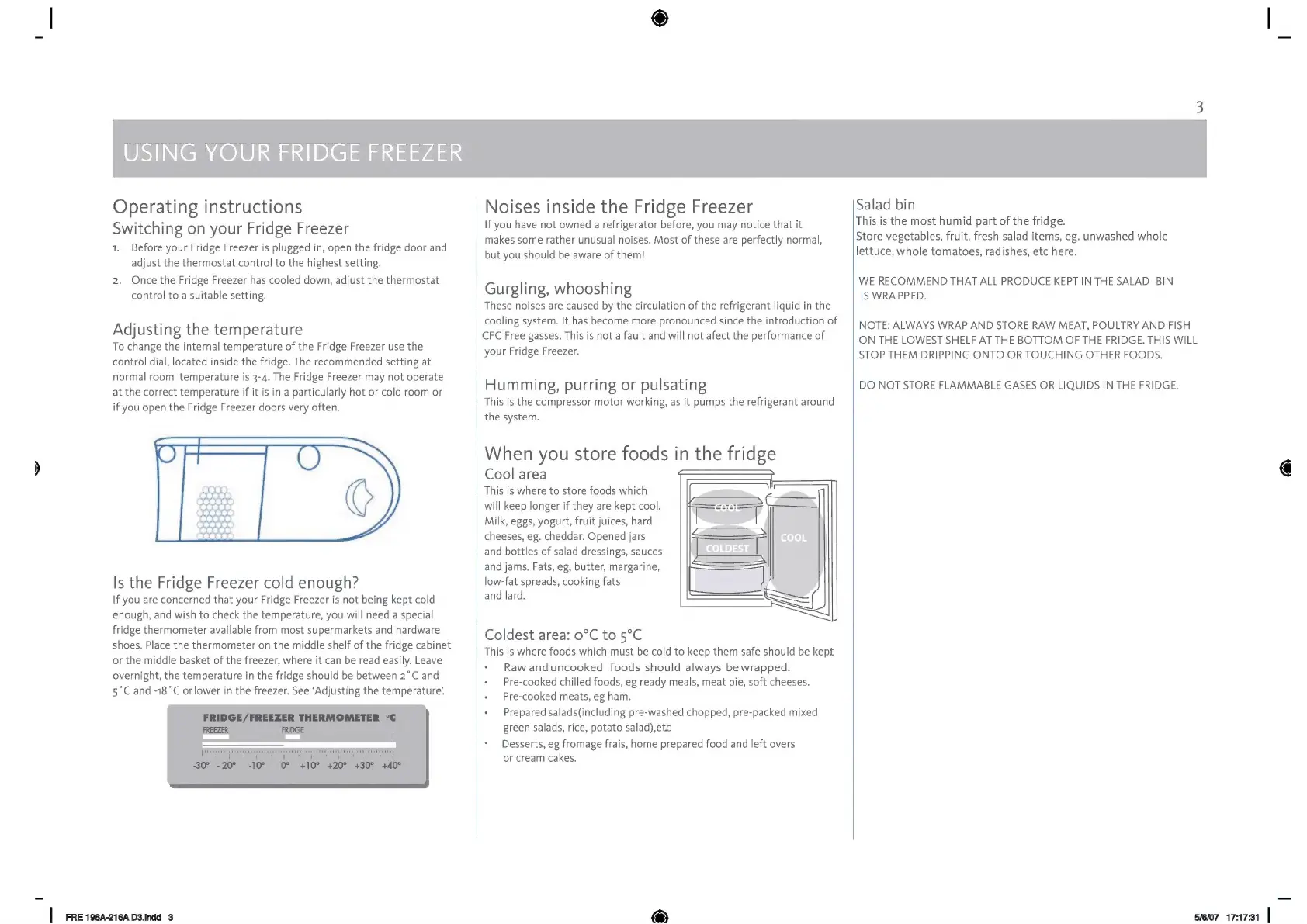
When
you
store
foods
in
the
fridge
Cool
area
This
is
where
to
store
foods
which
will
keep
longer
if
they
are
kept
cool.
Milk,
eggs,
yogurt,
fruit
juices,
hard
cheeses,
eg.
cheddar.
Opened
jars
and
bottles
of
salad
dressings,
sauces
and
jams.
Fats,
eg,
butter,
margarine,
low-fat
spreads,
cooking
fats
and
lard.
Coldest
area:
o°C
to
5°C
This
is
where
foods
which
must
be
cold
to
keep
them
safe
should
be
kept
+
Rawanduncooked
foods
should
always
be
wrapped.
*
Pre-cooked
chilled
foods,
eg
ready
meals,
meat
pie,
soft
cheeses.
+
Pre-cooked
meats,
eg
ham.
+
Prepared
salads(including
pre-washed
chopped,
pre-packed
mixed
green
salads,
rice,
potato
salad),etc
*
Desserts,
eg
fromage
frais,
home
prepared
food
and
left
overs
or
cream
cakes.
Salad
bin
This
is
the
most
humid
part
of
the
fridge.
Store
vegetables,
fruit,
fresh
salad
items,
eg.
unwashed
whole
lettuce,
whole
tomatoes,
radishes,
etc
here.
WE
RECOMMEND
THAT
ALL
PRODUCE
KEPT
IN
THE
SALAD
BIN
IS
WRAPPED.
NOTE:
ALWAYS
WRAP
AND
STORE
RAW
MEAT,
POULTRY
AND
FISH
ON
THE
LOWEST
SHELF
AT
THE
BOTTOM
OF
THE
FRIDGE.
THIS
WILL
STOP
THEM
DRIPPING
ONTO
OR
TOUCHING
OTHER
FOODS.
DO
NOT
STORE
FLAMMABLE
GASES
OR
LIQUIDS
IN
THE
FRIDGE.
5/6/07
17:17:31

Related product manuals