Adjusting the seat post cam action mechanism
The action of the cam squeezes the seat collar around the seat post to hold the seat
post securely in place. The amount of clamping force is controlled by the tension
adjusting nut. Turning the tension adjusting nut clockwise while keeping the cam
lever from rotating increases clamping force; turning it anticlockwise while keeping the
cam lever from rotating reduces clamping force. Less than half a turn of the tension
adjusting nut can make the dierence between safe and unsafe clamping force.
WARNING: The full force of the cam action is needed to clamp the seat post
securely. Holding the nut with one hand and turning the lever like a wing nut with
the other hand until everything is as tight as you can get it will not clamp the seat
post safely.
WARNING: If you can fully close the cam lever without wrapping your ngers
around the seat post or a frame tube for leverage, and the lever does not leave a
clear imprint in the palm of your hand, the tension is insucient. Open the lever;
turn the tension adjusting nut clockwise a quarter turn; then try again.
C. Brakes
There are three general types of bicycle brakes:
I. rim brakes, which operate by squeezing the wheel rim between two brake pads;
II. disc brakes, which operate by squeezing a hub-mounted disc between two brake pads;
III.
internal hub brakes.
All three can be operated by way of a handlebar mounted lever.
On some models of bicycle, the internal hub
brake is operated by pedalling backwards.
This is called a coaster brake and is described
in Appendix C.
WARNING:
1. Riding with improperly adjusted brakes, worn brake pads, or wheels on which
the rim wear mark is visible is dangerous and can result in serious injury or death.
2. Applying brakes too hard or too suddenly can lock up a wheel, which could
cause you to lose control and fall. Sudden or excessive application of the front
brake may pitch the rider over the handlebars, which may result in serious injury
or death.
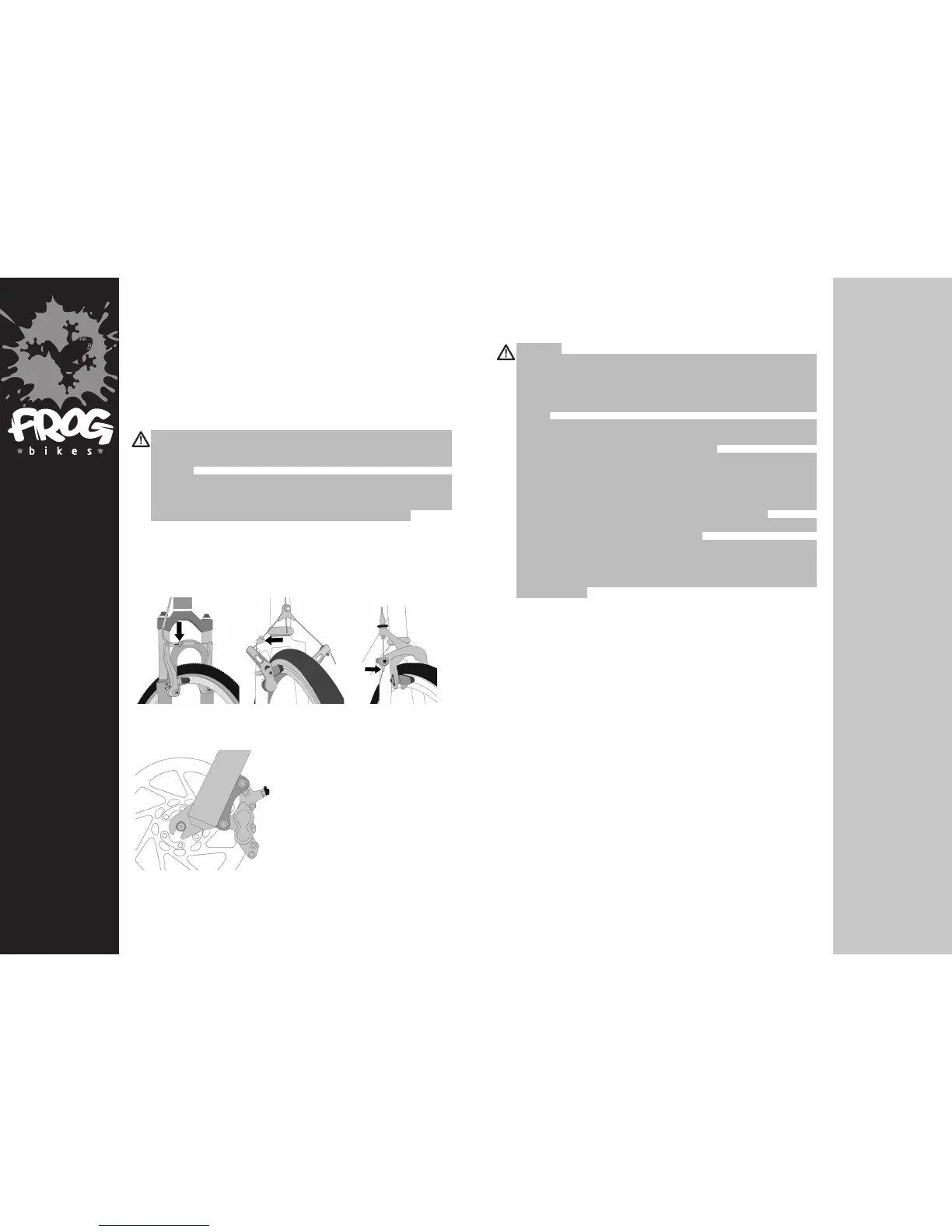
3. Some bicycle brakes, such as disc brakes (g. 11) and linear-pull brakes
(g. 12), are extremely powerful. Take extra care in becoming familiar with these
brakes and exercise particular care when using them.
4. Some bicycle brakes are equipped with a brake force modulator, a small,
cylindrical device through which the brake control cable runs and which is
designed to provide a more progressive application of braking force. A modulator
makes the initial brake lever force more gentle, progressively increasing force until
full force is achieved. If your bike is equipped with a brake force modulator, take
extra care in becoming familiar with its performance characteristics.
5. Disc brakes can get extremely hot with extended use. Be careful not to touch
a disc brake until it has had plenty of time to cool.
6. See the brake manufacturer’s instructions for operation and care of your
brakes, and for when brake pads must be replaced. If you do not have the
manufacturer’s instructions, see your stockist or contact the brake manufacturer.
7. If replacing worn or damaged parts, use only manufacturer-approved genuine
replacement parts.
C1. Brake Controls and Features
It’s very important to your safety that you learn and remember which brake lever
controls which brake on your bike. Traditionally, in the UK right brake lever controls the
Front brake and the left brake lever controls the Rear brake; but, to make sure your
bike’s brakes are set up the correct way for your country, squeeze one brake lever
and look to see which brake, front or rear, engages. Now do the same with the other
brake lever. If you need them swapped over, please ask your Frog Bikes stockist to
do this.
Make sure your hands can reach and squeeze the brake levers comfortably. If your
hands are too small to operate the levers comfortably, consult your stockist before
riding the bike. The lever reach may be adjustable; or you may need a dierent brake
lever design.
Most rim brakes have some form of quick-release mechanism to allow the brake
pads to clear the tyre when a wheel is removed or reinstalled. When the brake quick
release is in the open position, the brakes are inoperative. Ask your stockist to make
sure that you understand the way the brake quick release works on your bike (see
gs. 12, 13. 14 & 15) and check each time to make sure both brakes work correctly
before you get on the bike.
4/ TECHNICAL INFORMATION


 To Next Page