Fastener Torque Specications
Correct tightening torque of threaded fasteners is very important to your safety. Always
tighten fasteners to the correct torque. In case of a conict between the instructions
in this manual and information provided by a component manufacturer, consult with
your stockist or the manufacturer’s customer service representative for clarication.
Bolts that are too tight can stretch and deform. Bolts that are too loose can move and
fatigue. Either mistake can lead to a sudden failure of the bolt. Always use a correctly
calibrated torque wrench to tighten critical fasteners on your bike. Carefully follow
the torque wrench manufacturer’s instructions on the correct way to set and use the
torque wrench for accurate results.
Getting Started with a Tadpole Balance Bike
A Tadpole Balance Bike is the easiest way for a child to learn to ride a bike. Learning
on a Tadpole Balance Bike separates the need to pedal and balance at the same
time, and so very young children can learn to ride safely by learning the balance rst
without the need for pedalling. The rate at which children develop the necessary
motor skills for balance may vary greatly, so don’t worry if your child can’t manage it
straight away – just keep trying.
Follow these simple steps to ride a Tadpole Balance Bike safely:
• Choose a at place for their rst lesson with plenty of space and nothing for the
child to bump into. This can be indoors or outdoors on rm grass.
• Help the child on to their bike and support them by holding them under the armpits
from behind.
• If you have purchased a parent handle, connect this under the seat.
• Make sure the child holds the handlebars – it’s the fastest way to learn.
• Younger children will often stand over the bike initially, rather than let the saddle
take their weight. Try and encourage them to sit down.
• It’s usual for your child to waddle cautiously at rst. With practice they will gain
condence and will learn to stride and in time ‘scoot’ by lifting up their legs.
• Remember young children do not yet possess the judgement to assess risks so
they must always be closely supervised.
APPENDIX F
Recommended tools for proper bicycle maintenance
• Torque wrench with lb•in or N•m gradations
• 2, 4, 5, 6, 8 mm allen wrenches
• 9, 10, 15 mm open-end wrenches
• 15 mm box end wrench
• Socket wrench, 14, 15, and 19 mm socket
• T25 torx wrench
• No. 1 phillips screwdriver
• Bicycle tube patch kit, tyre pump with gauge, and tyre levers
• Special high pressure air pump for rear shock or suspension fork
Note: Not all bikes require all these tools
APPENDIX D APPENDIX E
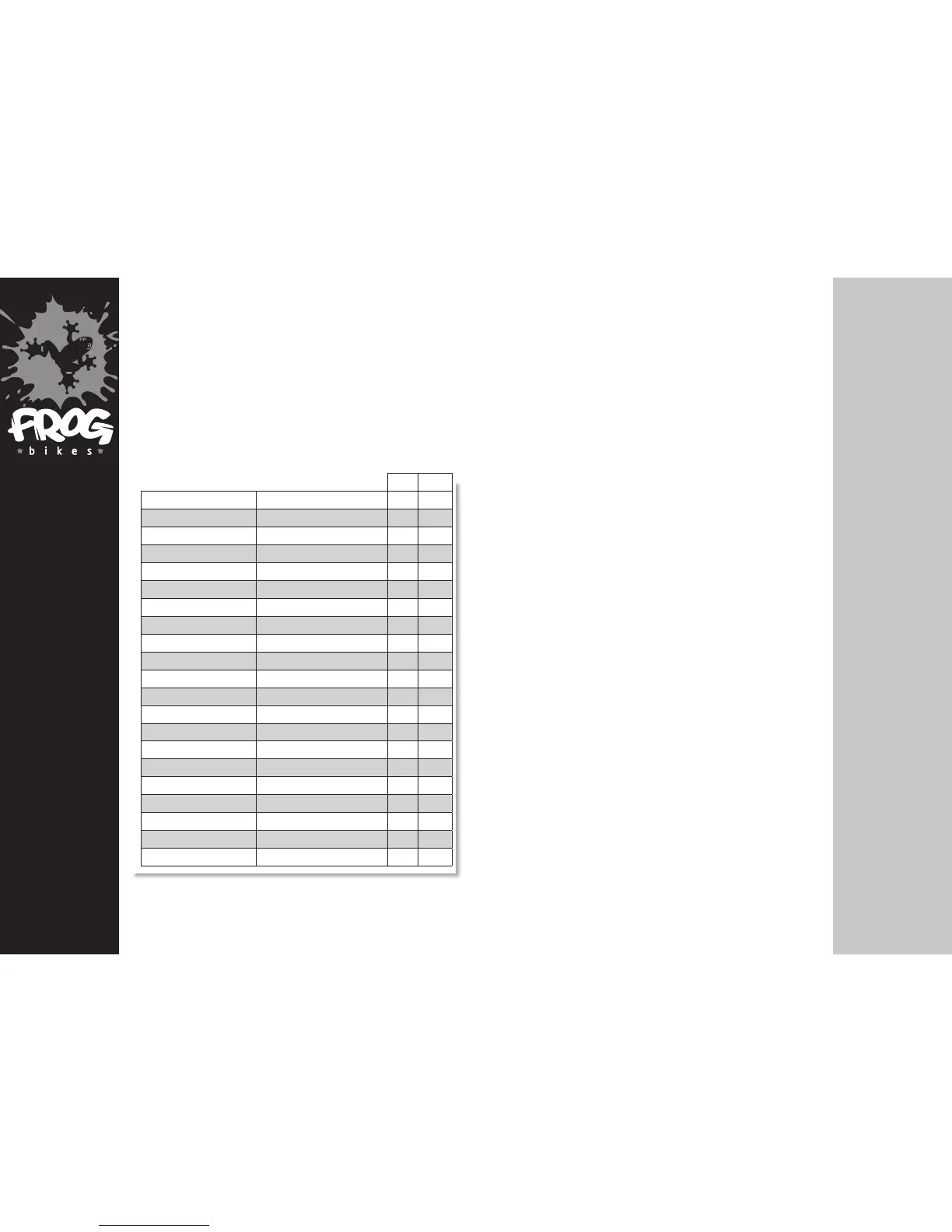
In-lbf NM
Seat posts 2-bolt clamp serrated 100 11
Seat posts 2-bolt clamp non serrated 80 9.0
Pedal-to-crank Interface 304 34.3
Forks 80 9.0
Cranks Pro-Wheel generic 305 34
Chain-ring bolts Alloy 85 9.4
Stem Handlebar 4 bolt 45 5.1
Shimano shifter Revo shift 40 4.5
Rear derailleur Mounting Road/Hybrid 50 5.4
Front derailleur Mounting bolt Road or Mountain 44 5
Seat tube collar 55 6.2
Tektro brake lever 40 4.5
Tektro V brake 52 5.9
Brake pad 43 4.9
Rear axle 133 15
Freewheel 261 29.5
Nutted axle 200 22.6
Derailleur hanger Alloy 60 6.8
Water bottle cage 35 4
Bottom bracket cable guide 25 2.8
Mudguard (fender) Mounting bolts 35 4


 To Previous Page