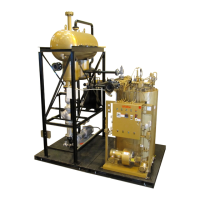
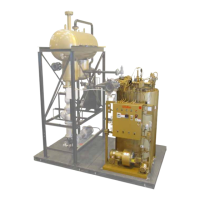
FT-C Vertical Electric Thermal Fluid Heater Manual 12 2013 ISSUE 1
f) The pump suction pressure should be checked periodically, under similar operating conditions.
A vacuum reading on the suction gauge indicates that the screen must be cleaned. For isolating
purposes, globe, wedge, gate, ball, or other shut-off valves should be used. When there is a
likelihood that some manual balancing will be required, a ball or globe valve should be used.
g) Manual control and isolating valves should be the anged or weld type, manufactured from cast
or forged steel or ductile iron, with internals and gland seals made from materials suitable for
use with high temperature uids.
h) When ordering valves, the maximum possible service temperature and type of uid must be
indicated on the order.
j) A partial list of manufacturers known to market valves of acceptable quality follows:
1. Ari Arimaturen
2. Velan
3. Vogt Machine Company
4. Worcester Valve Company
k)
1. Because of the widely varied processes Fulton Thermal Fluid Heaters are used in, it is
not possible to set down specic rules for the selection of automatic uid control valves.
Generally, these valves must satisfy the materials and construction requirements described
above.
2. The type of operation and design of porting are governed by the degree of control required
as well as the particular application.
l)
1. When process ow requirements do not match heater ow requirements, a by-pass valve
must be installed.
2. If the process ow will vary with the system load, a suitable bypass system can be
recommended by Fulton Ltd.
a) Upon completion of the installation, a pneumatic test not exceeding 0.5 barg should be
conducted. Soap tests should be made at all welds and joints to ensure that the system is free
from leaks.
b) Under no circumstances should the system be lled with water. Make sure that the air supply is
as free from moisture as possible.
c) The most satisfactory method of testing is to introduce bottled nitrogen through a pressure
control valve. Check pressure ratings on all the equipment in the system to make sure that it is
capable of withstanding the pressure involved.
d) The time needed to be spent during boilout directly corresponds to the amount of moisture in
the system. Boilout can take anywhere from two to three days to complete. Pressure testing on
the system should be done by means of an inert gas, such as nitrogen, or by an air compressor
producing dry air (air with a dew point of 10°C or less).



 To Next Page