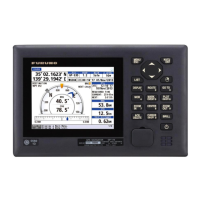
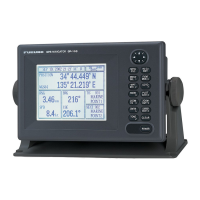
The FURUNO GP-320B is a GPS receiver with Wide Area Augmentation System (WAAS) capability, designed to provide accurate position information for various applications. It supports Satellite Based Augmentation System (SBAS) providers, including WAAS (North America), MSAS (Japan), EGNOS (Europe), and GAGAN (India), offering enhanced position accuracy, typically better than three meters. The device is intended for use with external equipment such as FURUNO NavNet series displays, Multi Display RD-30, and Echo Sounder LS-6100, or other non-NavNet equipment via a junction box.
Function Description:
The GP-320B functions as a GPS receiver, acquiring and processing signals from GPS satellites to determine its position, speed, and time. Its WAAS capability allows it to receive differential correction data from geostationary satellites, significantly improving the accuracy of the reported position. The device outputs standard NMEA 0183 Ver 2.30 data sentences, including GPDTM (Geometric datum), GPGGA (GPS fix data), GPZDA (UTC time and date), GPGLL (Geographic position, latitude and longitude), GPVTG (Course over ground and ground speed), and GPRMC (Recommended minimum specific GPS/TRANSIT data). It can also receive DGPS correction data in RTCM SC-104 format and control commands. The output data priority is from high to low, with GPDTM data attached in front of GPGGA, GPGLL, and GPRMC when those sentences are output. The device supports various default settings for initial latitude/longitude, date/time, antenna height, almanac and ephemeris data, local zone time, PDOP, geometric datum (WGS84), mask elevation, satellite disabling, smoothing and dynamic coefficients, data output cycle, DGPS setting parameters, GEO satellite/provider ID, WAAS availability, and Type 0 messages.
Important Technical Specifications:
- Receiving Channels: 12 channels parallel, 12 satellites tracking for GPS; 1 channel for WAAS.
- Rx Frequency: 1575.42 MHz.
- Rx Code: C/A code, WAAS.
- Position Fixing System: All in view, 8-state Kalman filter.
- Position Accuracy:
- GPS: 10 m (95% of the time, HDOP 4)
- DGPS: 5 m (95% of the time, external data required)
- WAAS: 3 m (95% of the time)
- Tracking Velocity: 999 kt.
- Position-fixing Time: Warm start: 12 s approx.; Cold start: 90 s approx.
- Position Update Interval: 1 s.
- I/O Interface:
- Data format: IEC 61162-1 (NMEA 0183 Ver 2.30).
- Output data: DTM, GGA, ZDA, VTG, GLL, RMC.
- Input data: DGPS: RTCM SC-104, Control command.
- Power Supply: 12-24 VDC; 105-55 mA.
- Environmental Conditions:
- Ambient Temperature: -25°C to +70°C.
- Relative Humidity: 95% at 40°C.
- Waterproofing: IEC 60529: IPX6.
- Vibration: IEC 60945.
- Coating Color: N9.5.
- Dimensions: Antenna unit has a diameter of 89 mm and a height of 119 mm.
- Cable Length: Standard 10 m cable. Optional extension cables (10 m each) can extend the total length up to 50 m.
- Weight: 0.80 kg (including cable).
Usage Features:
The GP-320B is designed for straightforward integration into existing marine navigation systems.
- Connectivity: It can be directly connected to FURUNO NavNet equipment via the DATA1 port. For Multi Display RD-30, it connects to the AUX port, and for Echo Sounder LS-6100, it connects to the NMEA port, both requiring 12-24 VDC power. When connecting to other non-NavNet equipment, the antenna cable's connector must be removed, and crimp-on lugs or similar terminals attached to the cable's cores for connection to a locally supplied junction box.
- RS-422 Signal: The device supports RS-422 signal input for radar/plotter (NMEA 0183 Ver. 2.0) and RS-422 output for correction data from GR-80.
- WAAS Functionality: The WAAS function is inoperative when wired to other equipment as shown in the provided wiring diagram, or when connected to the Multi Display RD-30.
- Mounting Flexibility: The antenna unit can be mounted in three ways: screwed into a pipe (local supply), fixed to a post with an optional mast mounting kit, or screwed into an optional mounting base. Stays are recommended for post or pipe mounting to prevent damage.
- Optimal Mounting Considerations: To ensure optimal GPS signal reception, the antenna should be mounted:
- Out of the radar beam.
- Well away from VHF and Inmarsat antennas to avoid interference.
- Without interfering objects in the line-of-sight to satellites.
- As high as possible to avoid interfering objects and water spray.
- With minimum separation distances from other antenna units (e.g., 3m from LOOP ANTENNA, 1m from RX WHIP ANTENNA, 4m from WHIP ANTENNA (VHF/UHF), 1.5m from WHIP ANTENNA (MF/HF), and 0.5m from TX ANTENNA (MF/HF) depending on mast diameter).
- Waterproofing: When using optional cable assemblies, their connectors must be waterproofed by wrapping them with vulcanizing tape and then vinyl tape, secured with cable-ties.
Maintenance Features:
- Troubleshooting: If "No position data" appears on the display of NavNet equipment, troubleshooting steps include checking for objects obstructing reception, ensuring the antenna cable is firmly fastened, inspecting extension cable junction points for water leakage, and checking the antenna and cable for damage. If issues persist, contacting a dealer is recommended.
- Battery: The antenna unit contains a lithium battery that preserves data when power is off. Its life is approximately 20 years for large vessels (70% operating rate) and 10 years for small vessels (20% operating rate). The unit can still operate with a low battery, but data will not be backed up, leading to a "cold start" condition upon power-up.
- Discarding Product/Battery: The product and its battery must be discarded according to local regulations for industrial waste. For batteries, the + and - terminals should be taped before disposal to prevent short circuits. In the European Union, batteries should be taken to a collection site as per the Batteries Directive 2006/66/EU. In the USA, Ni-Cd and lead-acid rechargeable batteries should be recycled at a collection site according to local laws.

 Need help?

 To Next Page
 General