Need help?
Do you have a question about the GAC ESD5300 Series and is the answer not in the manual?
Details performance metrics like speed range, drift, idle speed, and droop.
Defines supply voltage, polarity, power consumption, and signal ranges.
Covers operating temperature, humidity, and surface finish.
Guidance on using shielded cables for external connections to the ESD control.
Minimizes throttle movement caused by drive train resonance.
Allows speed setting to reduce with increased engine load.
Adjusts starting fuel and acceleration for optimal engine start.
Sets idle speed and engine acceleration/deceleration rates.
Diagnoses and resolves engine speed instability issues.
Addresses issues related to weak speed sensor signals.
Covers protection against electromagnetic interference.
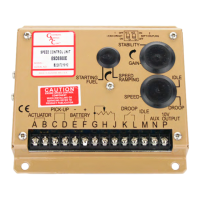
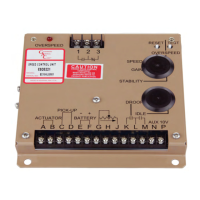
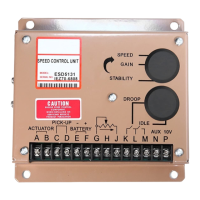
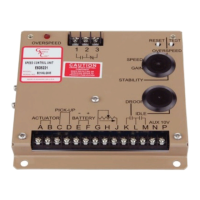
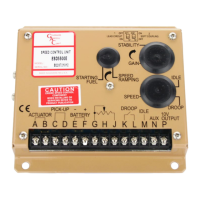
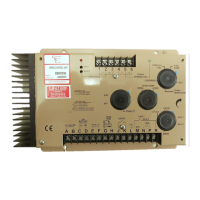
The ESD5300 Series Speed Control Unit is an advanced electronic device designed to precisely regulate engine speed, offering rapid and accurate responses to transient engine loads. This unit is compatible with all GAC Actuators, including the ACB2001, forming a complete closed-loop control system when integrated with a magnetic pickup for speed sensing and a 24 V DC power supply.
The core function of the ESD5300 is to maintain engine speed at a desired set point, even under varying load conditions. It achieves this through a sophisticated control algorithm that continuously monitors engine speed and adjusts the actuator to maintain stability. A key feature is its two-element speed switch, which provides robust control and protection. The unit incorporates speed ramping capabilities, allowing for a smooth transition from idle to operating speed, which is crucial for reducing engine wear and emissions. For starting, it includes a starting fuel control mechanism designed to minimize lower engine exhaust emissions.
The ESD5300 features a unique actuator power drive circuit that ensures efficient and responsive control of the engine actuator. It also supports accessory inputs for load sharing and synchronizing applications, making it versatile for multi-engine setups. Variable speed governing is another integral capability, allowing the engine to operate across a range of speeds as required by the application. Protection against reverse battery connections and transient voltage spikes is built-in, safeguarding the unit from electrical damage. The ESD5340 model further enhances startup performance with an advanced startup circuit specifically designed for large-bore engines.
The ESD5300 is designed for ease of installation and operation. It can be mounted in a control cabinet or an engine-mounted enclosure. For environments where water, mist, or condensation might be present, vertical mounting is recommended to allow fluids to drain away.
The unit offers several adjustable parameters to fine-tune engine performance. These include GAIN, STABILITY, and External Frequency Trim, which are initially set to mid-point positions for ease of startup. The STARTING FUEL adjustment allows users to control the fuel delivery during cranking to achieve optimal starting without excessive smoke. The FUEL RAMPING adjustment then controls the acceleration rate to rated speed, again aiming for quick and smoke-free transitions.
Idle and ramp speeds are easily set using a dedicated IDLE switch and adjustment. The ACCEL and DECEL controls allow for precise manipulation of acceleration and deceleration rates, optimizing engine response and emissions. The internal speed ramping function automatically manages the engine's speed increase from near idle to the set point upon startup. For variable speed applications, a 0-10 V DC variable voltage can be connected to the auxiliary input.
The ESD5300 also features a dual gain function, which is particularly useful for engines exhibiting different stability characteristics at various speeds or when operating with different fuel types (e.g., gaseous fuels). This allows for two independent gain settings that can be switched as needed, ensuring optimal performance across the engine's operating range.
Adjustable chopping frequency (CF ADJ) provides an additional layer of stability enhancement by introducing dither to the actuator, helping to overcome static friction and improve immediate response. An overspeed monitor circuit, with an adjustable trip point, provides critical engine protection. In the event of an overspeed, the unit will shut off the actuator output and change the state of internal relay contacts, which can be used to trigger external shutdown mechanisms. A CRANK TERMINATION circuit ensures that the engine starts and reaches a stable operating speed before the starter motor is disengaged.
While the ESD5300 is designed for robust operation, the manual provides comprehensive troubleshooting guidance for system inoperability and instability. For instance, if the engine governing system fails to function, a series of voltage tests are outlined to diagnose common issues such as incorrect battery power, faulty wiring, or defective speed sensors.
The unit's design incorporates filters and shielding to protect its sensitive circuits from external electromagnetic interference (EMI). For installations where EMI is a concern, the use of shielded cables for all external connections is recommended, with shields grounded to a single point on the ESD case. Mounting the speed control to a grounded metal backplate or within a sealed metal box can further enhance EMI susceptibility.
The manual also emphasizes the importance of proper dip switch settings, particularly for actuator configuration and dead time compensation, to prevent startup engine trouble and ensure optimal performance. Regular checks of these settings are implicitly part of routine maintenance. The unit's internal components are designed for reliability, with 100% functional testing performed during manufacturing.
 General
| Model | ESD5300 Series |
|---|---|
| Operating Temperature Range | -40°C to +85°C |
| Humidity | Up to 95% |
| Input Power | 12 or 24 VDC Battery Systems (Transient & Reverse Voltage Protected) |
| Operating Temperature | -40°C to +85°C |

 To Next Page