Chapter 8: Measurement of Small Signals--Overview
8 - 1
Chapter 8: Measurement of Small Signals
Overview
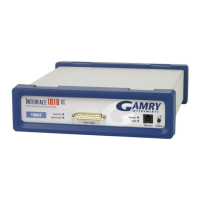
The Interface 1000 is a very sensitive scientific instrument. It can theoretically resolve current changes as
small as 333 femtoamperes (333 x 10
−15
A). To place this current in perspective, 333 fA represents the flow
of about 2 000 000 electrons per second!
The small currents measured by the Interface 1000 place demands on the instrument, the cell, the cables
and the experimenter. Many of the techniques used in higher-current electrochemistry must be modified
when used to measure pA currents. In many cases, the basic physics of the measurement must be
considered.
This chapter will discuss the limiting factors controlling low-current measurements. We offer hints on cell
and system design. The emphasis is on EIS (Electrochemical Impedance Spectroscopy), a highly demanding
application for the Interface 1000.
Measurement System Model and Physical Limitations
To get a feel for the physical limits implied by very sensitive current measurements, consider the equivalent
circuit shown in Figure 8-1. We are attempting to measure the cell impedance given by Z
cell
.
This model is valid for analysis purposes even though the real Interface 1000 circuit topology differs
significantly.
In Figure 8-1:
E
s
is an ideal signal source
Z
cell
is the unknown cell impedance
I
cell
is the “real” cell current
R
m
is the current-measurement circuit’s current-measurement resistance
R
shunt
is an unwanted resistance across the cell
C
shunt
is an unwanted capacitance across the cell
C
in
is the current-measurement circuit’s stray input capacitance
R
in
is the current-measurement circuit’s stray input resistance
I
in
is the measurement circuit’s input current
In the ideal current-measurement circuit R
in
is infinite while C
in
and I
in
are zero. All of the cell current, I
cell
,
flows through R
m
.
With an ideal cell and voltage source, R
shunt
is infinite and C
shunt
is zero. All the current flowing into the
current measurement circuit comes from Z
cell
.
The voltage developed across R
m
is measured by the meter as V
m
. Given the idealities discussed above, you
can use Kirchoff’s and Ohm’s law to calculate Z
cell
:
Z
cell
= E
s
× R
m
/ V
m


 To Next Page