Chapter 8: Measurement of Small Signals--Measurement System Model and Physical Limitations
8 - 2
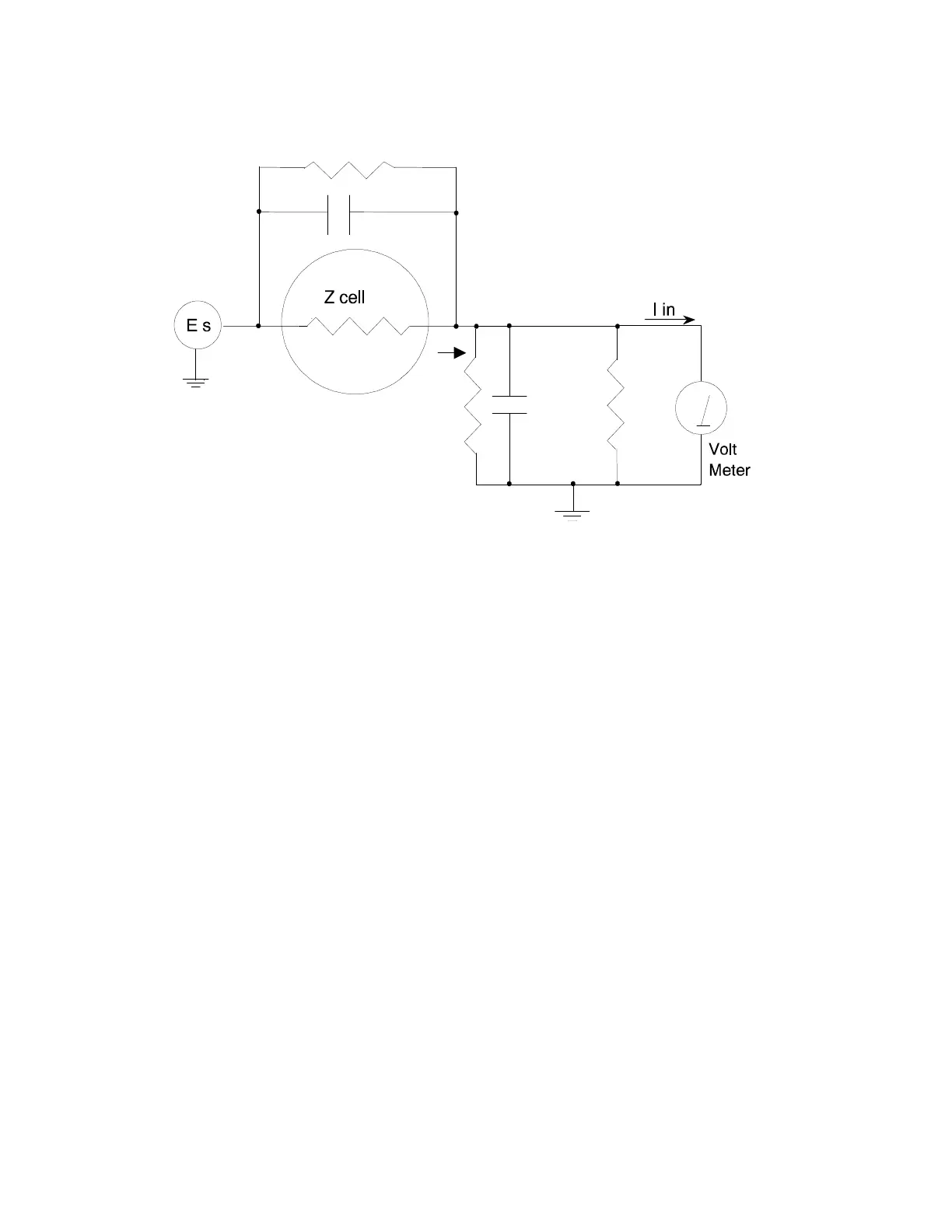
Figure 8-1
Equivalent Measurement Circuit
Icell
C shunt
R shunt
R in
Rm
Unfortunately, technology limits high-impedance measurements because:
Current measurement circuits always have non-zero input capacitance, i.e., C
in
> 0.
Infinite R
in
cannot be achieved with real circuits and materials.
Amplifiers used in the meter have input currents, i.e., I
in
> 0.
The cell and the potentiostat create both a non-zero C
shunt
and a finite R
shunt
.
Additionally, basic physics limits high-impedance measurements via Johnson noise, which is the inherent
noise in a resistance.
Johnson Noise in Z
cell
Johnson noise across a resistor represents a fundamental physical limitation. Resistors, regardless of
composition, demonstrate a minimum noise for both current and voltage, per the following equations:
E = (4kTRF)
1/2
I = (4kTF/R)
1/2
where
k = Boltzman’s constant, 1.38 × 10
−23
J/K
T = temperature in K
F = noise bandwidth in Hz
R = resistance in Ω.
For purposes of approximation, the noise bandwidth, F, is equal to the measurement frequency. Assume a
10
11
Ω resistor as Z
cell
. At 300 K and a measurement frequency of 1 Hz, this gives a voltage noise of 41 µV
rms. The peak-to-peak noise is about five times the rms noise. Under these conditions, you can make a
voltage measurement of 10 mV across Z
cell
with an error of about 0.4%. Fortunately, an AC
measurement can reduce the bandwidth by integrating the measured value at the expense of additional
measurement time. With a noise bandwidth of 1 mHz, the voltage noise falls to about 1.3 µV rms.
Current noise on the same resistor under the same conditions is 0.41 fA. To place this number in
perspective, a 10 mV signal across this same resistor generates a current of 100 fA, or again an error of


 To Next Page