Chapter 7 -- Auxiliary Electrometer Option--Overview
7 - 1
Chapter 7 -- Auxiliary Electrometer Option
Overview
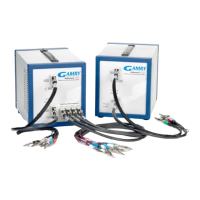
The AE is a factory-installed option for the Reference 3000. The AE acronym stands for Auxiliary Electrometer.
The AE allows eight independent, high voltage differential electrometer channels available to be read by the
Reference 3000’s A/D converter. Difference voltages (between the two inputs of each channel) of up to ± 5 V
can be measured.
All AE inputs are rated to operate at all voltages available at the Reference 3000’s Counter Electrode terminal.
This allows operation between –18 volts and +18 volts in the 3 amp/15 volt compliance setting and between
-36 volts and +36 volts in the 1.5 amp/30 volt compliance setting. These voltages are all versus the Reference
3000’s Floating Ground.
The channels are all completely independent. One channel can measure the difference between -1 V and
-2 V while a different channel measures the difference between 30V and 31V.
The primary function of the AE is simultaneous measurement of individual cells within a multi-cell battery, fuel
cell, or super-capacitor stack. Both AC parameters and DC performance of the cells can be measured. The
stack is often polarized using Galvanostatic control. Alternatively, you can use the Reference 3000 in Stack
mode to control the voltage of the entire stack or of one cell in the stack.
Regardless of the control mode used, the same cell current flows though all the cells in the stack. As a result,
we only need voltage measurements to measure the current and voltage of each cell in the stack. You can also
use the AE to use to measure non-electrochemical signals. The voltage input to an AE channel can be the
output from a temperature, pressure, or other transducer.
AC Performance and CMRR
Each AE channel has 2 differential inputs. The channel measures the difference voltage between these inputs,
labeled as the + input and the - input.
The AE inputs can operate with input voltages as high as 36 volts and can still maintain pA level input currents.
They are also capable of high-speed measurements. The AE is specified to have less than 2° of phase shift for
100 kHz input signals applied to an input channel.
Another very important, although often disregarded, specification for differential inputs is common mode
rejection (CMR). CMR is a measure of how well differential inputs reject a signal applied equally to both inputs
(often called a common mode input). The ratio of output voltage to common mode voltage is called the
common mode rejection ratio, CMRR. By convention, it has units of dB, a logarithmic scale where 20 dB
represents a factor of 10. Assuming one volt of common mode voltage, 20 dB of CMRR corresponds to 100
mV of output voltage, 40 dB corresponds to 10 mV, 60 dB corresponds to 1 mV, etc.
CMR is generally dependent on frequency. As frequency increases, CMRR falls. Each AE channel is specified
to have better than 94 dB CMRR at frequencies between DC and 5 kHz and better than 76 dB of CMRR
between 5 kHz and 100 kHz.
NOTE
AC CMR is highly dependant on resistance in the measurement leads. The AE’s CMR
specifications only apply when the there is less than 10 Ω
ΩΩ
Ω of resistance in the input leads.
A typical aqueous reference electrode has 500 Ω
ΩΩ
Ω of resistance. Gamry does not
recommend use of reference electrodes in high frequency AE measurements.


 To Next Page