Chapter 10 – EIS Measurement of Small Impedances--How Should You Hook Up Your Cell?
10 - 4
From your basic physics course, you may remember that the E B cross-product relationship for current
through a wire obeys the Right-Hand-Rule. If your thumb points in the direction of the current flow in a wire,
when you curl your fingers around the wire, the magnetic field curves around the wire in the same direction as
your fingers.
The current in the primary wires is flowing in opposite directions in the two wires, so your thumb points in
opposite directions for each wire, causing some cancellation of the fields. If the wires were in exactly the same
place, the cancellation would be perfect.
Since the wires cannot be in identically the same location, the cancellation is imperfect, and some net magnetic
field is always present. The more the wires are separated, the larger the net field.
The most common arrangement for inductance and field minimization is the twisted pair. Two insulated wires
are simply twisted together. A coaxial wire arrangement with current flowing in opposite directions in the
center conductor and the outer conductor is also effective.
Separate the pairs
If you place a magnetic field probe near a wire passing current, you will measure a field inversely proportional
to the square of the distance between the probe and the wire.
In an electrochemical system, the probe is our sense wiring. Separating the sense wires from the current
carrying wires can dramatically reduce the magnetic coupling, reducing errors in the EIS measurement.
The Reference 3000 has two cell cables, so that we can separate the current carrying wires from the sense
wires. The current carrying pair is in the Counter/Working Cable and the sense pair is in the Sense Cable.
Twist the Sense Wires
The concept of a magnetic loop probe is useful in understanding why twisted wire minimizes magnetic pickup.
A loop of wire in a changing magnetic field will see a loop voltage proportional to the area of the loop.
Twisting the sense wires together helps in two ways – even though twisting the wire forms loops. First, the
twisted wires are forced to lie close to each other, minimizing the loop areas. Secondly, adjacent loops pickup
opposite polarity voltages resulting in cancellation.
How Should You Hook Up Your Cell?
Always use four-terminal connections to the cell. Try to avoid conductors that are shared by both the current
carrying path and the voltage sensing bath.
If your experiments are in the region where mutual inductance may limit performance, keep the voltage sensing
leads in a twisted pair and the current carrying leads in a different twisted pair. Keep the pair of sensing wires
far away from the pair of current carrying wires. Try to arrange each pair so that they approach the cell from
opposite directions.
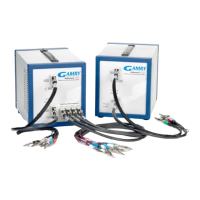
These recommendations are summarized in the Figure below.


 To Next Page