8
UK
more than 30% approx., adjust them almost
equally and measure again.
•Wind can adversely affect the ability of the
meter to make a reading by creating excessive
background noise. If measuring in a windy
location, shield the sensor from the wind or use
a microphone windscreen.
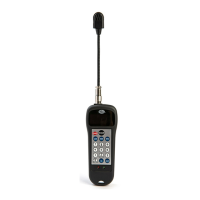
•Anoptionalinductivesensorshouldbeutilised
for measuring tension of steel reinforced
synchronous belts and in noisy or windy
environments to produce optimal results. The
inductive sensor uses a magnetic field rather
than sound waves.
•Ifaspecificprocessisusedtosetbelttension
in a particular application, and the meter is
used only to monitor the resulting belt tensions,
the frequency mode can be used rather than
displaying an absolute tension value. Belt span
frequencies for minimum and maximum tension
conditions can be measured so assemblers/
technicians can use the meter to verify that
belt installation tension is within an acceptable
range.
7. Meter recalibration
for non-standard
belts
Measuring the tension of special belts with extra
thick backings, alternate materials, etc., may
yield less than accurate results using unit weights
for standard belts. In these cases, a simple
calibration process may be used. The belting can
be placed on a fixture with a known span length
under various known tensions (hanging weights
can be used). By taking frequency measurements
at various tensions, span frequency vs. tension
data can be collected. These data can then be
used in a graphical format or in equation form
to convert measured span vibration frequencies
to accurate belt tensions. Data of this type is
specific to each application and cannot be applied
to drives with different span lengths. Because
the resulting data may not be linear, it is best
to measure the tension of non-standard belts in
terms of frequency rather than deriving a new
belt unit weight to measure in terms of absolute
tension.
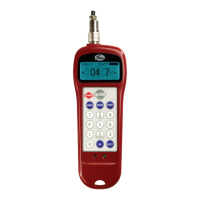
8. Summary of features
•H160mmxD26mmxW59mm
•Batteries:2xAAA
•Suitable for multi-ribbed belts, V-belts and
synchronous belts
•Measurementrange:10Hzto5,000Hz
•Measuredaccuracy:±1%
•LCDscreenbacklight
•Doubledisplaypossible(Newtonand/orHz)
•Flexiblesensor
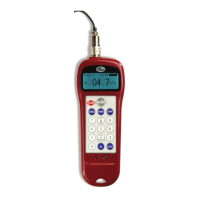
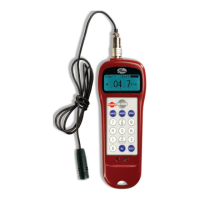
•Cordsensor,inductivesensorandoscillator
available on request
•Storesweight,widthandspanconstantsfor
up to twenty different drive systems
•Autogainadjustmentfunctioncancelsout
background noise automatically
•Shutsoffautomaticallyafterfiveminutesof
inactivity, making it an energy-saving device
•CEapproved


 To Next Page
 Loading...