Need help?
Do you have a question about the Gemas PURITRON GSC 10 and is the answer not in the manual?
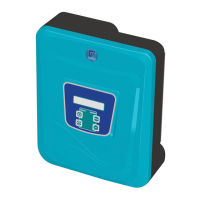
Details the components of the power supply and control unit, including LCD screen and control keys.
Instructions for attaching the control unit, specifying placement and ventilation requirements.
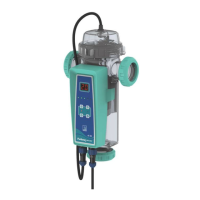
Guidance on installing the cell housing, including orientation and connection details.
Information on connecting the pH flow cell for water measurement and return.
Explains the cell's self-cleaning polarity reversal and how to adjust its period.
Details how to configure the pH mode for the dosing pump's operation.
Specifies the warranty period for the electrolytic cell and rectifier.
Lists conditions that will void the product warranty, including improper use.
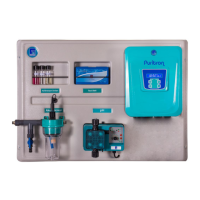
The GEMAS pH Controlled Puritron Salt Water Chlorinator is an advanced device designed for efficient and automatic maintenance of swimming pool water quality. This system combines saltwater electrolysis for chlorine production with pH measurement and dosing capabilities, ensuring a balanced and sanitized pool environment with minimal user intervention.
The primary function of the Puritron chlorinator is to generate chlorine from salt dissolved in the pool water through an electrolytic process. This eliminates the need for manual addition of chlorine chemicals, providing a continuous and consistent sanitization method. The device is equipped with an electrolytic cell that produces chlorine, which then disinfects the pool water.
A key feature of this system is its integrated pH control. The device includes a pH flow cell and an electrode that continuously measures the pH level of the pool water. Based on these measurements, a dosing pump automatically injects pH-adjusting chemicals (either pH increaser or pH reducer) into the return line, maintaining the pH within optimal ranges. This dual functionality ensures that both chlorine levels and pH are consistently balanced, which is crucial for effective sanitization and swimmer comfort.
The chlorinator operates by circulating pool water through its housing, where the electrolytic cell and pH flow cell are located. The system is designed to be powered only when the pool pump is running, ensuring that chlorine is produced and pH is adjusted only when water is actively circulating. A by-pass installation with three valves is recommended to allow for adjustment of water flow through the cell and to enable the pool to operate even when the housing is disassembled for maintenance.
The device features an LCD screen and control keys for user interaction, allowing for monitoring of production levels, pH readings, and system settings. It also includes a polarity change system that periodically reverses the polarity applied to the cell electrodes. This self-cleaning mechanism helps to dislodge and prevent the accumulation of lime scale on the electrodes, reducing the need for manual cleaning and extending the lifespan of the cell.
The Puritron chlorinator is designed for ease of use and automated operation. Before initial startup, the pool water needs to be prepared by ensuring appropriate salt concentration (5-6 kg/m³), TAC (60-100 ppm), TH (15-20° French), and stabilizer levels (20-30 ppm). It is crucial to add salt to the pool and allow it to dissolve completely before operating the chlorinator, as operating with undissolved salt can irreversibly damage the cell. The salt dissolving process can be accelerated using a pool cleaner, and salt should be added near the return lines, avoiding skimmers or drain inlets.
The device offers adjustable chlorine production rates, ranging from 0% (stopped) to 100% (full efficiency), which can be set via the control keys on the main screen. This allows users to customize chlorine output based on pool conditions such as swimmer load and temperature. The pH mode can be set to OFF, ON, or AUTO. In AUTO mode, the system automatically measures pH and adjusts dosing based on a user-defined stopping value and tolerance. This ensures that the pH is maintained within a desired range, typically a factory setting of 7.00 with a recommendation of 7.20.
The chlorinator also features a polarity change period setting, which determines how frequently the cell electrodes reverse polarity for self-cleaning. The manufacturer's default is 8 hours, but this can be adjusted to increase cleaning frequency if high calcium concentration leads to excessive lime scale.
The device includes fault messages displayed on the LCD screen to alert users to potential issues, such as low salt concentration or low water level. These alerts guide users to take corrective actions, such as adding salt or checking water circulation, to prevent damage to the system.
While the Puritron chlorinator is designed for minimal maintenance, certain practices are recommended to ensure its longevity and optimal performance. The self-cleaning polarity change system significantly reduces the need for manual cleaning of the electrolytic cell by preventing lime scale accumulation. However, in areas with very high calcium concentration, visual inspection of the cell is recommended regularly to detect any lime residue.
If manual cleaning is necessary, the cell should be completely dried for one or more days to allow lime residue to release naturally. Gentle tapping can assist this process, but care must be taken not to harm the delicate electrodes. Metallic or sharp objects should never be used to scratch the electrodes. If pressurized water does not remove deposits, the cell can be submerged in a 20% hydrochloric acid solution, ensuring that the cover with terminals is not submerged. After cleaning, the cell should be rinsed with freshwater, dried, and reinstalled. It is important not to leave the cell in acid solution for longer than 5 minutes.
Regular checks of the cell terminals and oiling them are recommended to prevent sulfating. The chlorinator should be turned off whenever there is no water circulation, during filter cleaning, when the pool is being emptied, when the water is frozen, or when cleaning the cell.
Proper installation is crucial for maintenance and longevity. The control unit should be placed in a well-ventilated area, protected from rain and water leaks, and within 1.5 meters of the electrolytic cell. The pH reducer injection point should always be after the electrolysis cell to prevent corrosion of cell electrics. Acid tanks should not be located in areas with insufficient flow, as this can expose electronic components to corrosive effects. The pH flow cell should be positioned before the chlorine cell to prevent high-density chlorine from damaging it.
Adhering to these usage and maintenance guidelines will ensure the efficient and long-lasting operation of the GEMAS pH Controlled Puritron Salt Water Chlorinator, providing a consistently clean and balanced swimming pool.
 General
| Filter Type | Sand Filter |
|---|---|
| Flow Rate | 10 m³/h |
| Working Pressure | 2.5 bar |
| Filter Media | Sand |
| Connection Size | 1.5" |
| Tank Material | Polyethylene |

 To Next Page