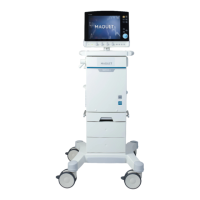
Servo-i Ventilator System Description of functions
Revision 02 Service Manual 3 - 3
3
Patient unit
Inspiratory section
Functional Main Blocks diagram marking: 'I'
The main block Inspiratory Section conveys the
breathing gas from its gas inlets for Air and O
2
supply
to the patient breathing system. It comprises the
following main functions:
• Gas Modules – Air and O
2
.
• Connector Muff.
• Inspiratory Pipe.
•O
2
Cell.
• Temperature Sensor.
• Inspiratory Pressure Tube.
• Safety Valve incl. pull magnet.
• Inspiratory Outlet.
• PC 1780 Pneumatic Back-Plane.
Gas modules – Air and O
2
The Air and O
2
Gas Modules regulates the inspiratory
gas flow and gas mixture.
1.Filter
2.Inspiratory valve temperature sensor
3.Supply pressure transducer
4.Flow transducer (Delta pressure transducer and net)
5.Nozzle unit with valve diaphragm
6.Inspiratory solenoid
The Gas Modules are factory calibrated. Each
Gas Module must not be disassembled further
than described in chapter 'Preventive
maintenance'.
Gas inlet
Gas supply is connected to the ventilators gas inlet
nipples. The design of the gas inlet nipples and their
color markings vary according to the standard
chosen.
Gas is to be connected from hospital central gas
supply or from gas cylinders. The Air supply may be
connected from a compressor for medical air.
Filter
The Filter protects the ventilator from particles in the
gas delivered to the Gas Modules. The filter must be
replaced during the ”Preventive maintenance”.
The filter housing and the filter cover are provided
with matching guide pins. These guide pins prevent
mounting of the filter cover (with gas inlet nipple) on
the wrong module.
A non-return valve for the gas inlet is located in the
filter cover. This valve will suppress short pressure
drops in the gas supply.
The non-return valve is also designed to slowly
evacuate compressed gas from the module, if the
gas supply to the module is disconnected.
Inspiratory valve temperature sensor
The temperature of the supplied gas is measured by
the Inspiratory Valve Temperature Sensor. This
sensor is situated in the gas flow.
The output signal from this sensor is used to
compensate for the gas density variations due to
temperature.
Supply pressure transducer
The pressure of the supplied gas is measured by the
Supply Pressure Transducer.
The output signal from this transducer is amplified. It
is then used to calculate the absolute pressure of the
gas to compensate for gas density variations due to
pressure.
Flow transducer
The gas flows through a net (resistance) which
causes a pressure drop. The pressure is measured
on both sides of this net and the differential pressure
value is then amplified.

 To Next Page
 Loading...