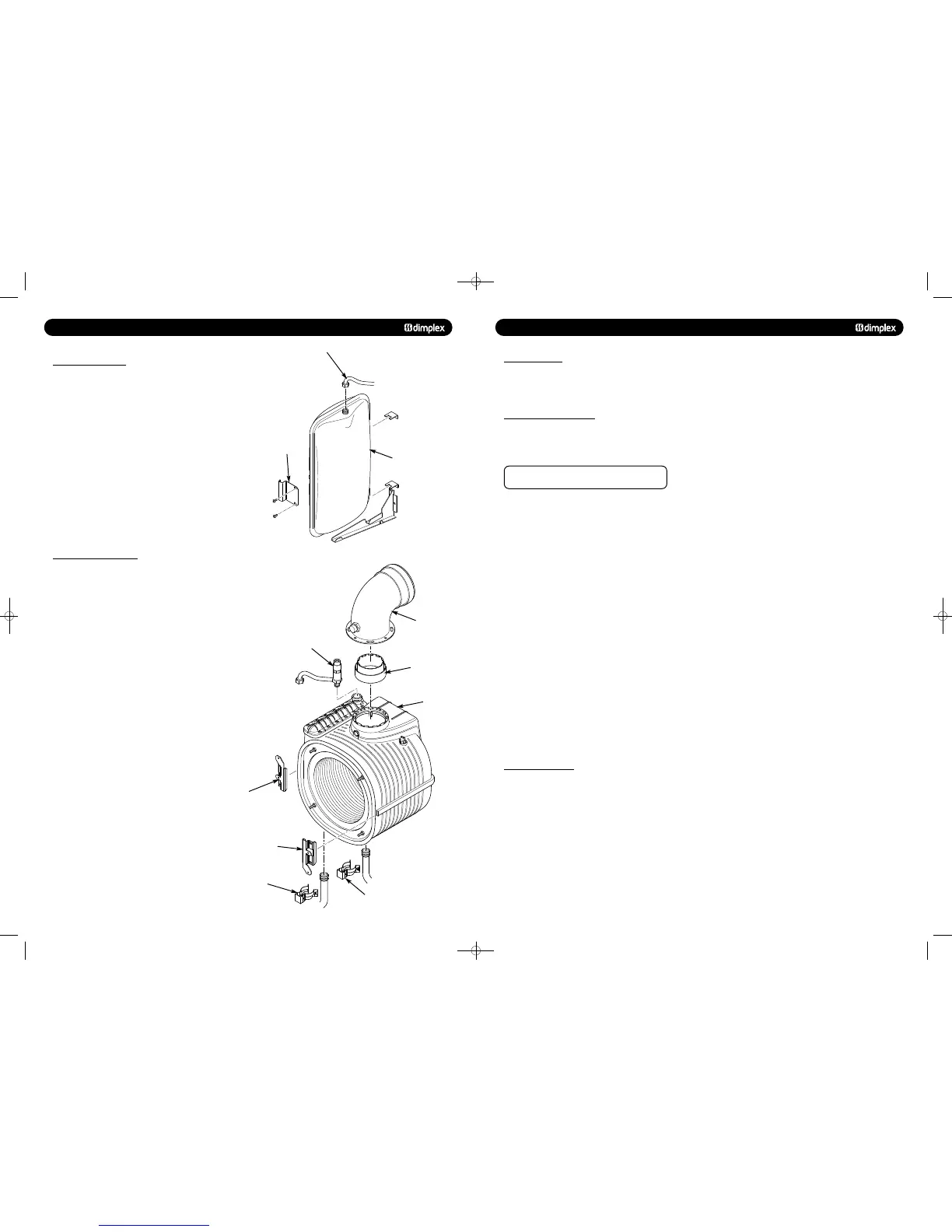
1. Drain the primary circuit.
2. Remove the electrode leads, noting their positions as
described in section 13.2.
3. Remove the valve and fan assembly as described in Section
13.3.
4. Examine the gasket and replace if necessary.
5. Undo the four nuts securing the burner door and remove the
cover plate from the heat exchanger.
6. Remove the two clips from the flow and return pipes on the
bottom of the heat exchanger and slide out the pipes (Fig. 68).
7. Remove the clip holding the manual air vent and remove the
pipe from the top of the heat exchanger.
8. Remove the four screws holding the left and right hand
retaining brackets and remove the brackets.
9. Remove the four screws securing the flue to the top of the
boiler. Lift the flue adaptor out of the flue outlet in the top of
the heat exchanger.
10. Carefully slide the heat exchanger out of the boiler.
11. Reassemble in reverse order.
1. The appliance is suitable for fully pumped SEALED SYSTEMS
ONLY.
Treatment of Water Circulating Systems
Failure to flush and add inhibitor to the system will
invalidate the appliance warranty.
• Central heating water systems will be subject to corrosion
unless an appropriate water treatment is applied. This means
that the efficiency of the system will deteriorate as corrosion
sludge accumulates within the system, risking damage to pump
and valves, boiler noise and circulation problems.
• When fitting new systems flux will be evident within the
system, which can lead to damage of system components.
• All systems must be thoroughly drained and flushed out.
Using, for example Betz-Dearborn Sentinel X300 or X400 or
Fernox Superfloc Universal Cleanser. They should be used
following the flushing agent manufacturer’s instructions.
• System additives - corrosion inhibitors and flushing
agents/descalers should comply to BS7593 requirements, e.g.
Betz-Dearborn Sentinel X300 and Femox-Copal which should
be used following the inhibitor manufacturer’s instructions.
• It is important to check the inhibitor concentration after
installation, system modification and at every service in
accordance with the manufacturer’s instructions. (Test kits are
available from inhibitor stockists.)
• For information or advice regarding any of the above contact
Technical Enquiries - Tel: 0844 3711121.
• If thermostatic radiator valves are fitted, a radiator must be
fitted with two lock shield valves or the system must include a
proprietary automatic bypass valve, to enable correct operation
of the pump over-run facility.
48pp MANUAL SPREADS 19/10/10 08:36 Page 11


 To Next Page
 Loading...