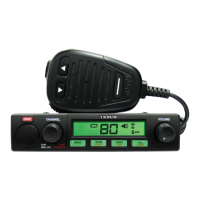
TX677 Instruction Manual
19
DISPLAY LIGHTING
The LCD backlighting activates automatically whenever a key is pressed and turns
o automatically after about 5 seconds.
RECEIVING SIGNALS
While the radio is not receiving signals, it will remain in ‘standby’ mode to
conserve battery power and ‘Save’ will be displayed. When a signal is received,
the LED indicator on the upper edge of the radio will light green and the
TX677 Instrucon Manual
12 June 2018
© 2018 Standard Communicaons Pty Ltd trading as GME. All rights reserved.
18
50157
Content
Use Low Transmit Power
The transmier has both high and low power sengs. If you are only operang over short distances,
are in a reasonably high locaon or are close to a local repeater, try using the Low transmier power
seng. This reduces the transmier power to 0.5 was which increases the talk me available.
General Operaon
Turning the Radio On/O
1. Rotate the Volume control clockwise past the click to turn the radio on.
2. Rotate the Volume control counter-clockwise past the click to turn the radio o again.
Adjusng the Volume
With the unit powered on, rotate the Volume control clockwise to increase the volume and counter-
clockwise to decrease the volume.
Display Lighng
The LCD backlighng acvates automacally whenever a key is pressed and turns o automacally
aer about 5 seconds.
Receiving Signals
While the radio is not receiving signals, it will remain in ‘standby’ mode to conserve baery power
and ‘Save’ will be displayed. When a signal is received, the LED indicator on the upper edge of the
radio will light green and the icon will appear on the display. Adjust the Volume control for a
comfortable listening level.
If the incoming signal is encoded with a CTCSS or DCS tone matching the one set in your radio,
the LED indicator will light orange and you will be able to hear the signal in the speaker. If the LED
indicator lights green and the icon appears but you cannot hear the signal, it is likely that the
incoming signal is using a dierent CTCSS or DCS tone to that selected in your radio (see Menu
opons for more details on seng CTCSS/DCS tones).
If no further signals are received, the unit will return to ‘standby’ mode aer a few seconds.
icon
will appear on the display. Adjust the Volume control for a comfortable listening
level.
If the incoming signal is encoded with a CTCSS or DCS tone matching the one set
in your radio, the LED indicator will light orange and you will be able to hear the
signal in the speaker. If the LED indicator lights green and the
TX677 Instrucon Manual
12 June 2018
© 2018 Standard Communicaons Pty Ltd trading as GME. All rights reserved.
18
50157
Content
Use Low Transmit Power
The transmier has both high and low power sengs. If you are only operang over short distances,
are in a reasonably high locaon or are close to a local repeater, try using the Low transmier power
seng. This reduces the transmier power to 0.5 was which increases the talk me available.
General Operaon
Turning the Radio On/O
1. Rotate the Volume control clockwise past the click to turn the radio on.
2. Rotate the Volume control counter-clockwise past the click to turn the radio o again.
Adjusng the Volume
With the unit powered on, rotate the Volume control clockwise to increase the volume and counter-
clockwise to decrease the volume.
Display Lighng
The LCD backlighng acvates automacally whenever a key is pressed and turns o automacally
aer about 5 seconds.
Receiving Signals
While the radio is not receiving signals, it will remain in ‘standby’ mode to conserve baery power
and ‘Save’ will be displayed. When a signal is received, the LED indicator on the upper edge of the
radio will light green and the icon will appear on the display. Adjust the Volume control for a
comfortable listening level.
If the incoming signal is encoded with a CTCSS or DCS tone matching the one set in your radio,
the LED indicator will light orange and you will be able to hear the signal in the speaker. If the LED
indicator lights green and the icon appears but you cannot hear the signal, it is likely that the
incoming signal is using a dierent CTCSS or DCS tone to that selected in your radio (see Menu
opons for more details on seng CTCSS/DCS tones).
If no further signals are received, the unit will return to ‘standby’ mode aer a few seconds.
icon appears
but you cannot hear the signal, it is likely that the incoming signal is using a
dierent CTCSS or DCS tone to that selected in your radio (see Menu options for
more details on setting CTCSS/DCS tones).
If no further signals are received, the unit will return to ‘standby’ mode after a few
seconds.
TRANSMITTING
To transmit:
1. Press and hold the PTT (Push-To-Talk) switch. The other radio
you are talking to must be set to the same channel.
2. Hold the radio approximately 5-8 cm from your mouth with the
antenna vertical and speak into the built-in microphone.
3. While the PTT switch is pressed, the LED indicator on the upper
edge of the radio will light red and the
TX677 Instrucon Manual
12 June 2018
© 2018 Standard Communicaons Pty Ltd trading as GME. All rights reserved.
19
50157
Content
Transming
To transmit:
1. Press and hold the PTT (Push-To-Talk) switch. The other radio you are talking to must be
set to the same channel.
2. Hold the radio approximately 5-8 cm from your mouth with the antenna vercal and
speak into the built-in microphone.
3. While the PTT switch is pressed, the LED indicator on the upper edge of the radio will
light red and the
icon will appear on the LCD.
4. When you have nished speaking, release the PTT switch to receive incoming signals (it is
not possible to transmit and receive at the same me). If no further signals are received,
the unit will revert to ‘Standby’ mode.
The PTT switch can also be used to transmit a Call Alarm Melody.
When the call alarm melody is enabled (see Menu opons for more details on
Call Alarm sengs), pressing the PTT switch twice quickly will play the call alarm melody in the
speaker of other radios on the same channel to alert them to your call. During this me the
icon is displayed and the LED indicator will light red for about 5 seconds. The call alarm can
only be sent once per minute.
Time-out Timer
The radio has a built-in me-out mer that automacally limits transmissions to a maximum of
3 minutes of connuous operaon. This feature is required by the ACMA to prevent accidental
blocking of the frequency should your PTT switch become jammed or be otherwise pressed
accidentally. When the me-out mer acvates, the radio will beep and ‘tot’ is displayed briey on
the LCD. Normal operaon will be restored once the PTT switch is released.
Selecng Channels
1. In the ‘Standby’ mode, press the key to step up one channel or the key to step down
one channel.
2. Press and hold the or keys to quickly scroll through the channels.
Squelch
The Squelch is used to eliminate the background noise when there are no signals present. When
the squelch is open the receiver’s background noise can be heard. When the squelch is closed the
receiver remains quiet while there are no signals present but any incoming signals will override the
squelch and be heard in the speaker.
To open the squelch:
Briey press the SQL key. This will allow you to check the current channel for acvity before
transming, parcularly if you have CTCSS/DCS enabled.
icon will appear on the
LCD.
4. When you have nished speaking, release the PTT switch to
receive incoming signals (it is not possible to transmit and receive
at the same time). If no further signals are received, the unit will
revert to ‘Standby’ mode.


 To Next Page
 Loading...