EasyManua.ls Logo

Goodman GMS8 - User Manual

Goodman GMS8
32 pages
Print Icon
To Next Page IconTo Next Page
Loading...
These furnaces comply with requirements
embodied in the American National
Standard / National Standard of Canada
ANSI Z21.47·CSA-2.3 Gas Fired Central
Furnaces.
RECOGNIZE THIS SYMBOL AS A SAFETY PRECAUTION.
ATTENTION INSTALLING PERSONNEL
As a professional installer you have an obligation to know the product better than the customer. This includes all
safety precautions and related items.
Prior to actual installation, thoroughly familiarize yourself with this Instruction Manual. Pay special attention to all
safety warnings. Often during installation or repair it is possible to place yourself in a position which is more
hazardous than when the unit is in operation.
Remember, it is your responsibility to install the product safely and to know it well enough to be able to instruct a
customer in its safe use.
Safety is a matter of common sense...a matter of thinking before acting. Most dealers have a list of specific good
safety practices...follow them.
The precautions listed in this Installation Manual are intended as supplemental to existing practices. However, if
there is a direct conflict between existing practices and the content of this manual, the precautions listed here take
precedence.
*NOTE: Please contact your distributor or our website for the applicable product data book referred to in this manual.
C
US
®
(CATEGORY 1)
IO-242D © 2004-2006 Goodman Manufacturing Company, L.P. 2/06
INSTALLATION & OPERATING
INSTRUCTIONS for
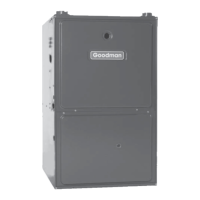
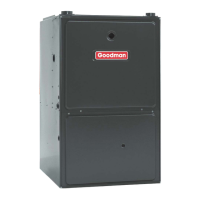
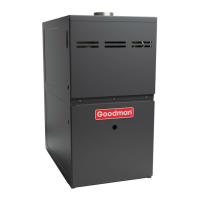
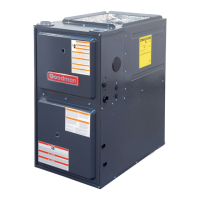
GMS8, GDS8 and GHS8
GAS FIRED WARM AIR FURNACE
SINGLE STAGE

Table of Contents

Other manuals for Goodman GMS8

Question and Answer IconNeed help?

Do you have a question about the Goodman GMS8 and is the answer not in the manual?

Goodman GMS8 Specifications

General IconGeneral
ModelGMS8
Efficiency Rating80% AFUE
Heat Exchanger MaterialAluminized Steel
StagesSingle Stage
Fuel TypeNatural Gas
Heating Capacity40, 000 BTU/h
Warranty10-Year Parts Limited Warranty

Summary

II. Safety

III. Product Application

Electrostatic Discharge (ESD) Precautions

Procedures to prevent damage to electronic components from static discharge during installation.

V. Combustion and Ventilation Air Requirements

VI. Category I Venting (Vertical Venting)

VIII. Electrical Connections

115 Volt Line Connections

Detailed guidelines for making 115-volt line voltage connections to the furnace's junction box.

24 Volt Thermostat Wiring

Procedures for connecting the 24-volt thermostat wiring to the control module.

IX. Gas Supply and Piping

High Altitude Derate

How altitude affects furnace performance and the necessary adjustments or orifice changes.

Firing Rate

Calculating and measuring the furnace's gas input rate to prevent overfiring or underfiring.

Gas Piping Connections

Detailed instructions and diagrams for making correct gas piping connections to the furnace.

X. Circulating Air and Filters

Filters - Read This Section Before Installing the Return Air Ductwork

Crucial information regarding filters before connecting return air ductwork to prevent issues.

XI. Sequence of Operation (Integrated Ignition Control)

Normal Heating Sequence

Step-by-step operational sequence during a normal heating call from the thermostat.

XII. Start-Up Procedure and Adjustment

Gas Supply Pressure Measurement

Detailed procedure for measuring the inlet gas supply pressure to the furnace.

Gas Manifold Pressure Measurement and Adjustment

Measuring and adjusting gas manifold pressure for optimal burner operation and safety.

Gas Input Rate Measurement (Natural Gas Only)

Procedure for measuring the natural gas input rate to ensure it matches the rating plate.

Temperature Rise

How to measure and adjust air temperature rise for correct heating performance.

Circulator Blower Speed Adjustment

Instructions on adjusting the circulator blower motor speed for proper airflow and temperature rise.

XIII. Operational Checks

Burner Flame

Visual inspection criteria for proper burner flame characteristics, stability, and color.

XIV. Safety Circuit Description

Integrated Control Module

Description of the electronic control module's function in monitoring and managing safety systems.

Primary Limit

Function of the primary limit control in guarding against heat exchanger overheating.

Auxiliary Limit

Function of the auxiliary limit control for safety, particularly in blower failure scenarios.

Rollout Limits

Role of rollout limit controls in preventing flame rollout from the burner assembly.

Pressure Switches

How pressure switches monitor airflow through the heat exchanger for safety.

Flame Sensor

Function and principle of the flame sensor in detecting flame presence or absence.

XV. Troubleshooting

XVI. Maintenance

Annual Inspection

Recommended annual inspection points and checks for furnace service and upkeep.

Related product manuals