6
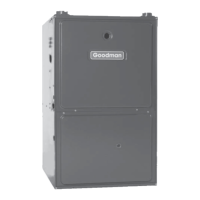
For GDS models, you must follow instructions for Downflow
installation only. GDS models are not approved for Horizontal or
Upflow installations.
WARNING
P
OSSIBLE PROPERTY DAMAGE, PERSONAL INJURY OR DEATH DUE TO FIRE,
EXPLOSION, SMOKE, SOOT, CONDENSTAION, ELECTRICAL SHOCK OR CARBON
MONOXIDE MAY RESULT FROM IMPROPER INSTALLATION, REPAIR, OPERATION,
OR MAINTENANCE OF THIS PRODUCT.
WARNING
TO PREVENT POSSIBLE EQUIPMENT DAMAGE, PROPERTY DAMAGE, PERSONAL
INJURY OR DEATH, THE FOLLOWING BULLET POINTS MUST BE OBSERVED
WHEN INSTALLING THE UNIT.
Follow the instructions listed below when selecting a furnace
location. Refer also to the guidelines provided in Section V,
Combustion and Ventilation Air Requirements.
• Centrally locate the furnace with respect to the proposed
or existing air distribution system.
• Ensure the temperature of the return air entering the
furnace is between 55°F and 100°F when the furnace is
heating.
• Provisions must be made for venting combustion products
outdoors through a proper venting system. The length of
flue pipe could be a limiting factor in locating the furnace.
• Ensure adequate combustion air is available for the
furnace. Improper or insufficient combustion air can
expose building occupants to gas combustion products
that could include carbon monoxide. Refer to Section V,
Combustion and Ventilation Air Requirements.
• The furnace must be level. If the furnace is to be set on a
floor that may become wet or damp at times, the furnace
should be supported above the floor on a concrete base
sized approximately 1-1/2" larger than the base of the
furnace.
• Ensure upflow or horizontal furnaces are not installed
directly on carpeting, or any other combustible material.
The only combustible material allowed is wood.
• Exposure to contaminated combustion air will result in
safety and performance-related problems. Do not install
the furnace where the combustion air is exposed to the
following substances:
chlorinated waxes or cleaners
chlorine-based swimming pool chemicals
water softening chemicals
deicing salts or chemicals
carbon tetrachloride
halogen type refrigerants
cleaning solutions (such as perchloroethylene)
printing inks
paint removers
varnishes
hydrochloric acid
cements and glues
antistatic fabric softeners for clothes dryers
and masonry acid washing materials
• If the furnace is used in connection with a cooling unit,
install the furnace upstream or in parallel with the cooling
unit coil. Premature heat exchanger failure will result if the
cooling unit coil is placed ahead of the furnace.
• If the furnace is installed in a residential garage, position
the furnace so that the burners and ignition source are
WARNING
T
O PREVENT PROPERTY DAMAGE, PERSONAL INJURY OR DEATH DUE TO FIRE,
DO NOT INSTALL THIS FURNACE IN A MOBILE HOME, TRAILER, OR RECREATIONAL
VEHICLE.
To ensure proper furnace operation, install, operate and maintain
the furnace in accordance with these installation and operation
instructions, all local building codes and ordinances. In their
absence, follow the latest edition of the National Fuel Gas Code
(NFPA 54/ANSI Z223.1), and/or CAN/CSA B149 Installation Codes,
local plumbing or waste water codes, and other applicable codes.
A copy of the National Fuel Gas Code (NFPA 54/ANSI Z223.1) can
be obtained from any of the following:
American National Standards Institute
1430 Broadway
New York, NY 10018
National Fire Protection Association
1 Batterymarch Park
Quincy, MA 02269
CSA International
8501 East Pleasant Valley
Cleveland, OH 44131
A copy of the CAN/CSA B149 Installation Codes can also be
obtained from:
CSA International
178 Rexdale Boulevard
Etobicoke, Ontario, Canada M9W 1R3
The rated heating capacity of the furnace should be greater than
or equal to the total heat loss of the area to be heated. The total
heat loss should be calculated by an approved method or in
accordance with “ASHRAE Guide” or “Manual J-Load Calculations”
published by the Air Conditioning Contractors of America.
In the USA, this furnace MUST be installed in accordance with the
latest edition of the ANSI Z223.1 booklet entitled “National Fuel
Gas Code” (NFPA 54), and the requirements or codes of the local
utility or other authority having jurisdiction. In Canada, this furnace
must be installed in accordance with the current CAN/CGA-B149.1
& 2 Gas Installation Codes, local plumbing or waste water codes
and other applicable codes. Additional helpful publications
available from the NFPA are, NFPA 90A - Installation of Air
Conditioning and Ventilating System and NFPA 90B - Warm Air
Heating and Air Conditioning System.
All venting shall be in accordance with PART 7, Venting of
Equipment, of the National Fuel Gas Code, ANSI Z223.1, or
applicable local building and/or air conditioning codes. These
publications are available from:
National Fire Protection Association, Inc.
Batterymarch Park, Quincy, MA 02269
The G**S8X of furnaces meet the California NOx emission
standards and California seasonal efficiency standards. ANNUAL
inspections of the furnace and its vent system is strongly
recommended.
IV. LOCATION REQUIREMENTS AND CONSIDERATIONS
GENERAL
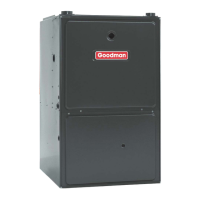
Model type determines which installation procedures must be
used. For GMS and GHS models, you must follow instructions for
Horizontal Left, Horizontal Right or Upflow installations only. GMS
and GHS models are not approved for Downflow installations.




 To Next Page

