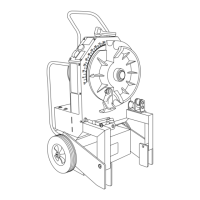
777 Segment Bender
Greenlee Textron Inc. / Subsidiary of Textron Inc. 4455 Boeing Dr., Rockford, IL 61109 815-397-7070
8
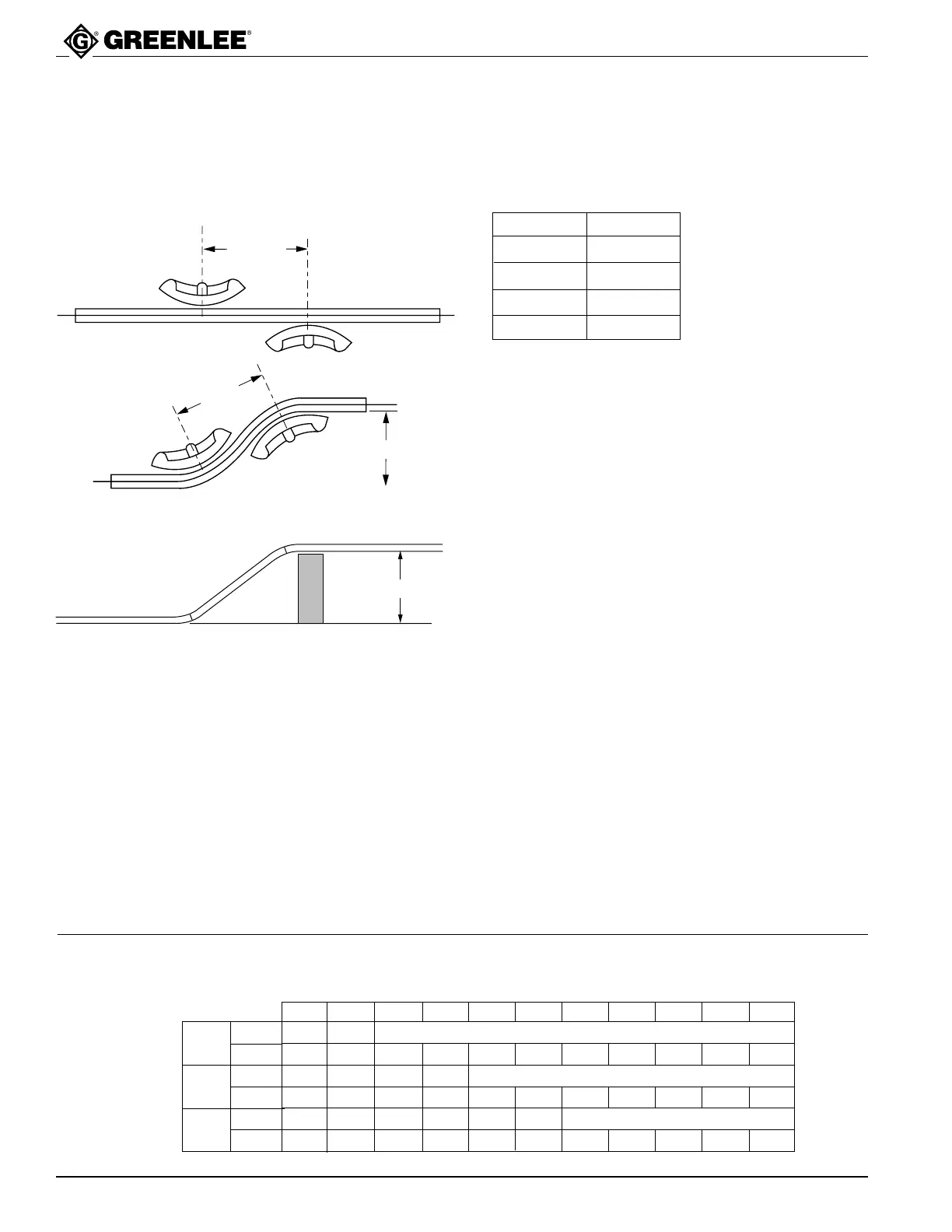
Laying Out Offset Bends
An offset bend is used to route the conduit around an
obstruction. To make an offset, two bends are required.
The operator must measure the height of the offset and
select the angle of the offset. The distance between the
two bends is the center-to-center distance.
Calculating the Center-to-Center Distance
To calculate the center-to-center distance of commonly
used offset bends, multiply the amount of offset by the
appropriate offset multiplier:
Offset Multipliers
15° 3.86
22-1/2° 2.6
30° 2
45° 1.4
60° 1.2
To use this table: Measure the obstruction and deter-
mine the angle of the offset. Find the angle of the offset
in the left column; multiply the height of the obstruction
by the corresponding multiplier in the right column to find
the center-to-center distance.
Example: 5 inches of offset
15-degree bend
Multiplier for 15
°
: 3.86
Multiply the amount
of offset by the multiplier
to find the center-to-
center distance: 5 x 3.86 = 19.3
Round off to the nearest
common fraction: 19-5/16
1. Measure the obstruction.
2. Determine the angle of the offset bends.
3. Calculate the center-to-center distance. See the
Greenlee Offset Multiplier and Shrink Table.
Note: If working toward an obstruction, calculate the
amount of shrink. See Calculating “Shrink” in this
manual.
4. Mark the conduit.
5. See bending instructions under “Bending Conduit” in
this manual.
HEIGHT OF OFFSET
2 4 6 8 10 12 14 16 18 20 22
3/4 1-1/2 2
7-3/4 15-7/16 23-3/16 30-15/16 38-5/8 46-3/8 54-1/16 61-13/16 69-9/16 77-1/4 85
3/4 1 1-1/2 2
8 121620 242832364044
1/2 1 1-1/4 1-1/2 2
8-1/2 11-15/16 14-1/8 16-15/1619-13/16 22-5/8 25-7/16 28-1/4 31-1/8
15°
MAX
CONDUIT
SIZE
CENTER
TO
CENTER
MAX
CONDUIT
SIZE
CENTER
TO
CENTER
MAX
CONDUIT
SIZE
CENTER
TO
CENTER
30°
45°
OFFSET ➧
Common
Offset
Bends
Offset Table
CENTER-TO
CENTER
OF BENDS
CENTER-TO
CENTER
OF BENDS
OFFSET
The following Offset Table shows the center-to-center distance for selected amounts of offset for commonly used bends.


 To Next Page