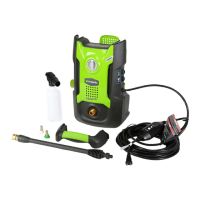
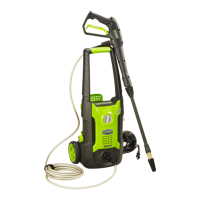
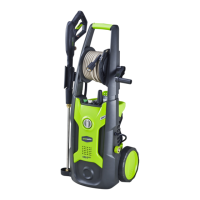
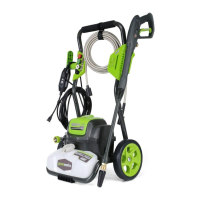
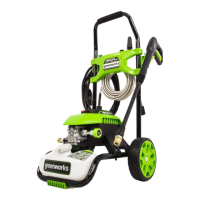
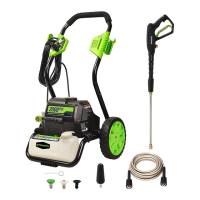
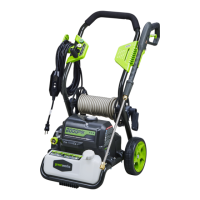
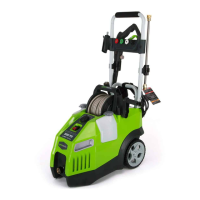
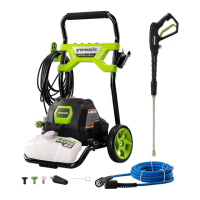
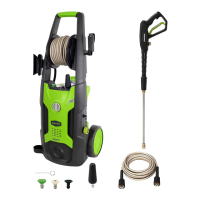
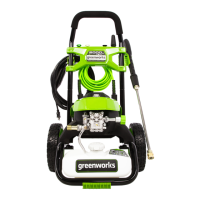
The Greenworks GPW 1702 is a 1700 PSI / 1.2 GPM electric pressure washer designed for various cleaning tasks around the home. This device is intended for personal use and is not recommended for industrial or commercial applications. Its primary function is to provide a high-pressure water stream for effective cleaning of surfaces such as cars, boats, motorcycles, outdoor furniture, grills, and house siding.
Technical Specifications:
- Motor: Universal Motor
- Voltage/Frequency: 120V, 60Hz
- Amperage: 13 Amps
- Max. Pounds Per Square Inch (PSI) Pressure: 1700 psi
- Rated Gallons Per Minute (GPM): 1.2 gpm
- Maximum Inlet Water Temperature: 104°F (40°C)
- Cleaning Units (C.U.): 2040 C.U.
- Unit Weight: 17.66 lbs (8 kg)
- Warranty: 1 Year
Usage Features:
The pressure washer is designed with user convenience and safety in mind. Key components include a trigger handle with a lock-out mechanism, spray tips, a water intake and outlet, a detergent tank, and a GFCI plug for electrical safety.
Assembly:
Before operation, the device requires some assembly. Users must carefully remove all components from the packaging and inspect them for damage. Any damaged or missing parts should be reported to Greenworks customer service.
- Gun Holder Assembly: The gun holder is inserted into a designated slot until it locks into place.
- Pressure Washer Gun Assembly: The male end of the wand is inserted firmly into the female bayonet outlet of the gun. While pushing, it is turned clockwise until the tabs lock, ensuring a leak-free connection.
- High Pressure Hose Connection: The high-pressure hose is connected to the pressure washer gun assembly by turning the fitting clockwise until fully tightened. Applying pressure washer or dish detergent to the rubber seal can facilitate easier installation and a snug fit.
- Detergent Tank Assembly: The male end of the detergent bottle is inserted into the female outlet on the trigger handle and turned clockwise until tabs lock. The bottle can then be unscrewed, filled with pressure washer detergents/soaps only, and reattached. A funnel is recommended to prevent spills.
- Garden Hose Connection: The garden hose is connected to the water intake. It's crucial to observe local regulations regarding direct connection to public drinking water supply. The water supply must come from a main, and hot water or water from pools/lakes should never be used. Before connecting, uncoil the hose, run water through it to clear debris, and inspect the screen in the water intake for damage or dirt. The hose faucet should be turned off before attaching the hose to the water intake and tightened by hand.
Operation:
- Starting the Pressure Washer:
- Connect the garden hose and turn on the water supply.
- Squeeze the high-pressure trigger to relieve air pressure until a steady stream of water appears, then release the trigger.
- Ensure the On/Off switch is in the "0/OFF" position.
- Connect the pressure washer to the power supply and plug it into an outlet. Verify the GFCI light is on.
- Switch the pressure washer to the "I/ON" position to start the motor.
- Stopping the Pressure Washer: To stop the motor, release the trigger and turn the switch to the "0/OFF" position.
- Auto On/Off Switch: The GPW 1702 features an Auto Start/Stop. When the power switch is "On" (I), the pump will pressurize and shut down immediately. It will turn on when the trigger is depressed and shut off when released, entering standby mode.
- Trigger Handle and Lock-out: The trigger handle should be held securely with both hands during operation due to reaction forces. The lock-out mechanism prevents unintentional starts. To engage, push the lock-out up until it clicks into the slot. To disengage, push it down to its original position. The spray tip should be held 8-24 inches from the cleaning surface for optimal results.
- Detergent Application: Soap is applied under low pressure and high volume for optimum performance. It cannot be applied under high pressure. Detergent can only be applied when the detergent tank is installed. To clean, install the soap attachment, start the washer, and spray detergent on a dry surface using long, even, overlapping strokes, preventing it from drying on the surface.
- Rinsing: After detergent application, spray away from the rinsing surface for approximately 10 seconds to flush any remaining detergent from the line. Start rinsing at the top of the area and work down, overlapping strokes.
- Changing Spray Tips: Always turn off the pressure washer, shut off the water supply, and pull the trigger to release water pressure before changing spray tips. Engage the lock-out. Pull back the quick-connect collar on the spray wand, push the desired spray tip into place, and push the collar forward to secure it. Never point the wand at your face or others when changing tips.
- Green - Narrow Fan Tip (25°): Provides high versatility with a 25-degree angle. Suitable for removing dirt from surfaces without causing damage. Versatile for sweeping foliage or debris due to its wide cleaning area and strong pressure.
- White - Wide Fan Tip (40°): Creates the widest cleaning area with relatively low pressure. Best for light or delicate cleaning applications, such as wood decks and other soft surfaces.
- Moving the Pressure Washer: Turn off the pressure washer, point the spray wand in a safe direction, and pull the trigger to release water pressure. Tilt the machine onto its wheels and roll it to the desired position.
Maintenance Features:
Regular maintenance ensures the longevity and optimal performance of the pressure washer.
- General Maintenance: Avoid using solvents when cleaning plastic parts, as they can cause damage. Use clean cloths to remove dirt, dust, oil, and grease. Never allow brake fluids, gasoline, petroleum-based products, or penetrating oils to contact plastic parts.
- Spray Tip Maintenance: Excessive pump pressure or a pulsing sensation during trigger squeeze may indicate a clogged or dirty spray tip.
- Unplug the pressure washer, turn off the water supply, and pull the trigger to release water pressure.
- Remove the spray tip from the spray wand.
- Use the provided spray tip cleaning tool to free any foreign materials.
- Flush debris out of the spray tip by back-flushing with a garden hose (running water from the outside to the inside).
- Reconnect the spray tip and turn on the water supply.
- Shutting Down and Cleaning Up:
- If using detergent, fill the detergent bottle with clean water and siphon at low pressure for one minute to flush the system. Remove and rinse the detergent bottle thoroughly.
- Disconnect the garden hose from the water inlet.
- Press the trigger to release any remaining water pressure.
- Turn the switch to "OFF" (0) position.
- Unplug the power cord.
- Engage the gun safety lock.
- Taking a Break: For breaks of five minutes or more, engage the gun safety lock, turn the unit to "OFF" (O), and unplug the power cord.
- Storing the Pressure Washer: Store the unit in a dry, covered, frost-free area. Empty all water from hoses, the pump, and the detergent container before storing. Avoid storing near furnaces or other heat sources that could dry out pump seals.
- Quick Winterizing Procedure: If the Optimum Winterizing procedure cannot be performed, disconnect all water connections, turn on the machine for a few seconds until remaining water exits the pump, then turn off immediately. Do not allow the high-pressure hose to kink. Store the machine and accessories in a room that does not reach freezing temperatures.
- Pump Protector: The use of a pump protector is recommended for storage to prevent freezing/ice damage and to keep seals from drying out in all climates.
Safety Instructions:
The manual emphasizes reading and understanding all safety instructions to prevent electric shock, fire, and personal injury. Key safety rules include:
- Close supervision when used near children.
- Familiarity with controls and quick pressure release.
- Staying alert and exercising control; not operating when tired or under the influence of drugs/alcohol.
- Keeping the operation area clear of people, children, and pets.
- Not overreaching or standing on unstable supports.
- Following maintenance instructions.
- Never directing the discharge stream at people or animals.
- Using GFCI protection (built into the plug) to prevent electric shock.
- Servicing by qualified personnel using identical replacement parts for double-insulated appliances.
- Not using extension cords; plugging directly into a receptacle.
- Keeping connections dry and off the ground; not touching the plug with wet hands.
- Knowing the product's applications and limitations.
- Wearing eye protection (ANSI Z87.1) and protective footwear.
- Using only recommended accessories.
- Checking for damaged parts before use.
- Never leaving the product running unattended.
- Keeping the motor free of grass, leaves, or grease.
- Following manufacturer's recommendations for transport and storage.
- Keeping the product dry, clean, and free from oil and grease.
- Checking the work area for debris before each use.
- Not using the product if the switch does not turn it off.
- Avoiding dangerous environments (rain, poor lighting).
- Not abusing the cord.
- Not using acids, alkalines, solvents, flammable materials, bleaches, or industrial-grade solutions in the product.
- Ensuring the extension cord is in good condition and of appropriate gauge (14 AWG for 25 ft or less).
- Never directing a water stream toward electrical devices or the machine itself.
- Closing doors and windows and clearing the area of debris before cleaning.
- Keeping the motor away from flammables.
- Checking bolts and nuts for looseness before each use.
- Allowing the motor to cool before storing.
- Using only cold water.
- Maintaining a minimum clearance of 3 feet from combustible materials.
- Connecting the pressure washer to an individual branch circuit.
- Holding the handle and wand securely with both hands to counter reaction forces.
- Being aware of chemicals in the hose (e.g., lead) and washing hands after use.
Troubleshooting:
The manual provides a comprehensive troubleshooting guide for common issues such as the motor not starting, unit not reaching high pressure, varying output pressure, garden hose connection leaks, spray wand/tip leaks, noisy pump, water leaks from pump, and oil dripping. Solutions range from checking power connections and water supply to cleaning spray tips and tightening fittings. For persistent issues, contacting the toll-free helpline is recommended.


 To Next Page
 General