EasyManua.ls Logo

Grundig CD 8400 - Page 8

Grundig CD 8400
44 pages
Print Icon
To Next Page IconTo Next Page
To Previous Page IconTo Previous Page
Loading...
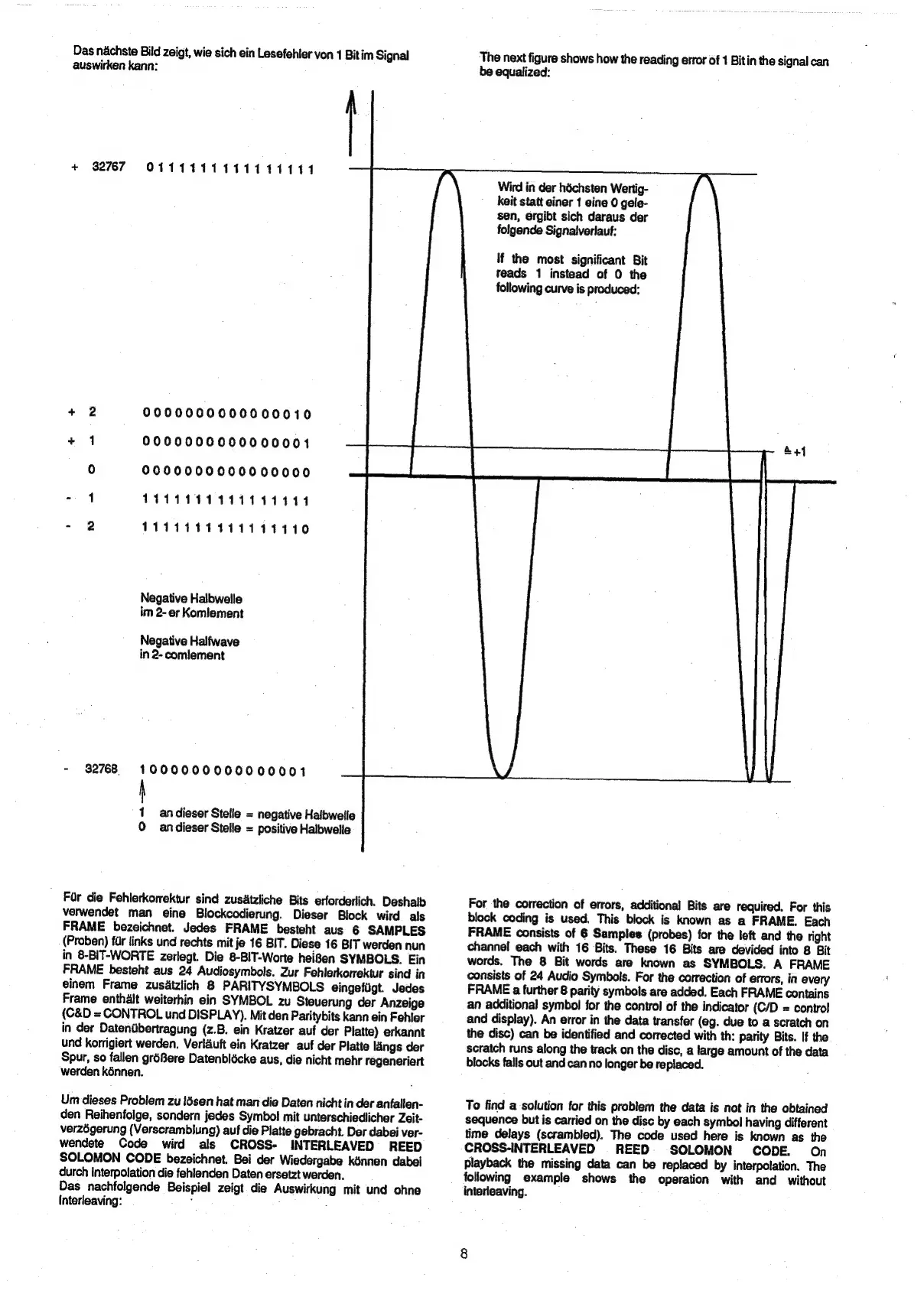
Das
nachste
Bild
zeigt,
wie
sich
ein
Lesefehler
von
1
Bitim
Signal
auswirken
kann:
+
32767
O111111111111111
+
2
0000000000000010
+
1
0000000000000001
0
0000000000000000
-
1
141111111111414491
-
2
111111411111111110
Negative
Halbwelle
im
2-
er
Komlement
Negative
Halfwave
in
2-
comlement
-
982768
1000000000000001
i
1
andieser
Stelle
=
negative
Halbwelie
0
andieser
Stelle
=
positive
Halbwelle
Fr
die
Fehlerkorrektur
sind
zusatzliche
Bits
erforderlich.
Deshalb
verwendet
man
eine
Blockcodierung.
Dieser
Block
wird
als
FRAME
bezeichnet.
Jedes
FRAME
besteht
aus
6
SAMPLES
(Proben)
fur
links
und
rechts
mit
je
16
BIT.
Diese
16
BIT
werden
nun
in
8-BIT-WORTE
zerlegt.
Die
8-BIT-Worte
heiGen
SYMBOLS.
Ein
FRAME
besteht
aus
24
Audiosymbols.
Zur
Fehlerkorrektur
sind
in
einem
Frame
zusatzlich
8
PARITYSYMBOLS
eingefigt.
Jedes
Frame
enthdlt
weiterhin
ein
SYMBOL
zu
Steverung
der
Anzeige
(C&D
=
CONTROL
und
DISPLAY).
Mitden
Paritybits
kann
ein
Fehler
in
der
Datenibertragung
(z.B.
ein
Kratzer
auf
der
Platte)
erkannt
und
korrigiert
werden,
Verlauft
ein
Kratzer
auf
der
Platte
langs
der
Spur,
so
fallen
gréBere
Datenblicke
aus,
die
nicht
mehr
regeneriert
werden
kénnen.
Um
dieses
Problem
zu
iésen
hat
man
die
Daten
nicht
in
der
anfalten-
den
Reihenfolge,
sondern
jedes
Symbol
mit
unterschiedlicher
Zeit-
verzégerung
(Verscramblung)
auf
die
Piatte
gebracht.
Der
dabei
ver-
wendete
Code
wird
als
CROSS-
INTERLEAVED
REED
SOLOMON
CODE
bezeichnet.
Bei
der
Wiedergabe
kénnen
dabei
durch
Interpolation
die
fehlenden
Daten
ersetzt
werden.
Das
nachfolgende
Beispiel
zeigt
die
Auswirkung
mit
und
ohne
interleaving:
:
:
:
The
next
figure
shows
how
the
reading
error
of
1
Bitin
the
signal
can
be
equalized:
Wird
in
der
hdchsten
Wertig-
keit
statt
einer
1
eine
0
gele-
sen,
ergibt
sich
daraus
der
folgende
Signalverlauf:
lf
the
most
significant
Bit
teads
1
instead
of
0
the
following
curve
is
produced:
eee
For
the
correction
of
errors,
additional
Bits
are
required.
For
this
block
coding
is
used.
This
block
is
known
as
a
FRAME.
Each
FRAME
consists
of
6
Samples
(probes)
for
the
left
and
the
right
channel
each
with
16
Bits.
These
16
Bits
are
devided
into
8
Bit
words.
The
8
Bit
words
are
known
as
SYMBOLS.
A
FRAME
consists
of
24
Audio
Symbols.
For
the
correction
of
errors,
in
every
FRAME
a
further
8
parity
symbols
are
added.
Each
FRAME
contains
an
additional
symbol
for
the
control
of
the
indicator
(C/D
=
control
and
display).
An
error
in
the
data
transfer
(eg.
due
to
a
scratch
on
the
disc)
can
be
identified
and
corrected
with
th:
parity
Bits.
If
the
scratch
runs
along
the
track
on
the
disc,
a
large
amount
of
the
data
blocks
falls
out
and
can
no
longer
be
replaced.
To
find
a
solution
for
this
problem
the
data
is
not
in
the
obtained
sequence
but
is
carried
on
the
disc
by
each
symbol
having
different
time
delays
(scrambled).
The
code
used
here
is
known
as
the
CROSS-INTERLEAVED
REED.
SOLOMON
CODE.
On
playback
the
missing
data
can
be
replaced
by
interpolation.
The
following
example
shows
the
operation
with
and
without
interleaving.
;

Related product manuals