
 Need help?
Do you have a question about the Guardian 36100 and is the answer not in the manual?
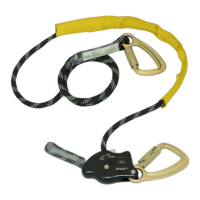
This document describes the Adjustable Rope Positioning Lanyard, a device designed for work positioning applications. Work positioning systems allow a worker to be supported while suspended, enabling them to work freely with both hands. This device is specifically engineered to support the user when working at height and in situations requiring a hands-free environment. It is crucial to note that a fall arrest backup system must always be used in conjunction with this lanyard. The device is intended for a single user only.
The Adjustable Rope Positioning Lanyard is primarily used for work positioning, providing support to a user at height. It allows for hands-free operation by supporting the user's weight, enabling them to perform tasks without needing to hold onto a structure for balance. The lanyard's length can be adjusted to suit the specific requirements of the work environment, ensuring that a fall cannot occur when used correctly. It is designed to connect to both side D-rings of a full-body harness, in pairs only.
The device features an adjuster mechanism that allows for easy modification of the lanyard's working length. To shorten the lanyard ("adjust up"), the user takes their weight off the lanyard, pulls themselves in with one hand, and then uses the other hand to pull the free end of the rope. To lengthen the lanyard, the user grasps the device with the hand closest to it, partially supports their weight on the structure, and depresses the release lever with a finger. This adjustability is key to maintaining a safe and efficient working position.
It is imperative that the device is connected to an anchorage of sufficient strength, capable of holding a load of 5,000 lbs, or meeting OSHA requirements for twice the anticipated load (certified by a Qualified Person). The anchorage must be fixed and prevent the device anchorage from moving during use. Anchorage points that may contact the rope lanyard must be free from sharp burrs, edges, abrasive surfaces, or any other hazards that could damage the rope.
The Adjustable Rope Positioning Lanyard is designed for ease of use while prioritizing safety. All PFAS (Personal Fall Arrest System) equipment, including this lanyard, must be selected and deemed compatible by a Competent Person. Before use, all risks of swing fall should be eliminated or minimized. The desired anchorage for the device must be determined, ensuring the location is free of debris, rot, cracking, and hazardous materials. Installation, set-up, and use of the system must be supervised by a Qualified Person.
When making connections with the device, it is essential to eliminate all possibility of roll-out, which occurs when interference between a connector and the attachment point causes the connector gate to unintentionally open and release. All connections must be selected and deemed compatible by a Competent Person, and all connector gates must be self-closing, self-locking, and capable of withstanding minimum loads of 3,600 lbs.
The device must never be used to make up a fall arrest lanyard with an Energy Absorber Pack, nor should it be used for material handling. Users must not loop the rope around objects with sharp edges or tie knots in the rope to shorten it. The device must always be connected to the correct attachment point of the full-body harness, and the closing mechanism of the connector(s) must automatically close and be secure before use.
The worker's weight capacity range, including all clothing, tools, and equipment, is OSHA 130-420 lbs and ANSI 130-310 lbs. Exceeding the maximum weight capacity is strictly prohibited. The device is not to be used in non-industrial settings, with incompatible equipment, or if it has been adapted or modified in any manner. Re-using the device after it has been subjected to fall forces is forbidden, and it must be removed from service immediately.
Regular maintenance and cleaning are crucial for ensuring the safety and longevity of the Adjustable Rope Positioning Lanyard. Before and after each use, all dirt, corrosives, and contaminants must be removed from the lanyard. If plain water (not exceeding 30°C) is insufficient for cleaning, a webbing/rope detergent can be used, followed by a rinse with plain water. The webbing must be allowed to dry naturally, away from direct sunlight and heat sources. Equipment should never be stored while wet, and corrosive substances must never be used for cleaning.
When not in use or during transport, the equipment should be stored in a manner that protects it from heat, light, excessive moisture, chemicals, or other degrading elements.
A pre-use inspection must be conducted before each use, though it does not need to be recorded. Thorough inspections by a Competent Person are mandatory every 12 months, or every 3 months if the equipment is kept in offshore or corrosive environments. These inspections must be recorded in the inspection log provided in the instruction manual and on the equipment inspection grid label, if applicable. The Competent Person must initial the box corresponding to the month and year of inspection.
During inspection, the Competent Person must consider all applications and hazards the equipment has been subjected to. It is essential to ensure that equipment certification is current before use. Any repairs to this equipment must only be performed by a Competent Person authorized by the manufacturer. Separate inspection logs must be used for each lanyard, and all inspection records must be visible and available to all users at all times.
The pre-use/thorough inspection includes checking the device itself: user instruction markings/labeling must be clear and legible, and the main body must be intact with no signs of deficiencies. The lifeline must be inspected for cuts, abrasions, wear marks, excessive heating/soiling, broken stitching, fraying, and reinforcement. A function test is also required to ensure the release lever operates smoothly, automatically returns to the locked position, allows the rope to pass through when unlocked, and securely holds the rope when locked.
If the equipment fails inspection, it must be immediately removed from service and safely discarded or repaired by a manufacturer-authorized Competent Person. The lifespan of metallic components is not fixed and depends on thorough inspections. Textile components or products are recommended to be replaced after a maximum of five years of use. Devices used in arduous environments (e.g., demolition, steel construction, salt-laden atmospheres) may have a reduced service life.
 General
| Product Type | Safety Glasses |
|---|---|
| Material | Polycarbonate |
| Lens Material | Polycarbonate |
| Lens Color | Clear |
| ANSI Z87.1 Compliance | Yes |
| Standards | ANSI Z87.1 |
| Impact Resistance | Yes |


 To Next Page