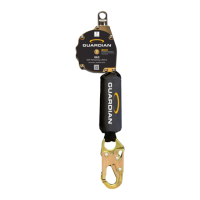
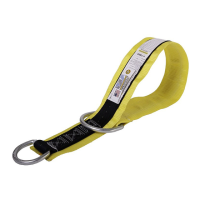
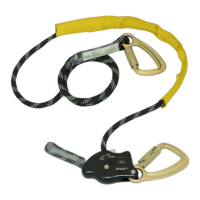
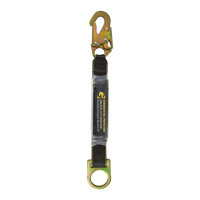
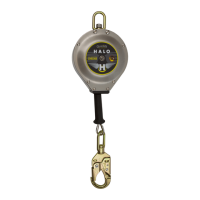
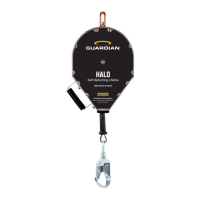
This document describes the Guardian Vertical Lifeline Assembly (VLA), a crucial component of personal fall protection systems designed for various work-at-height applications. The VLA is intended to support a maximum of one Personal Fall Arrest System (PFAS) for fall arrest applications or to be used in restraint applications.
Function Description
The Vertical Lifeline Assembly (VLA) serves as a flexible lifeline that workers can connect to, allowing for vertical mobility while maintaining fall protection. It is designed to arrest falls or prevent workers from reaching fall hazards, depending on the application. The VLA is available in various configurations, including those with integral shock absorbers, positioning devices, and lanyard extensions, as well as simpler co-polymer ropes with snap hook ends.
For Fall Arrest applications, the VLA is designed to support a maximum of one PFAS. The structure to which the VLA is anchored must withstand loads of at least 5,000 lbs in permitted directions. The maximum permitted free fall is 6 feet, and the maximum combined length of the D-ring, Fall Arrester, and Lanyard Extension is 36 inches. Acceptable D-rings for fall arrest include Dorsal, Chest, and Side (pairs only).
For Restraint applications, the VLA prevents workers from reaching the leading edge of a fall hazard. In this mode, no free fall is permitted. The connecting equipment's fully extended length must always be accounted for. The anchoring structure must withstand loads of at least 1,000 lbs. Restraint systems are only to be used on surfaces with slopes up to 4/12 (vertical/horizontal). Acceptable D-rings for restraint include Dorsal, Chest, and Side (pairs only).
Important Technical Specifications
- Worker Weight Capacity: The VLA is designed for a user weight range (including all clothing, tools, and equipment) of 130-310 lbs.
- Materials: The VLA is constructed from 5/8" diameter co-polymer, polyester, and steel components.
- Compliance: The VLA meets or exceeds OSHA 1910.140 and OSHA 1926.502 safety standards.
- Connector Requirements: All connector gates must be self-closing, self-locking, and withstand a minimum load of 3,600 lbs.
- Fall Clearance: When calculating fall clearance for fall arrest, a minimum 2-foot safety factor, deceleration distance, user height, length of lanyard/SRL, harness stretch, free fall, and all other applicable factors must be accounted for.
- Shock Absorber: If the VLA rope does not include an integral shock absorber, the Fall Arrester/Extension Lanyard must include one when used in Fall Arrest applications.
Product Specific Applications (Examples from Part Numbers):
- Vertical Lifeline Assembly w/Shock Absorber, Positioning Device, and 18" Lanyard Extension: Available in lengths from 25' (01310) to 200' (01327).
- No Tangle VLA w/Swivel Snap Hook, Shock Absorber, Positioning Device, and 18" Lanyard Extension: Available in 30' (11318) and 50' (11320) lengths.
- Co-polymer Rope w/Snap Hook End: Available in lengths from 25' (11329) to 200' (11335).
- VLA w/3-Strand Co-polymer Rope, Shock Pack, Positioning Device, and 18" Lanyard Extension: Available in lengths from 25' (11321) to 200' (11328).
- 5/8" Diameter Rope w/Snap Hook End: Available in lengths from 25' (01330) to 300' (01346).
Usage Features
- Installation:
- Ensure adequate fall clearance for fall arrest or that the VLA prevents reaching fall hazards for restraint.
- Eliminate or minimize all risk of swing fall.
- NEVER tie knots in the lifeline. The end of the lifeline must always be terminated to prevent detachment of the Fall Arrester.
- Attach the VLA snap hook to a compatible anchorage connector. If the VLA has an integral shock pack, this end must connect to the anchor.
- NEVER install the VLA in a tie-back method (do not wrap the VLA around an anchor point and connect the snap hook back to the rope).
- Attach the Fall Arrester/Extension Lanyard to the applicable harness D-ring.
- Movement along Lifeline:
- To move, compress and hold the Fall Arrester handle.
- ALWAYS adjust the Fall Arrester to reduce slack in the system as much as possible.
- When moving along a work surface, ALWAYS move the Fall Arrester along the rope, and NEVER move only the rope itself. This prevents excessive free fall.
- Restricting Movement: To restrict Fall Arrester movement, release the handle. NEVER grab the Fall Arrester during a fall, as this may cause accidental disengagement.
- Compatibility: All connections to the VLA must eliminate the possibility of roll-out, where interference causes the connector gate to unintentionally open. A Competent Person must deem all connections compatible.
- Leading Edge (LE) Use: The VLA is NOT suitable for Leading Edge use and must never impact the edge of a fall hazard.
- Component Integrity: Only one connection per VLA is permitted. Components must NEVER be removed from the VLA.
- Swing Falls: Prior to use, considerations must be made to eliminate or minimize swing fall hazards. Always work as close to in line with the anchor point as possible.
Maintenance Features
- Pre-Use Inspection: Prior to EACH use, inspect the VLA for deficiencies such as corrosion, deformation, pits, burrs, rough surfaces, sharp edges, cracking, rust, paint build-up, excessive heating, alteration, broken stitching, fraying, and missing or illegible labels. IMMEDIATELY remove the VLA from service if any defects or damage are found, or if it has been exposed to fall arrest forces.
- Work Area Inspection: Ensure the work area is free of debris, rot, rust, decay, cracking, and hazardous materials, and that it will support the application-specific minimum loads. The work area MUST be stable.
- Competent Person Inspection: At least every 12 months, a Competent Person (other than the user) must inspect the VLA. Inspections MUST be recorded in the inspection log within the instruction manual and on the equipment inspection grid label. The Competent Person must sign their initials in the box corresponding to the month and year of inspection.
- Product Lifetime: The product lifetime is indefinite as long as it passes both pre-use and Competent Person inspections. If equipment fails inspection, it must be discarded immediately.
- Cleaning: Cleaning after use is essential for safety and longevity. Remove all dirt, corrosives, and contaminants before and after each use. If plain water is insufficient, use mild soap and water, then rinse and wipe dry. NEVER clean with corrosive substances.
- Storage: When not in use or during transport, store equipment where it will not be affected by heat, light, excessive moisture, chemicals, or other degrading elements.
- Alterations: Do not alter or misuse the equipment.
- Fall Arrest Event: Equipment subjected to fall arrest forces must immediately be removed from use.

 Need help?
 General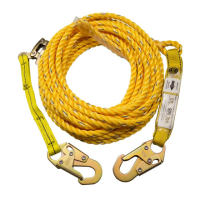

 To Next Page