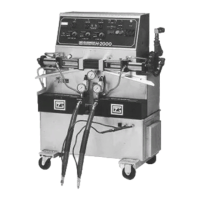
Model H-2000/H-3500 Proportioning Unit
32 159421A-1, Issue 2
d)
Remove the appropriate ball guide. Inspect the ball seat gasket and replace as
required. Flush and wipe clean the valve ball and ball seat of all residual
material.
Using the ball seat removal tool, check the seat for proper seat compression.
Snug the seat up to a ¼ turn maximum. The gasket should extend beyond the
seat by approximately 1/16 of an inch. If this does not resolve the problem
remove the seat inspect the gasket and replace as required.
In most cases, the cause of a leaking valve is a particle of foreign material
preventing the ball from seating properly. If cleaning the valve ball and seat
does not resolve the problem, replace these parts along with the gasket.
2.
PRESSURE UNBALANCE - The success of the troubleshooting procedure for this
problem will depend on the determination of two points:
a)
Which chemical did not reach the mixing chamber
b)
Why did the chemical fail to get there?
Which chemical is missing can usually be determined by observing the color of the
pattern as it exits the gun. Foam systems are usually a combination of light and dark
material. Therefore, by observing the color of the liquid exiting the gun, you can
determine which material is not reaching the mixing chamber. The determination as
to why the chemical did not reach the mixing chamber may be more difficult to
resolve. A restriction at the gun or the proportioning pump not properly pumping its
designed volume is the usual cause for a lack of material at the mixing chamber.
Once you have determined which chemical is missing, the chemical pressure gauges
on the problem side of the proportioning unit will tell you if the malfunction is due to
a restriction at the gun or a lack of material produced by the pump. To prevent
misinterpretation, the focus must be on the pressure gauge corresponding to the
missing chemical.
Assume that the R-component is not reaching the mixing chamber. Spray off target
and note the Resin pressure gauge. If the Resin gauge is considerably higher than the
Isocyanate gauge, the problem is within the gun. Refer to the gun manual to resolve
the problem.
3.
CAVITATION- Cavitation is the formation of a partial vacuum or void created
within the pump cylinder during the fill stroke. It is actually a “short fill” since the
fill chamber is not completely full when the pump reverses to start the discharge
stroke. This void occurs when the proportioning pump demands a greater volume of
material during its fill stroke than the supply system can supply. The most common
causes of Cavitation are as follows:
a)
The transfer pump cannot handle the supply requirement or is malfunctioning.
The Gusmer 2:1 Transfer Pump is recommended for use with the H-2000/H-
3500.
Also recommended is a minimum of three-quarter inch diameter supply hose as
short as practical.
b)
The chemical is too viscous (thick) to pump properly. Consult your Chemical
Supplier for the recommended supply temperature.
c)
Inlet strainer screen is restricted. Service as described in the Maintenance
section of this manual.


 To Next Page