5
ARTIC 800
EN
Translation of the original instructions
Regulations:
• Machine compliant with European directives.
• The certificate of compliance is available on our website.
• EAC Conformity marking (Eurasian Economic Community)
• Equipment in compliance with British requirements. The British Decla-
ration of Conformity is available on our website (see home page).
• Equipment in conformity with Moroccan standards. The declaration
Cم (CMIM) of conformity is available on our website (see cover page).
Waste management:
• This product should be disposed of at an appropriate recycling
facility. Do not throw away in a domestic bin.
GENERAL DESCRIPTION
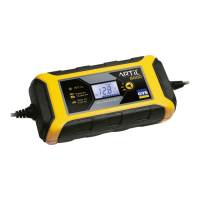
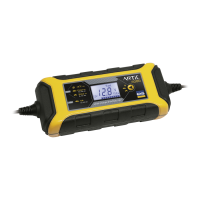
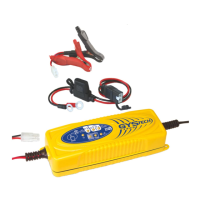
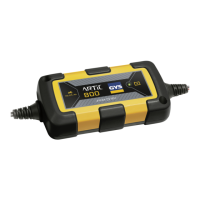
The ARTIC 800 charger is designed to charge small lead-acid batteries, typically found in motorbikes, boats and other small leisure
vehicles. The ARTIC can be used safely for : GEL (gel electrolyte), AGM (Absorbant Glass Mat), WET, MF (Maintenance Free), CA
(Calcium)...
This charger has been designed to charge 12V batteries (6*2V elements) from 1.6 Ah to 25 Ah, or for oating charge up to 80 Ah.
START UP
1. Connect the charger to the battery using the proper accessory (clamps, lugs, etc...).
2. Plug the charger to the mains (single phase 100-240Vac 50-60Hz).
3. During the charge, the device indicates the charge progress. When yellow indicator is on, the battery is being charged and once
the green indicator is on, the battery is fully charged.
4. After the charge, disconnect the charger from the mains, then disconnect the charger’s connections from the battery.
• Estimated charge time
Battery capacity 1.6 Ah 10 Ah 20 Ah 25 Ah
Charging time 20% >>> 80%
2 h 7h30 15 h 19 h
TROUBLESHOOTING
Troubleshooting Causes Solutions
1 Device connected and indicator off.
• Short-circuit.
• Open circuit.
• Polarity reversal
• Make sure that there is no power consumption (normal or
abnormal) in the vehicle circuit.
• Check that the clamps are properly connected.
• After following these steps, if the indicator still does not
light up, the sulfated/damaged battery must be replaced.
WARRANTY
The warranty covers faulty workmanship for 2 years from the date of purchase (parts and labour).
The warranty does not cover:
• Transit damage.
• Normal wear of parts (eg. : cables, clamps, etc..).
• Damages due to misuse (power supply error, dropping of equipment, disassembling).
• Environment related failures (pollution, rust, dust).
In case of failure, return the unit to your distributor together with:
- The proof of purchase (receipt etc ...)
- A description of the fault reported


 To Next Page